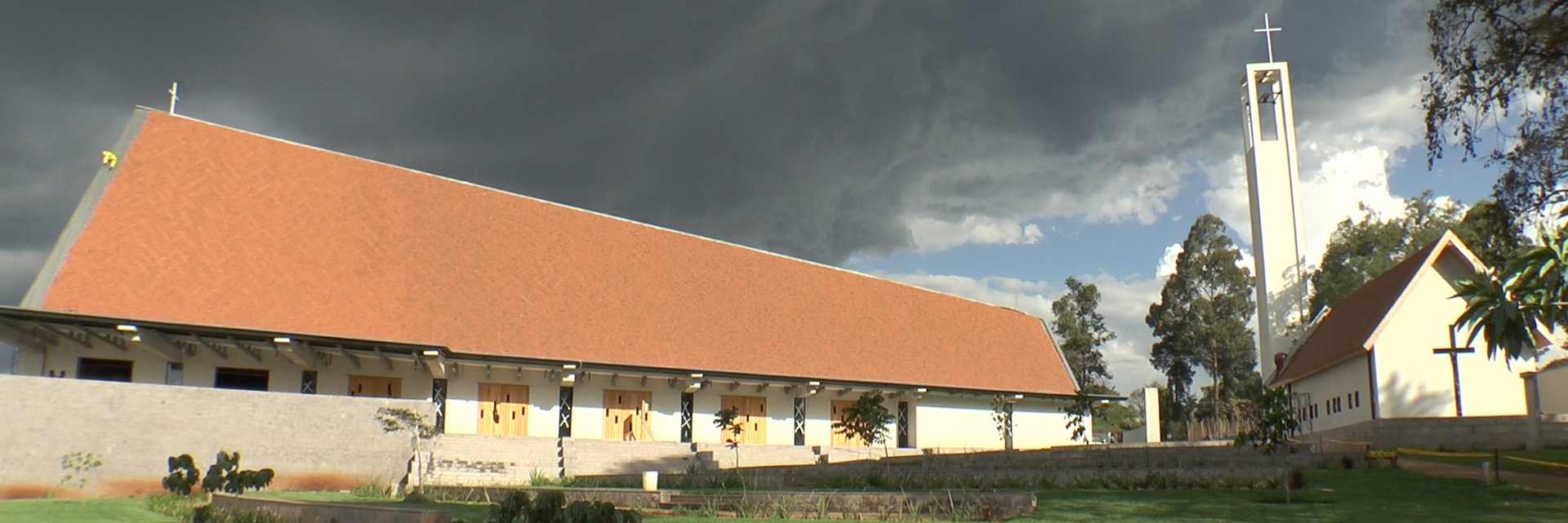
Sacred Heart of Jesus Cathedral - Kericho, Kenya

A Complete Architectural Arts Project
Who gets to do a project like this? To be part of the original design team, appointed before the architects, and asked to bring all of the artworks into being.
What a privilege — and what an unexpected forking of the road you thought you were on. Say no to an offer like this and you will probably regret it for the rest of your life. Say yes, and your life gets transformed. I have always preferred the possibility of regretting having done something over the certainty of regretting not doing it.
The question came about following a lecture I gave at the RIAS in Dundee in 2009. I had just finished my lecture and was having coffee when this man — architect George Paterson — came over and said something like: "I know it sounds a bit crazy, but I have been asked to build a cathedral in Kenya. Will you come and help me?"
So began a great adventure that carries on to this day.
The Sacred Heart Cathedral, Kericho was dedicated on Pentecost of 2015. The artworks were finally completed in 2018.
There is a film about the project, focused mainly on the building and the making of the artworks. I took on the role of videographer and filmmaker, as the clients — based outside Kenya — wanted regular reports showing what was happening between their visits.
This project was such a massive undertaking that I will break it down into the individual art works. The video here, although long, follows the construction of the building and making of all the art works and artists and craftspeople involved in the project. Before this project came along, I was kind of disappointed that I had , in my own mind, not reached my full potential as an artist. This project was the antidote to that thinking. The greatest challenge to date without a doubt.
My role, was to be part of the architectural design team and to gather artists and artisans to create all the art works for this building.
The Making of the Cathedral
a focus on the artworks
following the making of a Cathedral focussing in on the art works
I was engaged with this project for 9 years, and still am in some way.
The Stations of the Cross
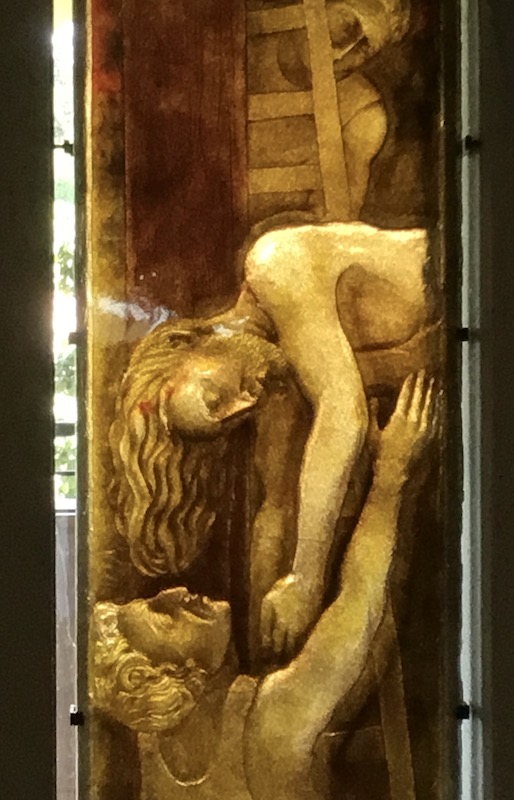
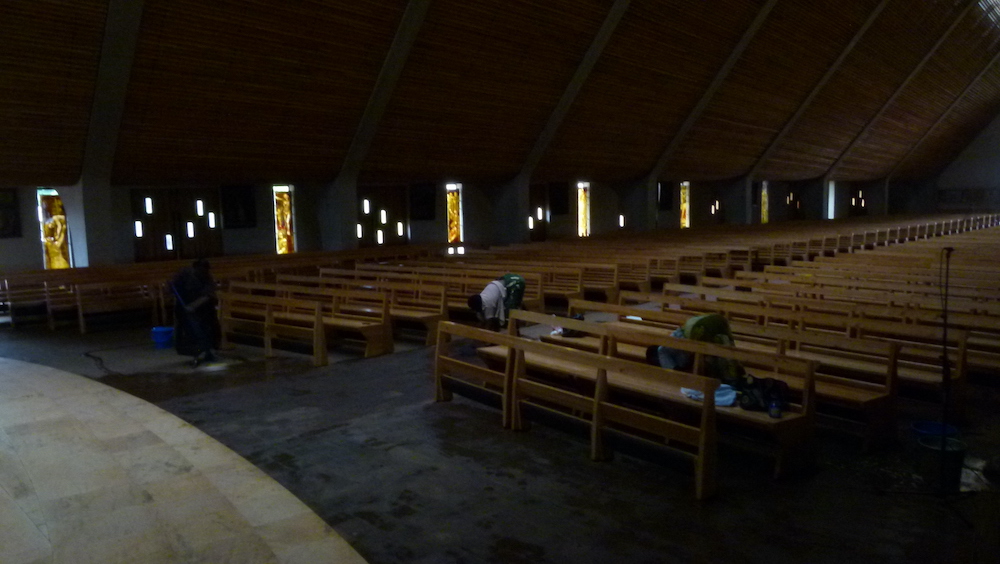
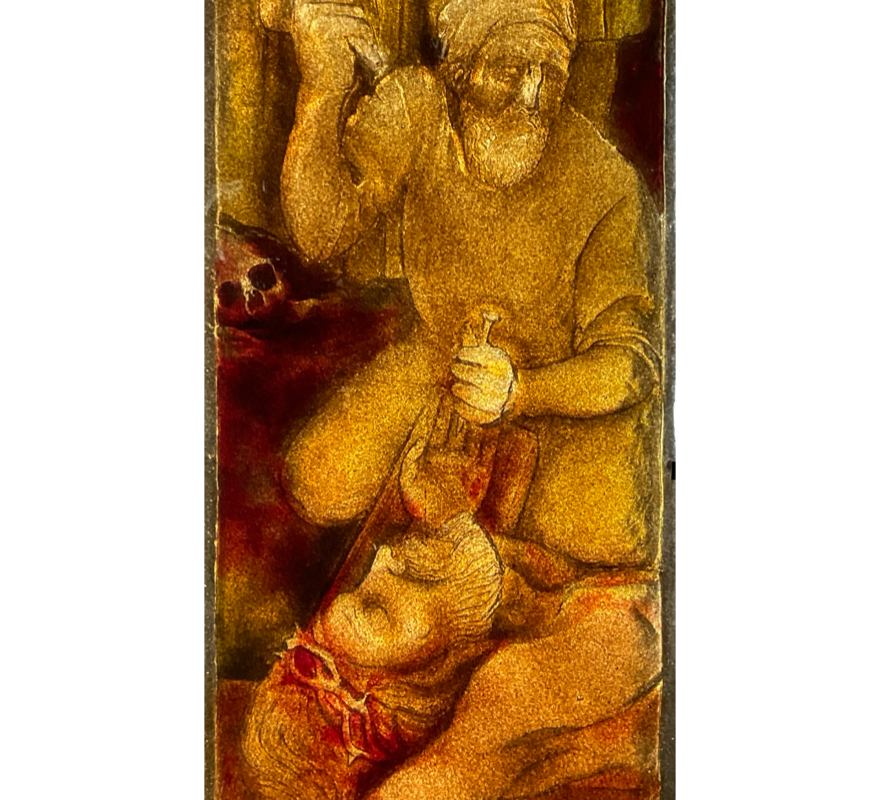
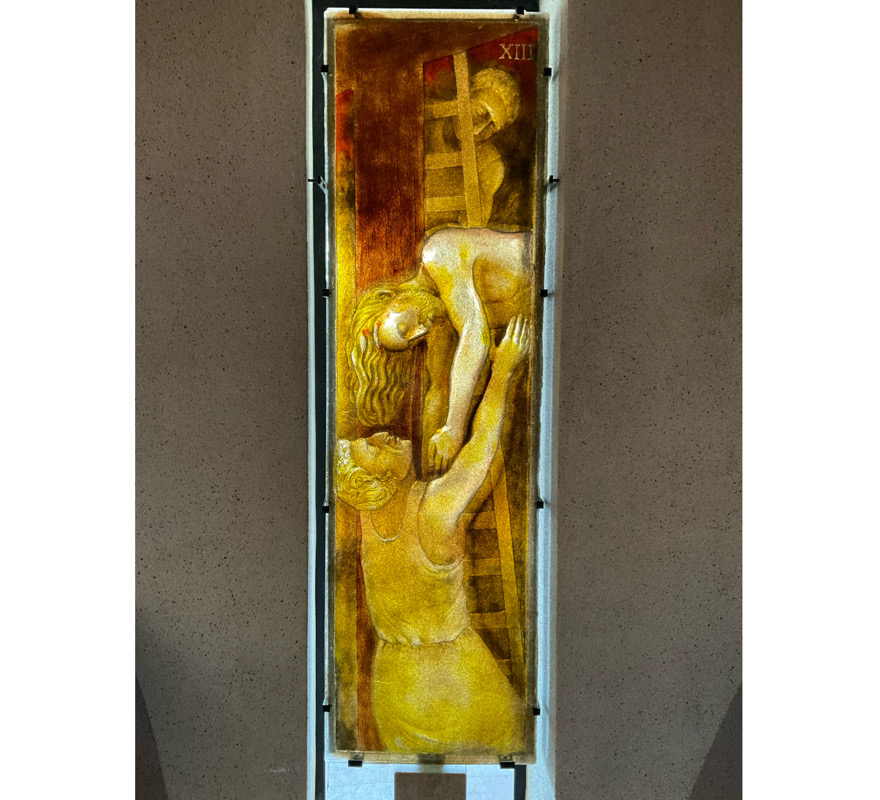
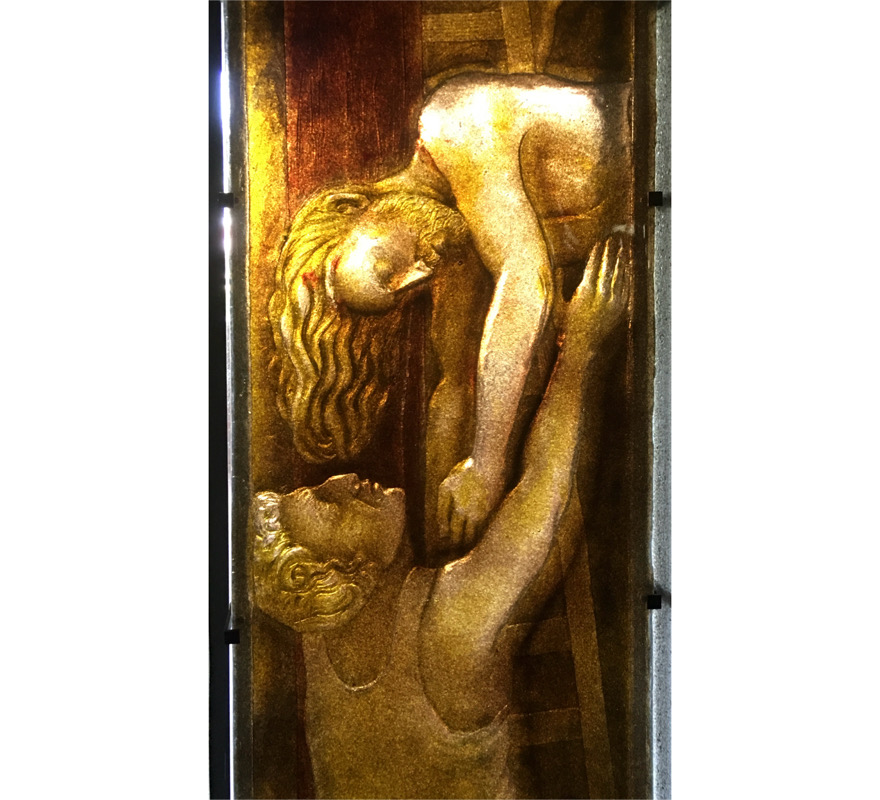
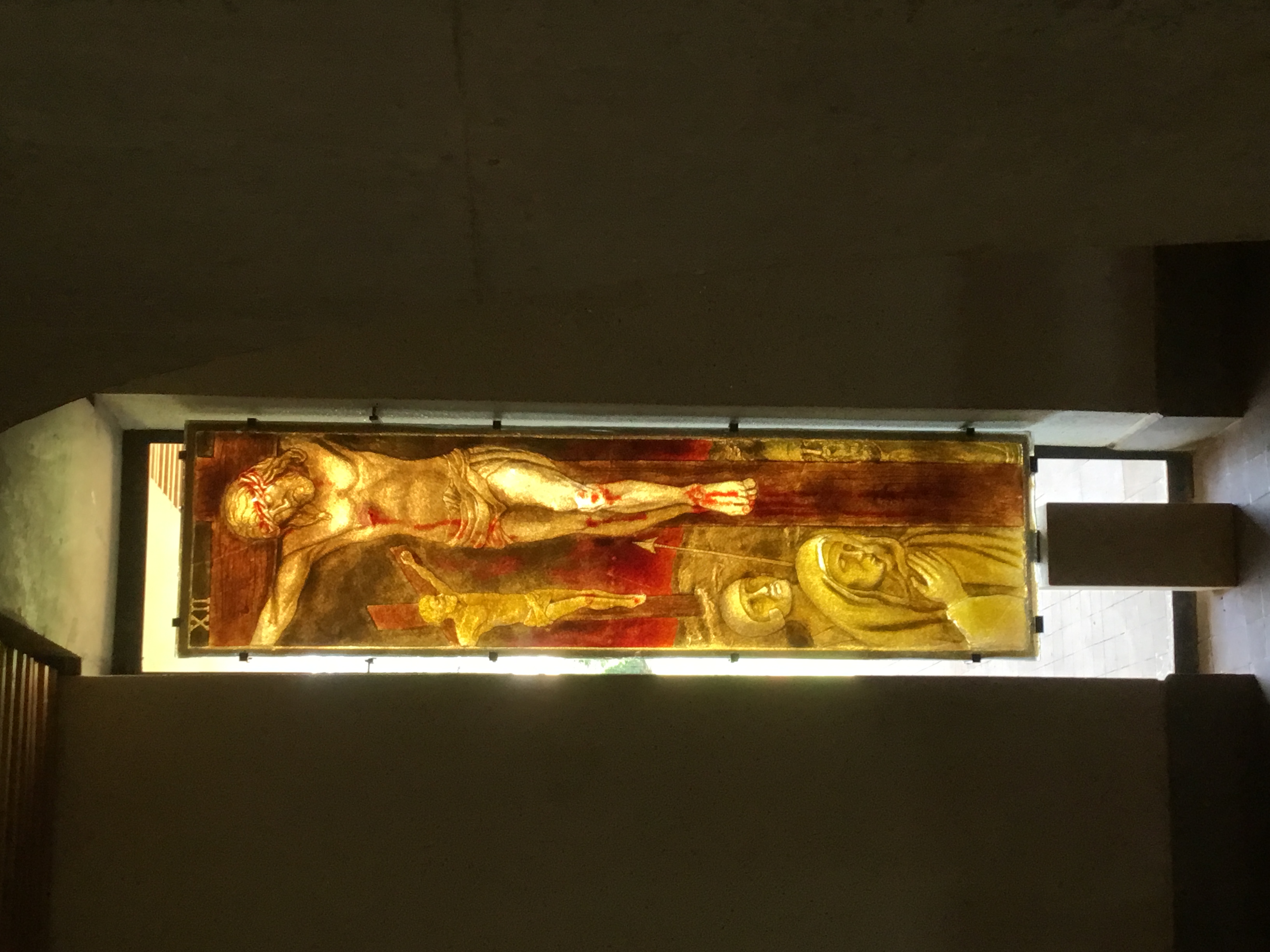
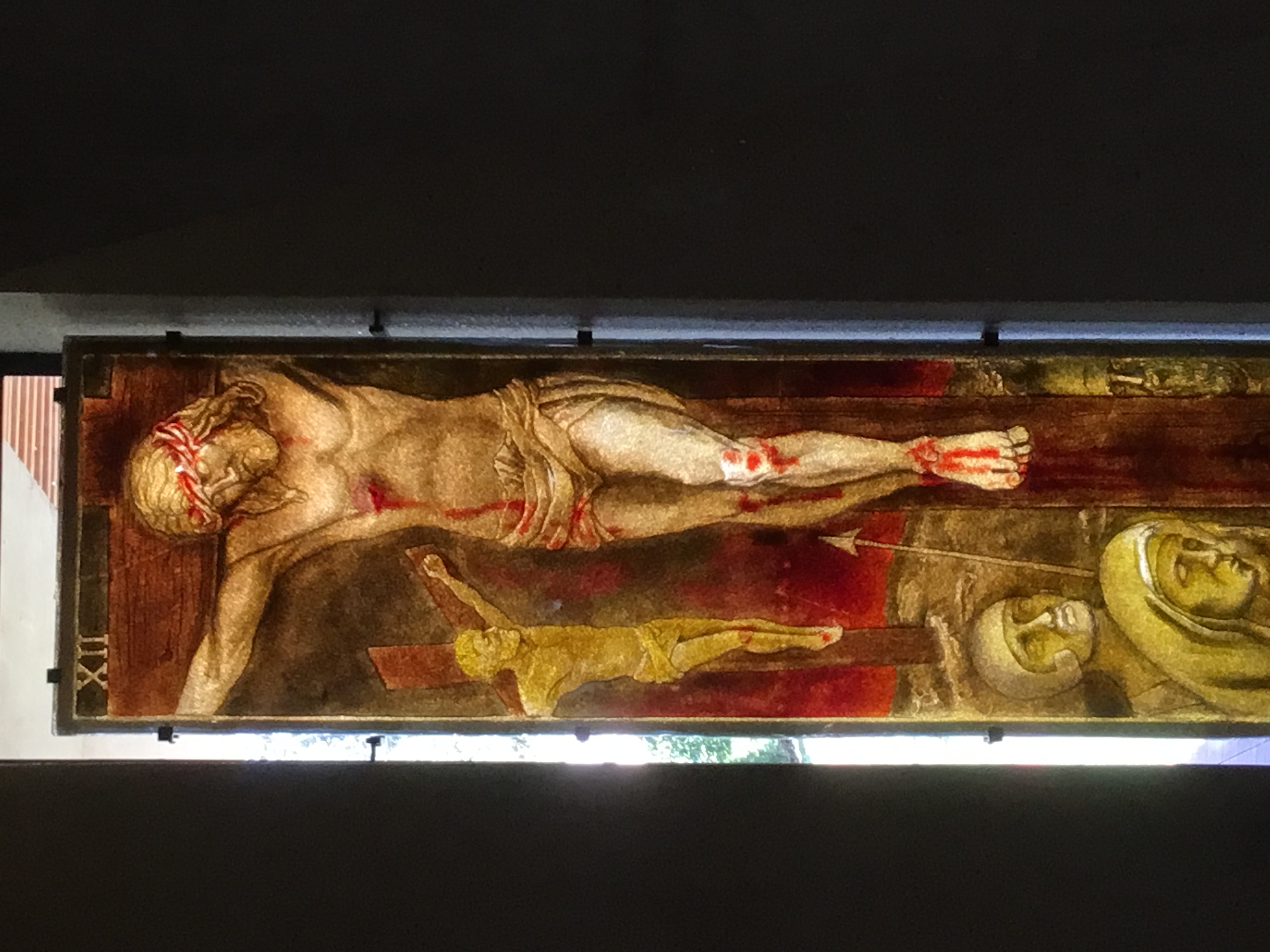
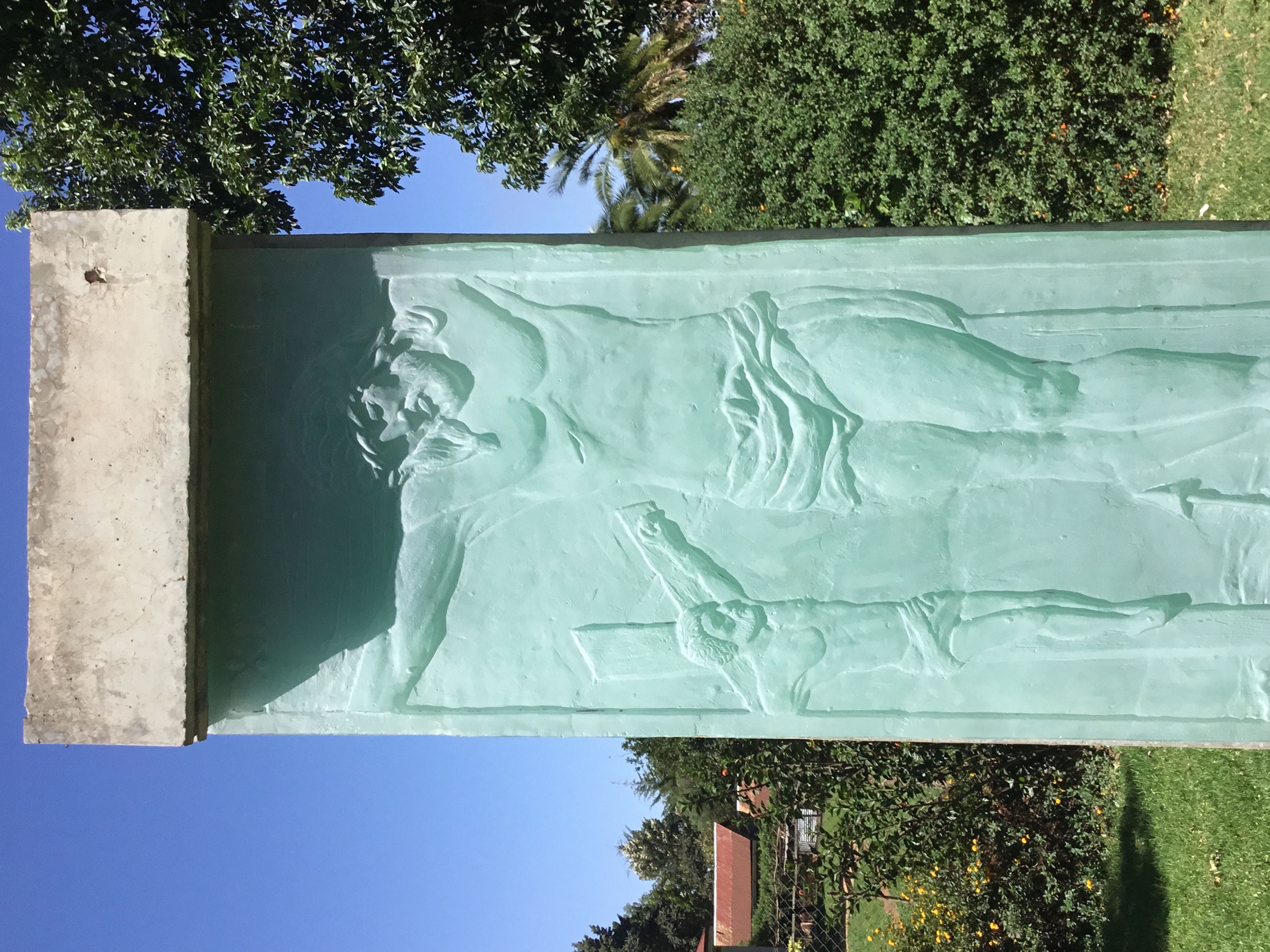
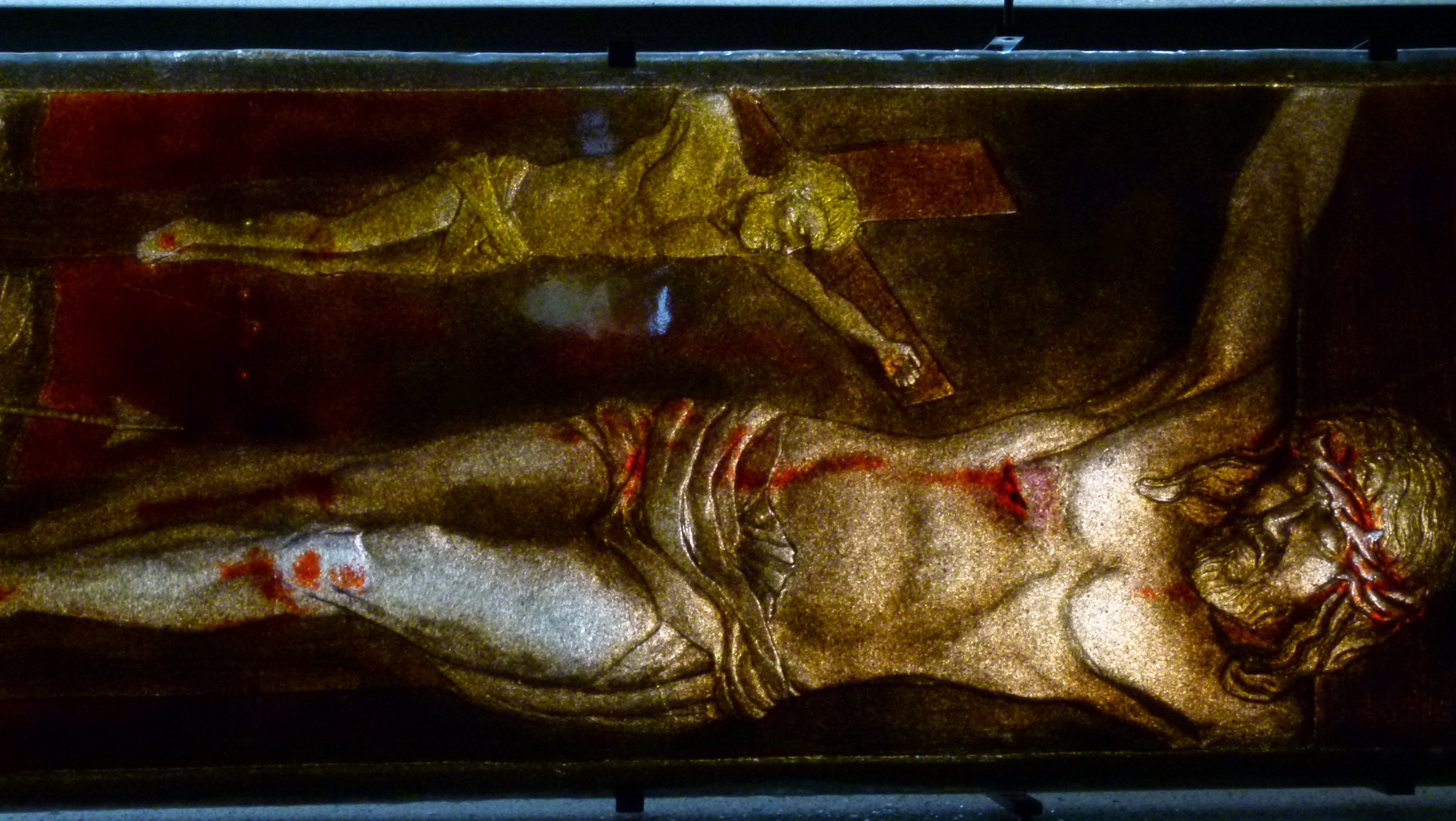
When the design of the Cathedral was still taking shape, glass was chosen as the building's principal artistic medium — but the architecture itself left very few openings for it. The original concept had no windows on the east or west walls. The only real opportunity was the series of side openings along the aisles, and it was decided these would carry the Stations of the Cross.
The method came from an unexpected direction. Shortly before, I had completed a fused Bullseye glass commission for Glenmorangie Distillery and been invited to spend time at Northlands Studio in Caithness, where Michael Bullen introduced me to casting — taking a small detail from the Glenmorangie piece and casting it in glass for the first time. I had long admired a carved stone Nativity scene from Autun Cathedral in France, and on a hunch I modelled it in clay, cast it, and turned it into a relief glass sculpture under Michael's guidance. It worked. That technique became the answer for Kericho: glass design wasn't really available in Kenya at the time, but relief-sculpted carving was a familiar and respected craft, and it offered a way in.
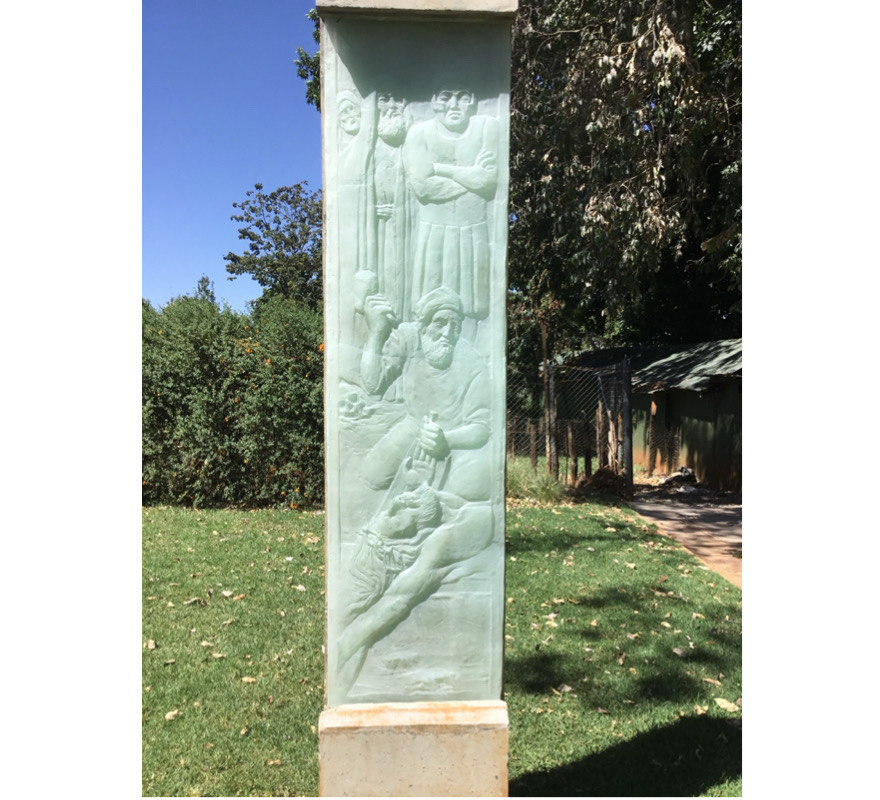
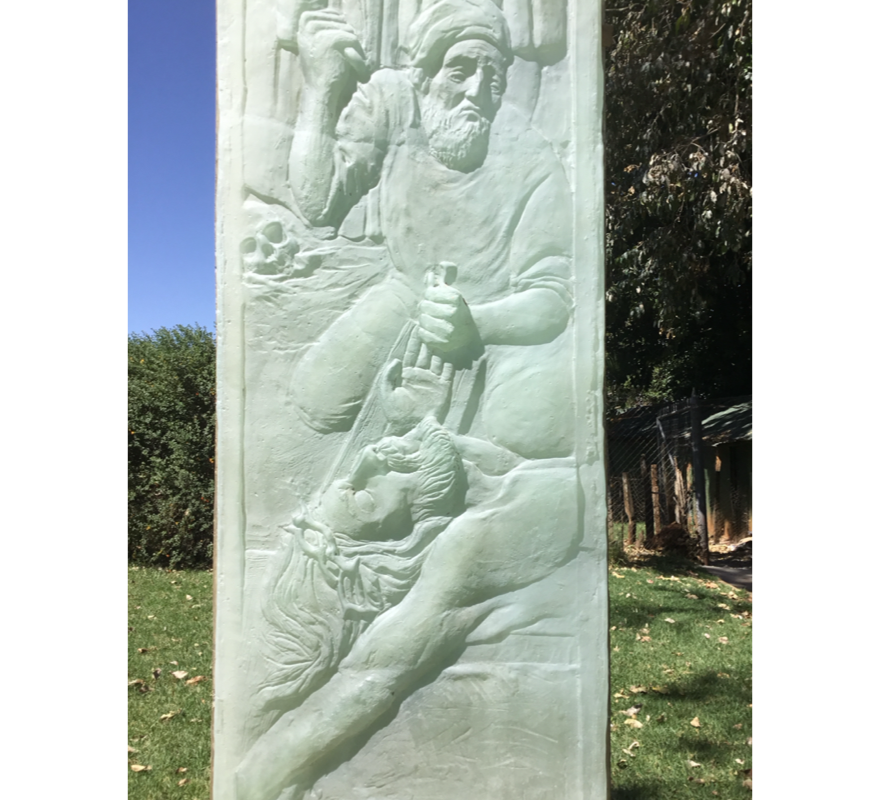
The collaborator who made it possible was Florence Wangui, an artist I met through a small exhibition at the Muthaiga Country Club, curated by Carol Lees of the One Off gallery. Florence had never worked with glass, or even with clay, and the very idea of a scaled design was new to her — but she was one of the few artists I met in Kenya genuinely drawn to the challenge of a commissioned project of this scope. We worked through every stage together: concept, full-scale drawings, clay sculpting, and on to the glass itself. Each panel needed to hold a fragment of the theme — a figure or partial figure of Christ, crossing the detail of the cross itself — a difficult shape to resolve, and one we solved together.
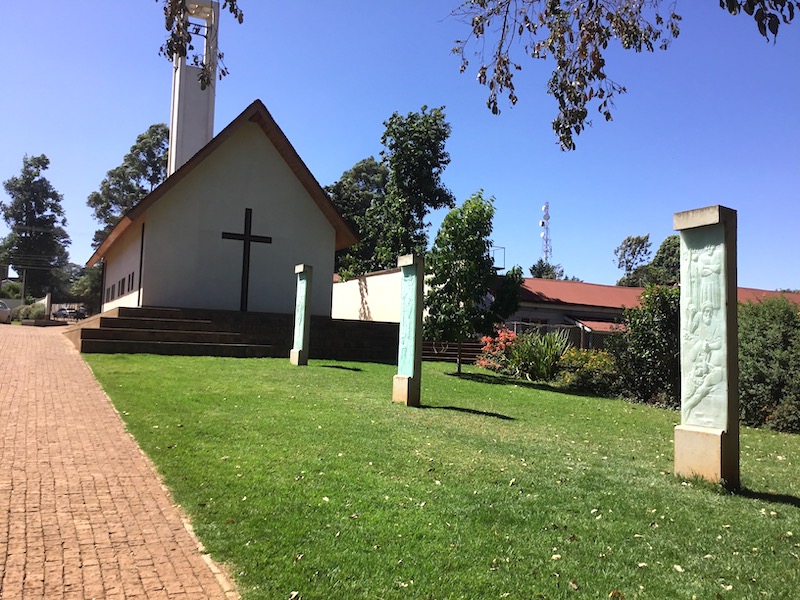
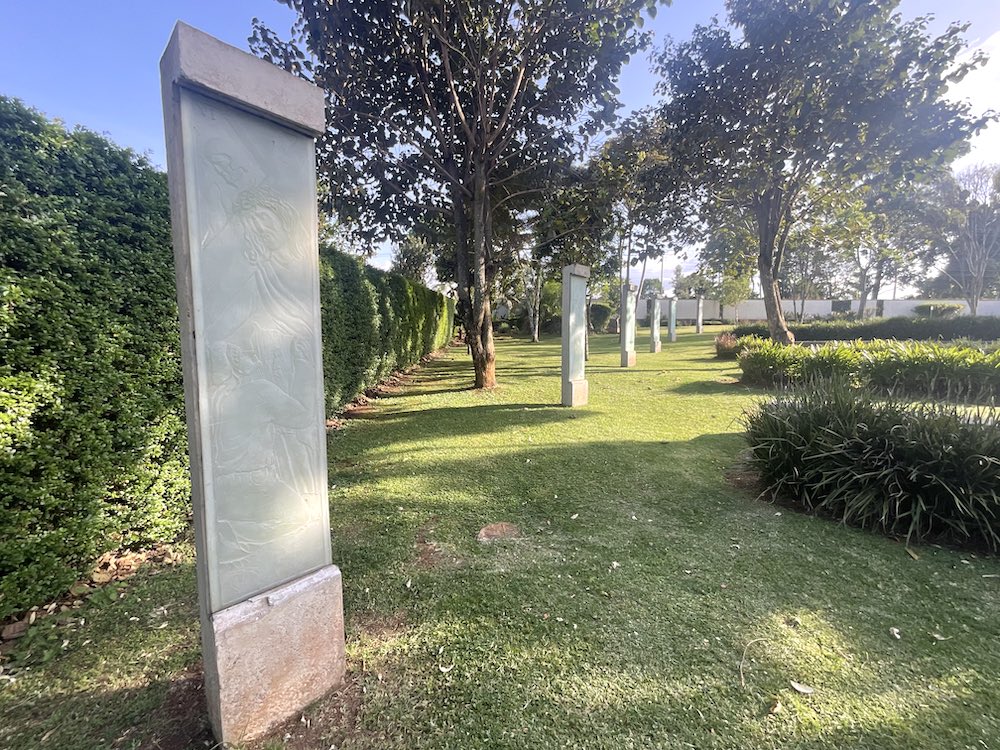
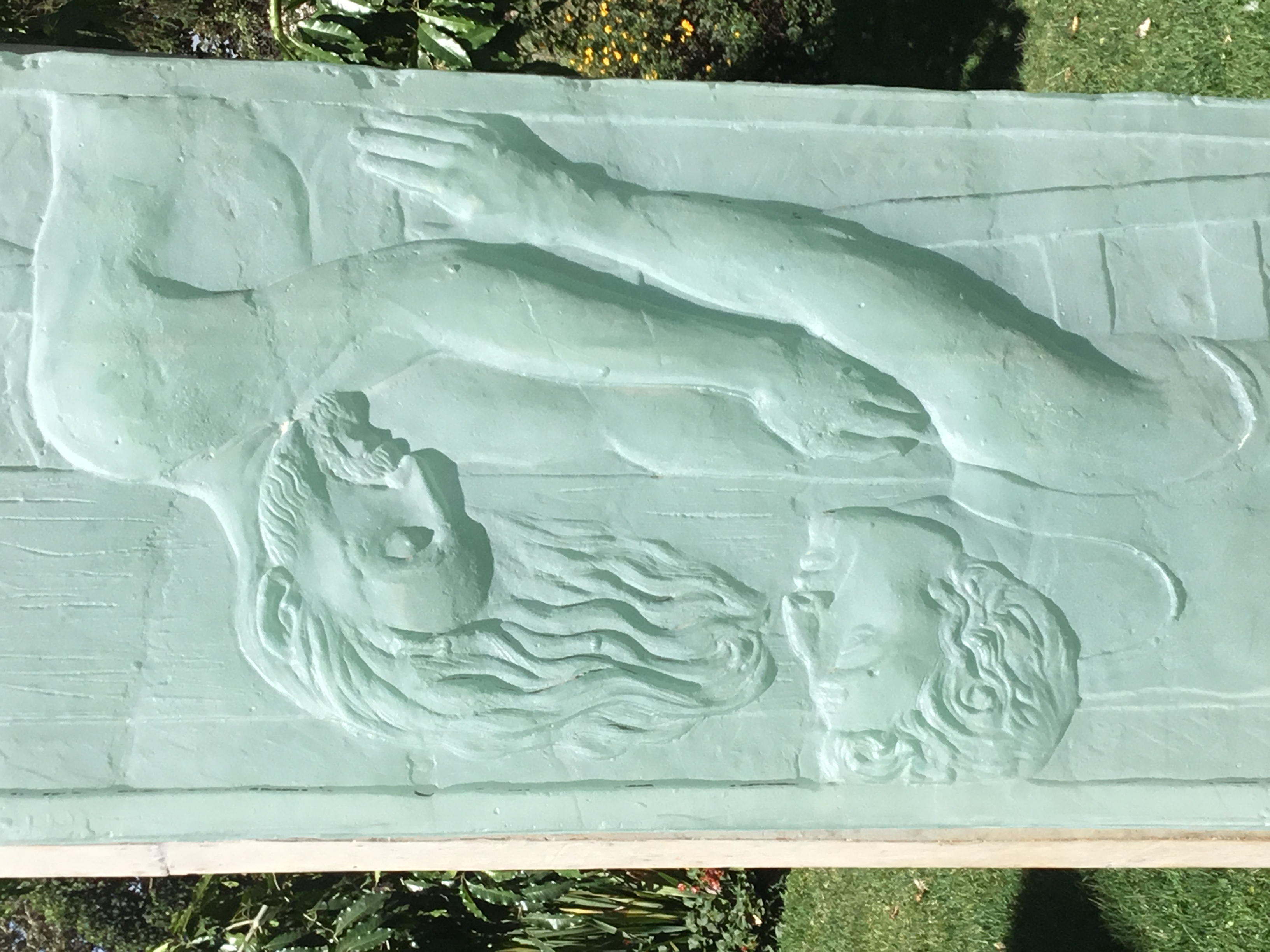
There are fourteen panels in total, each two metres high and between 0.45 and 0.60 metres wide. Partway through the project we were asked to create a second, external series for the cathedral gardens — an afterthought that became one of the most successful parts of the whole scheme. Using the same moulds, we cast positive relief forms in float glass, fused into 20mm sheets and slumped to take up the same imagery. The garden itself had been conceived from the outset as a recreational and meditative space; the external Stations give that garden its religious dimension. On overcast days, in shadow, the panels are quiet and almost withdrawn — but when sunlight finds them, they come alive entirely.
None of this was straightforward to make in Kenya. A large fusing kiln had to be imported, along with Bullseye glass and frit, after a long and ultimately unsuccessful attempt to secure access to underused kilns at Kenyatta University. Each firing took six to eight days, and needed an uninterrupted power supply for the whole of that time — a serious challenge against Kenya's unreliable grid. I also found, against some dispute, that altitude affects the fusing process, and had to adjust every firing schedule to compensate. To have completed this series at all, under these conditions, was something close to a minor miracle.
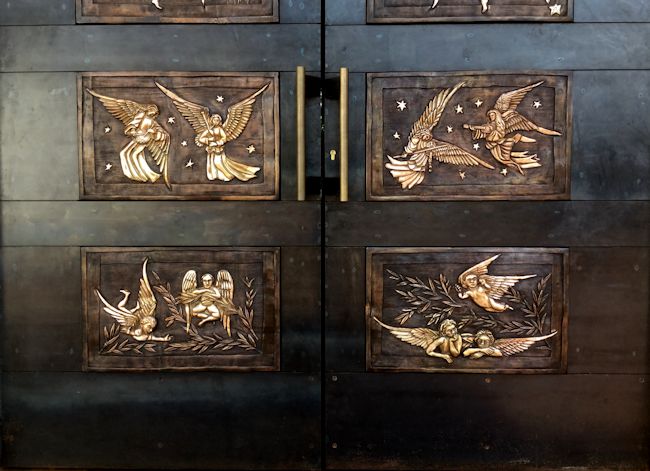
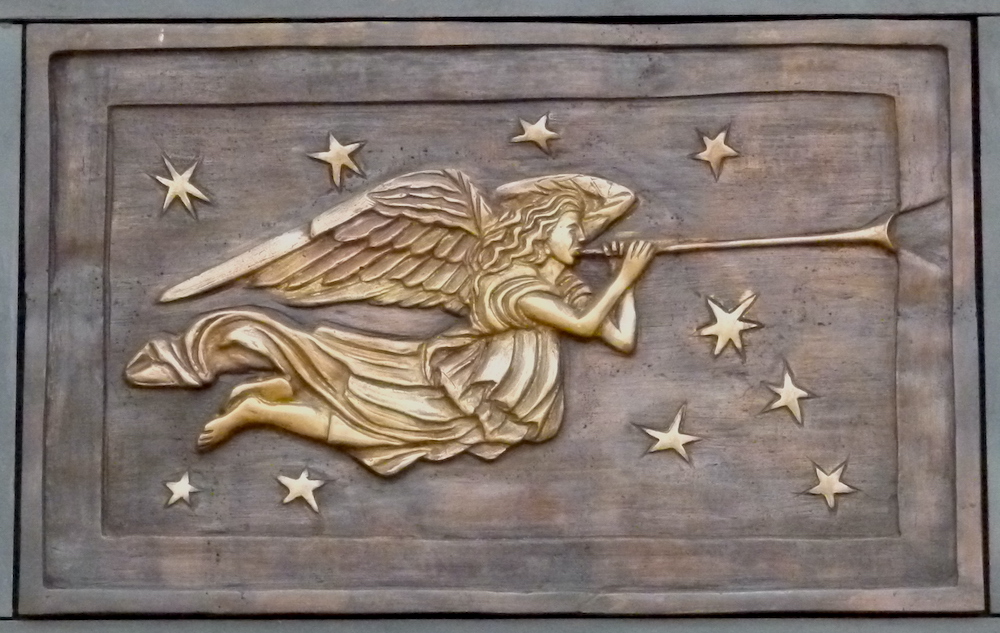
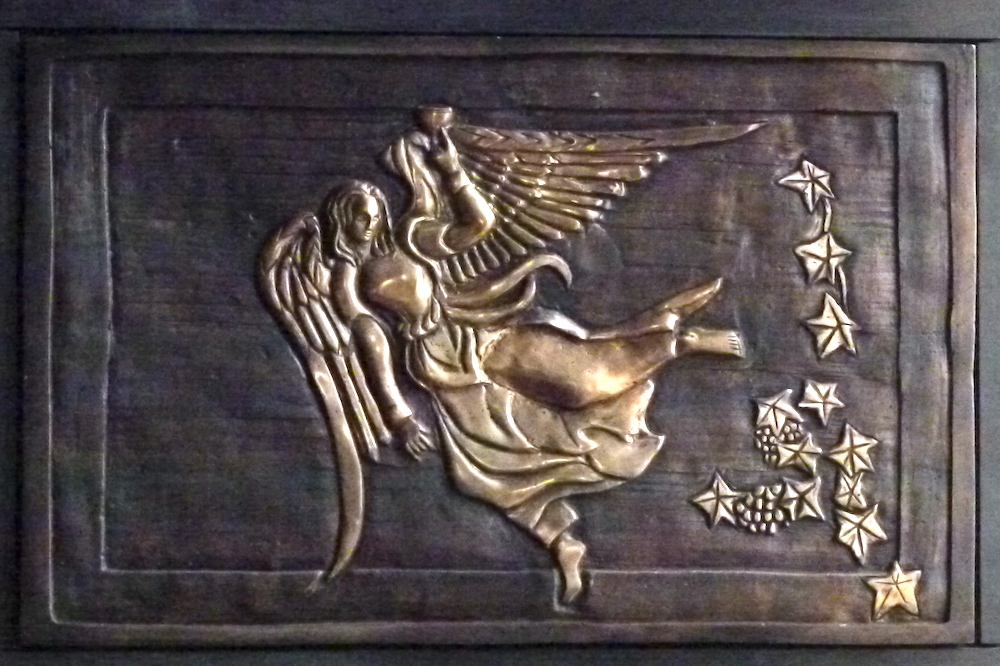
Florence's collaboration with the project didn't end with the Stations. The same partnership extended to the Cathedral's main doors, where she designed the bronze relief sculptures that were ultimately cast by Rajinder Ahmed at his Nairobi foundry — a project that, at one stage, we had also considered making in glass, before bronze became possible.
Stations of the Cross — Gallery
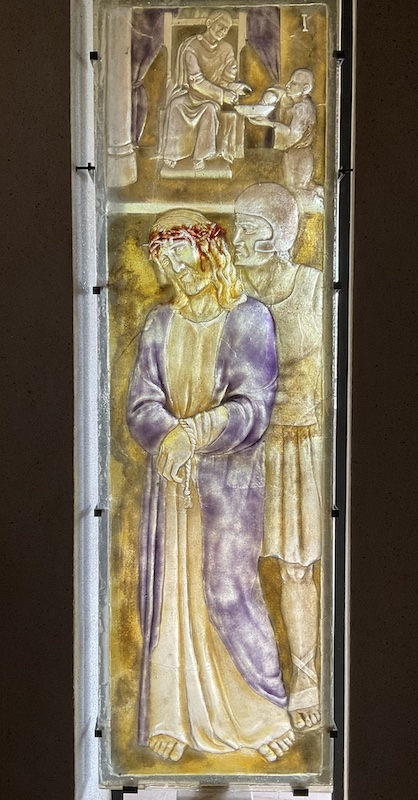
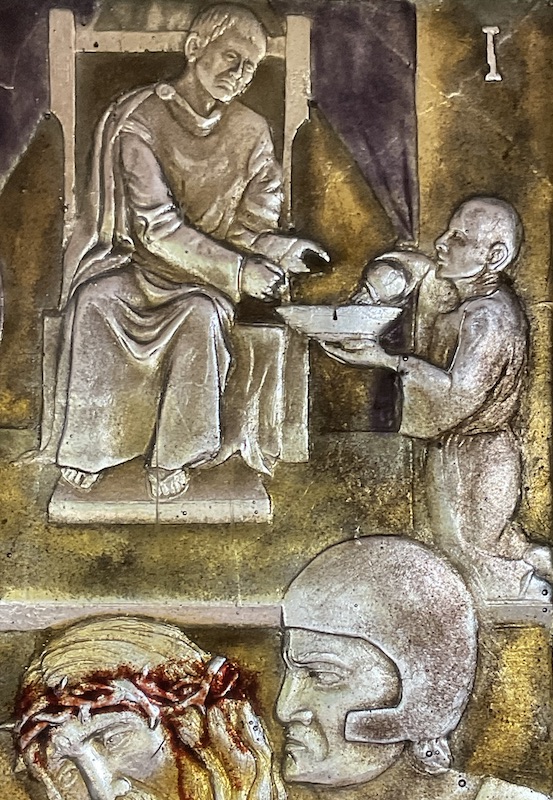
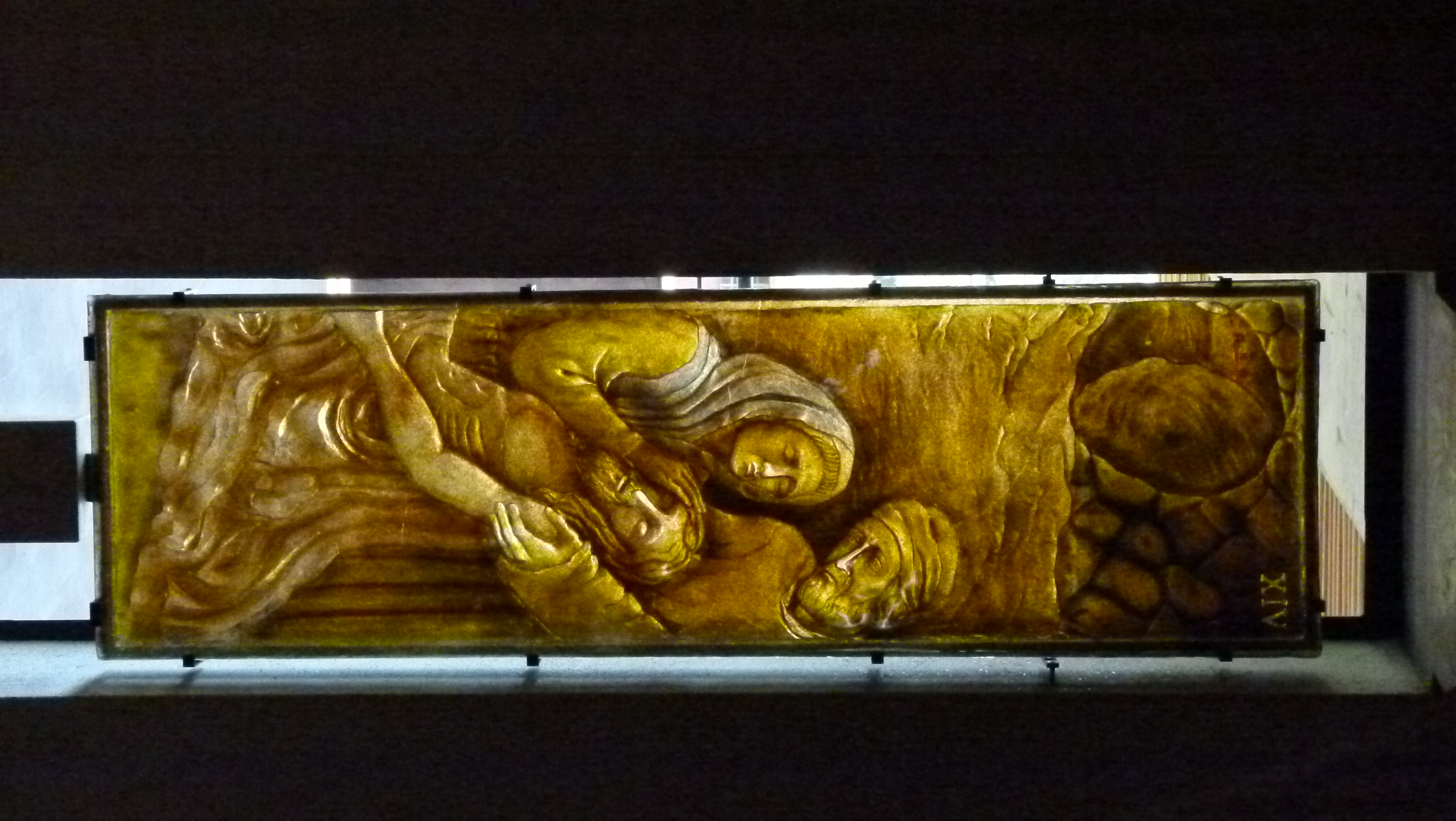
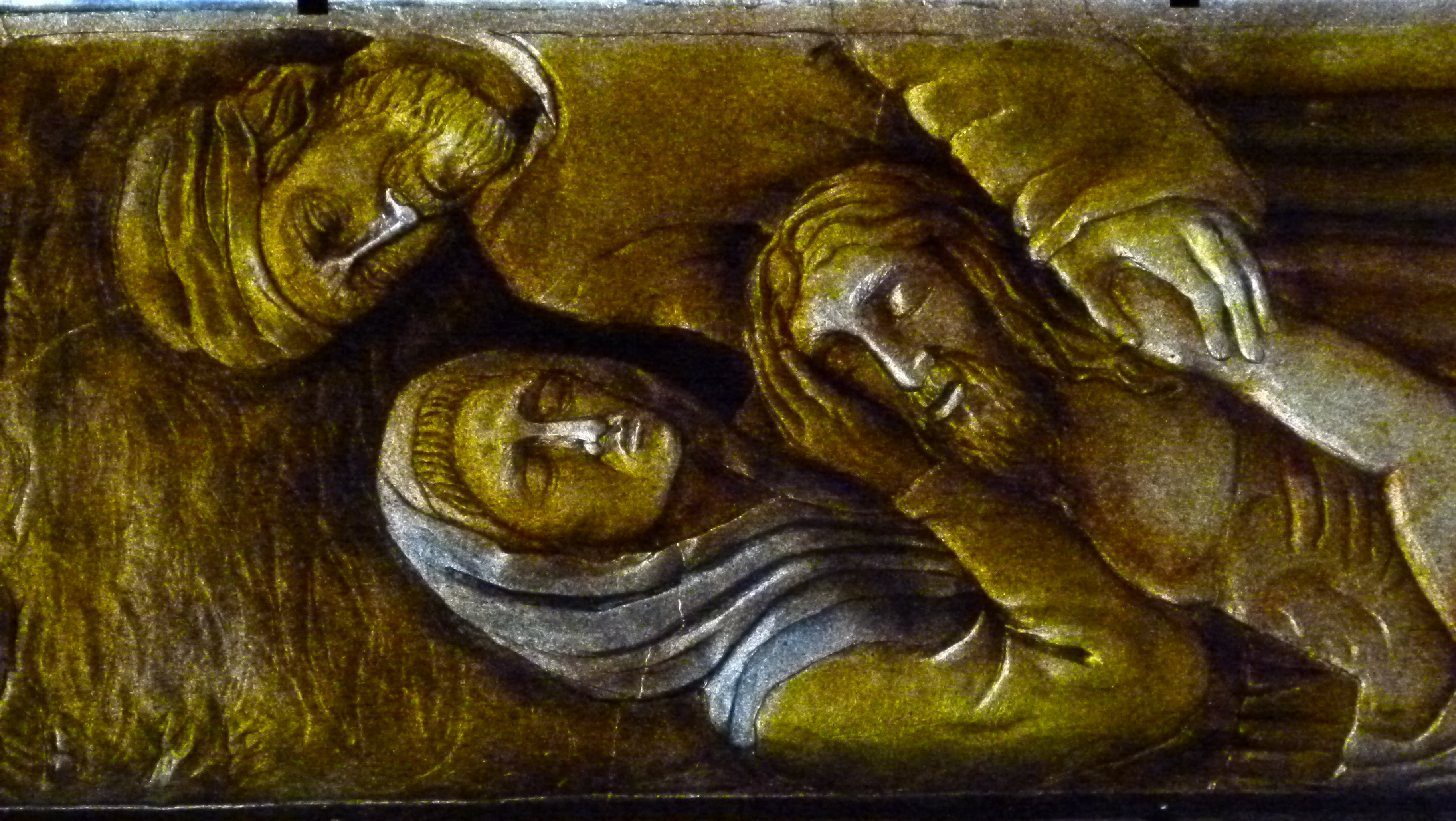
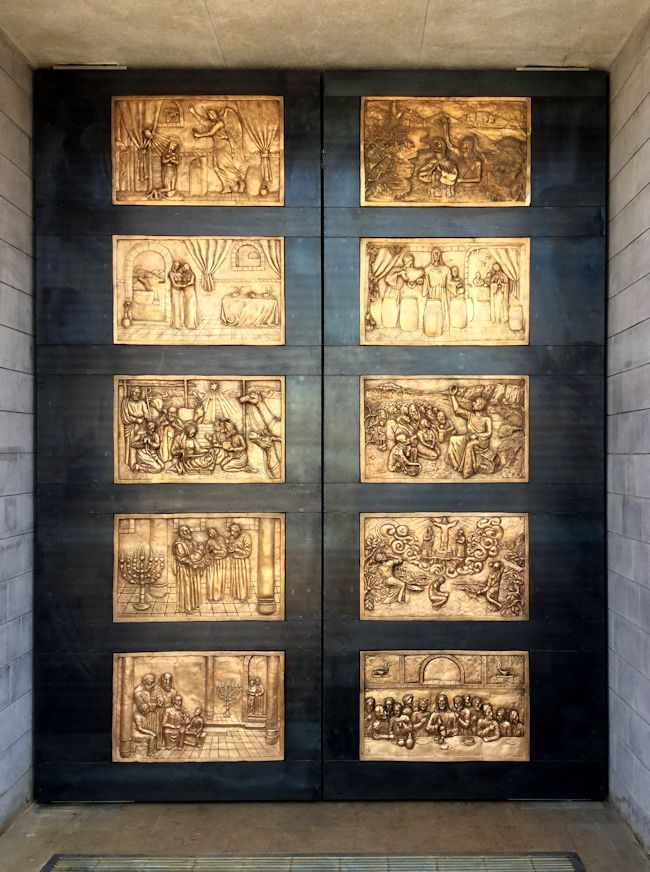
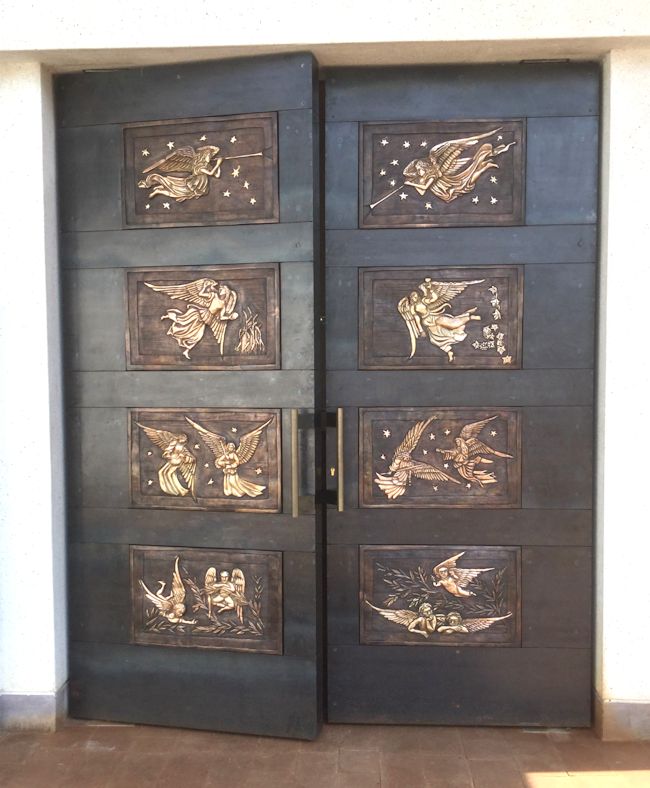
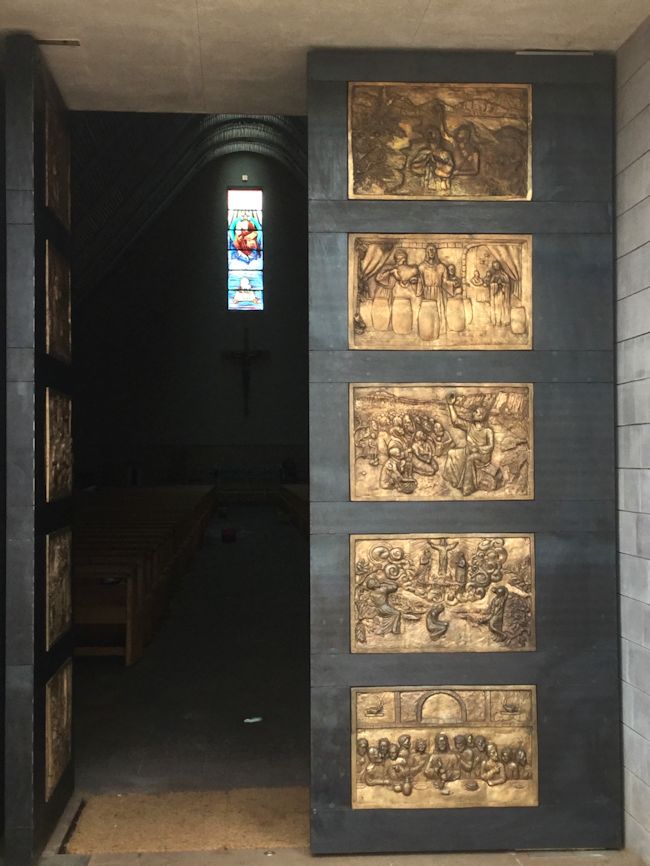
The Bronze Door Panels
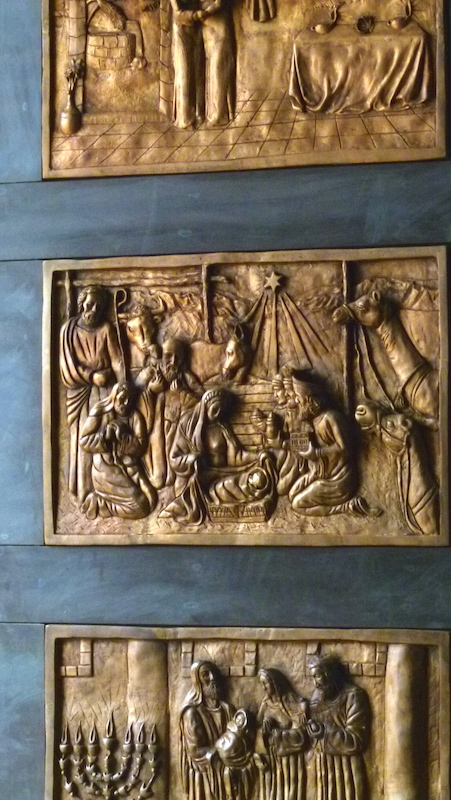
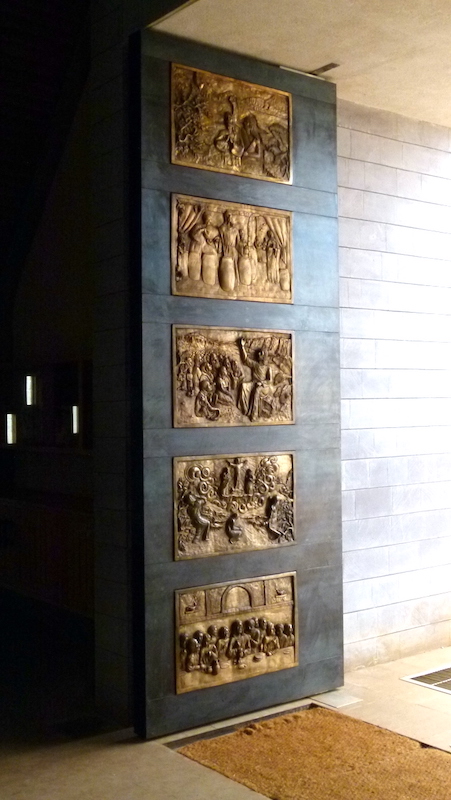
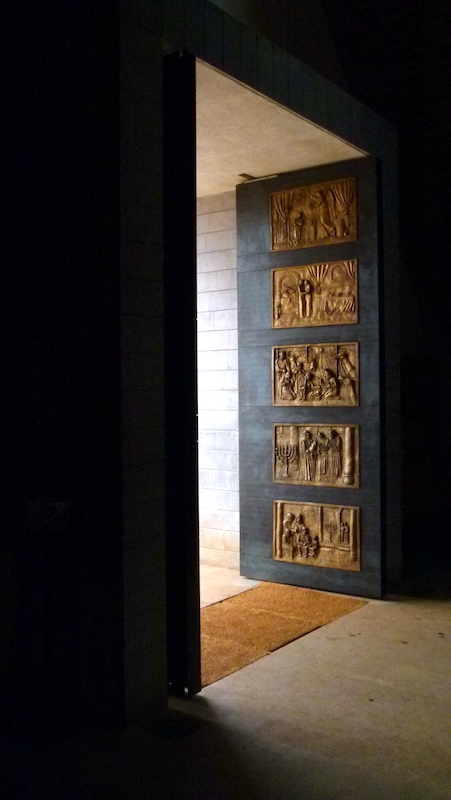
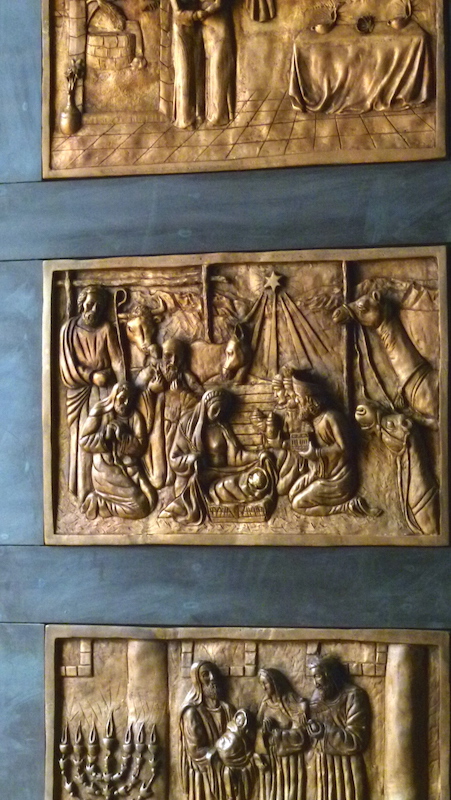
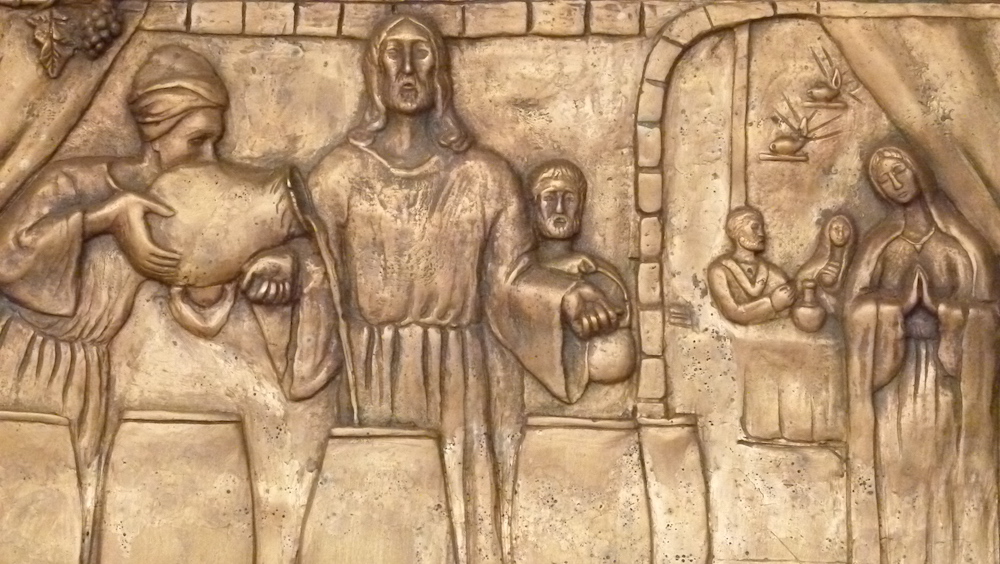
The Relief Sculpted Bronze Door Panels
The making of these steel doors and the bronze relief sculptures was essential to the building concept. At one time we were not sure that we could have them made in bronze, and thought we would make the relief sculpted panels in glass. However, it was fortunate that Rajinder Ahmed had not so long before opened a foundry, and we worked with him over several years to create the relief sculpted bronze panels.
Doors — Gallery
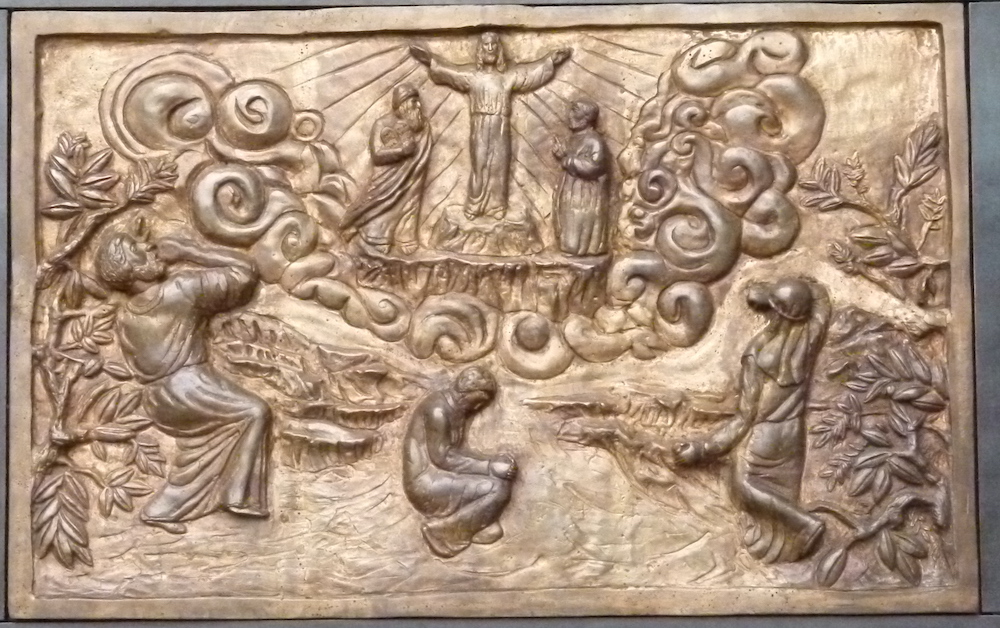
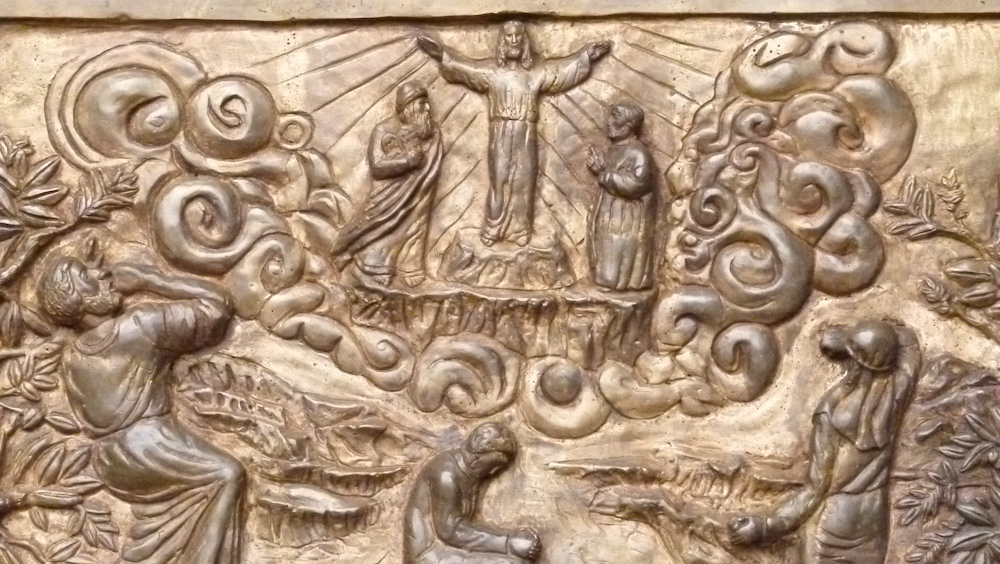
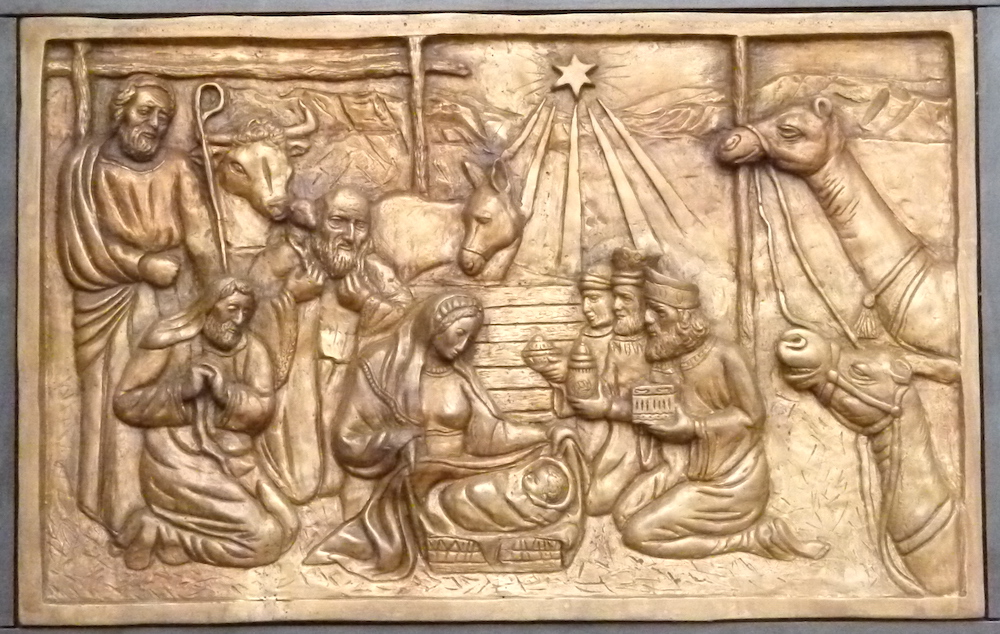
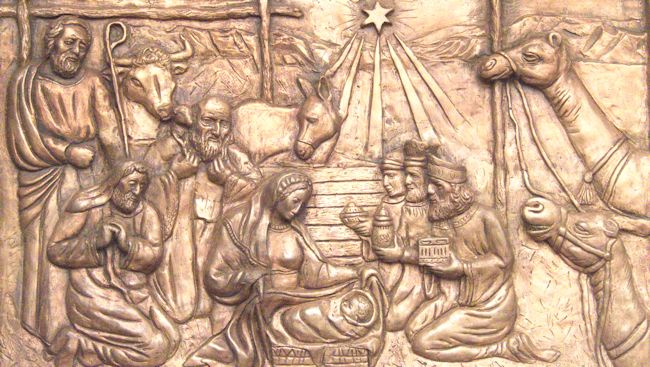
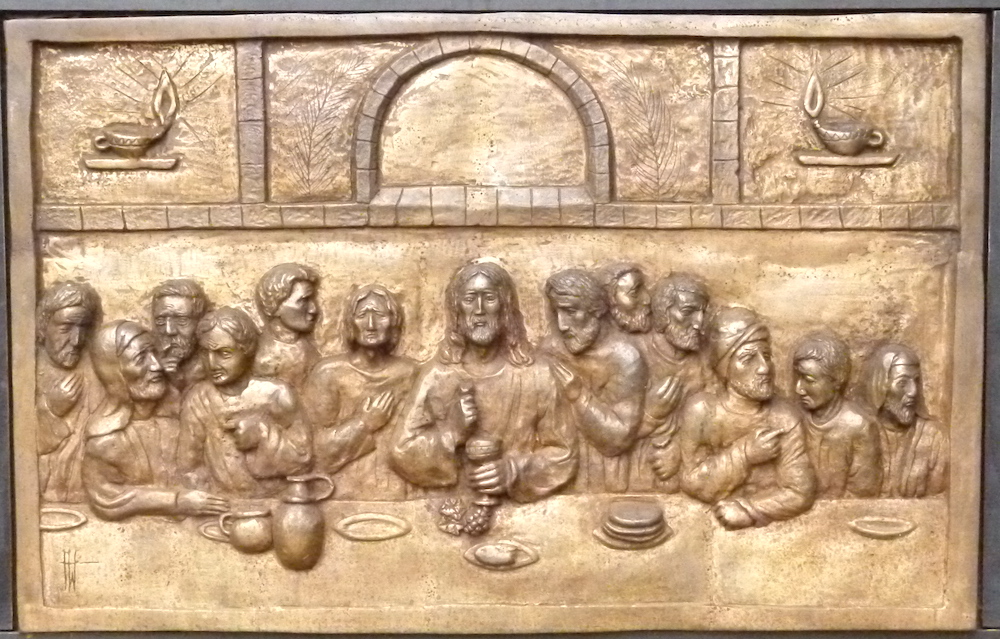
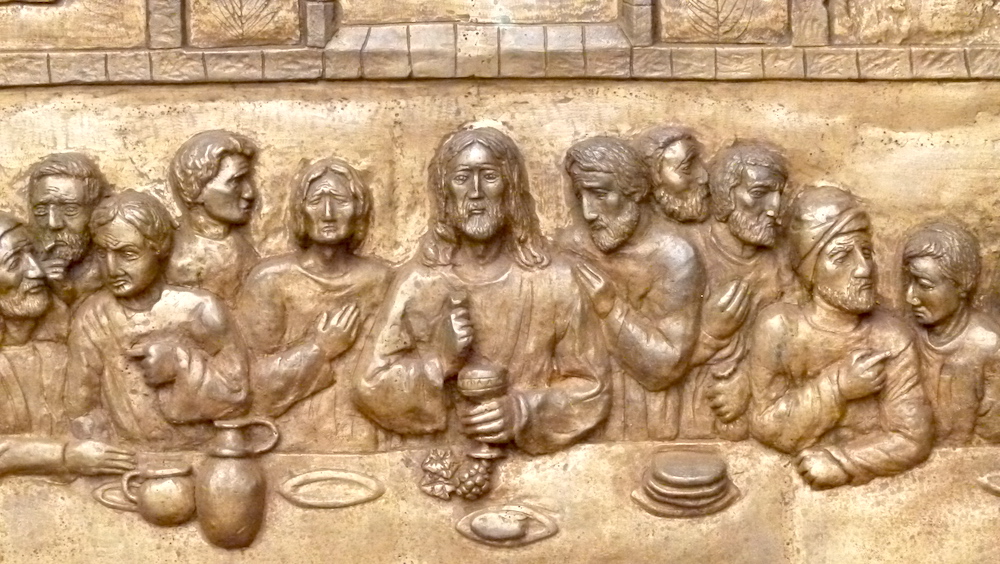
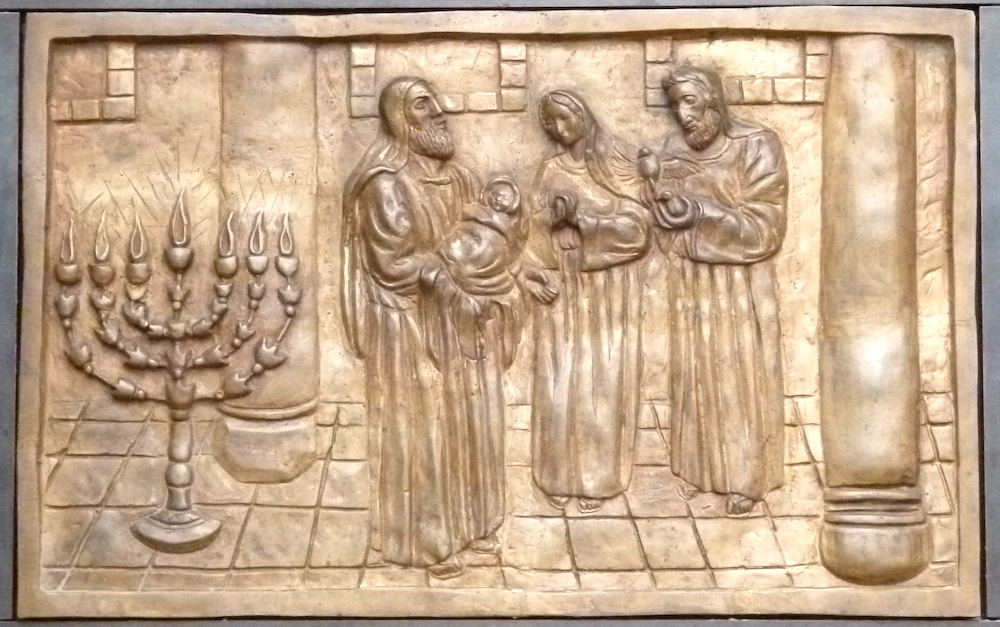
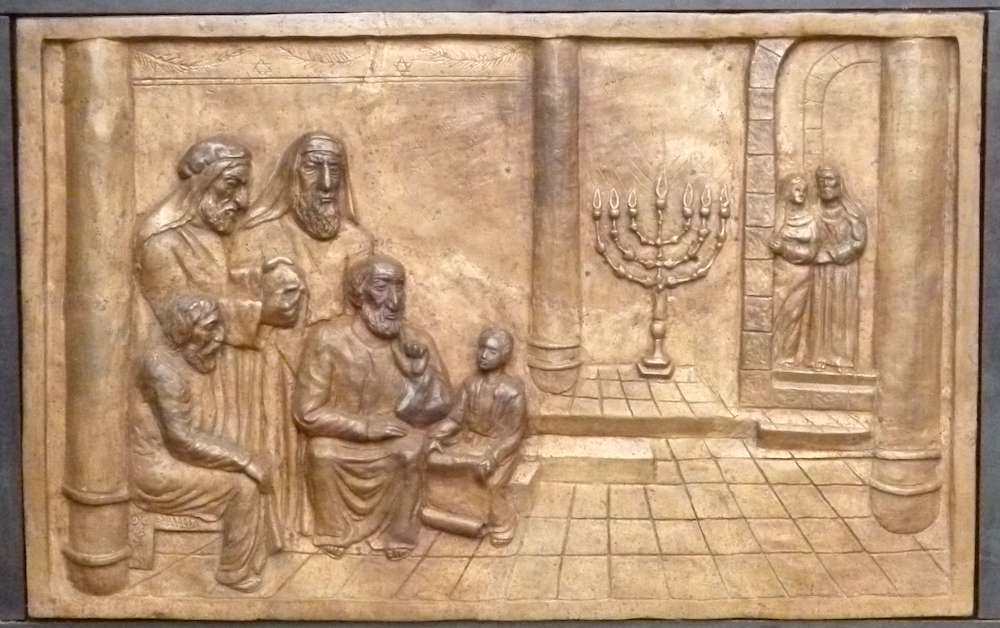
 >
>
The Crucifix and the Statues
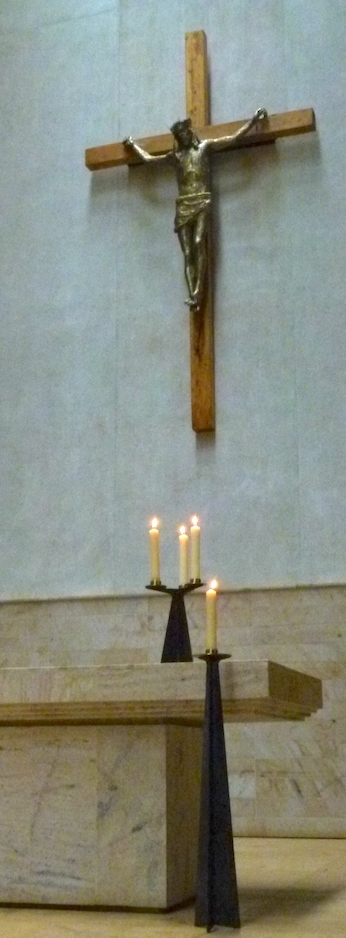
The Crucifix and Candlesticks
The story of the crucifix begins before the new cathedral had even broken ground — with the felling of a tree.
A tree stood in the footprint of where the new building was to rise. It had to be removed. I had taken on the role of video documenter for the project, and I saw in this necessary act an opportunity for something more than clearance work. I gathered the architecture team, the Bishop, the priest, the church elders, members of the Diocese of Kericho, and the wider congregation, and we assembled together near the tree. The atmosphere was warm and ceremonial. The tree was trimmed and then felled.
The following day I arranged for a man to come with a chainsaw. I had realised that the wood from this tree — rooted in the very ground the cathedral would occupy — could become the cross on which the figure of Christ would hang. The trunk was cut into broad planks and put into storage. It would wait there until the building was ready for it.
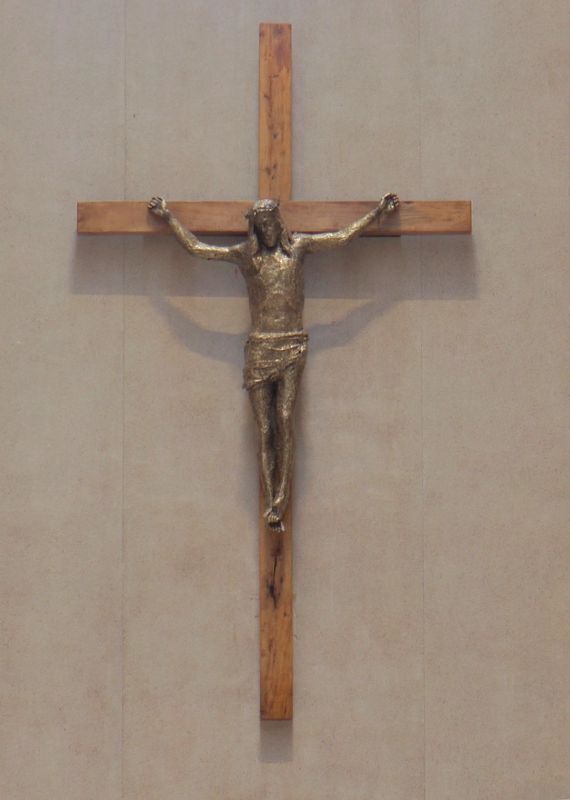
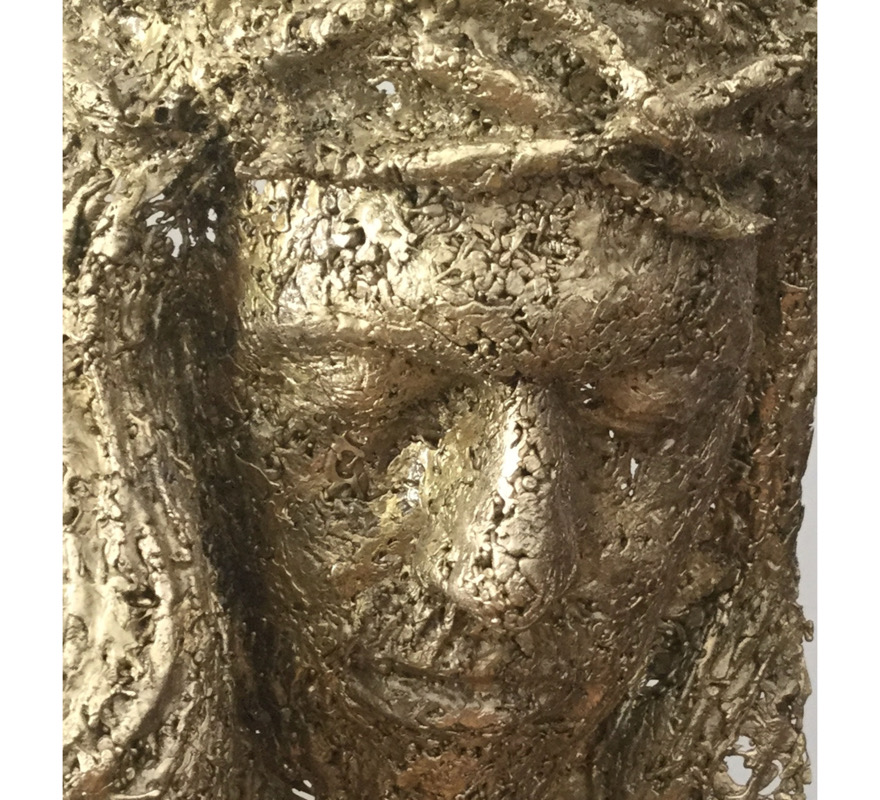
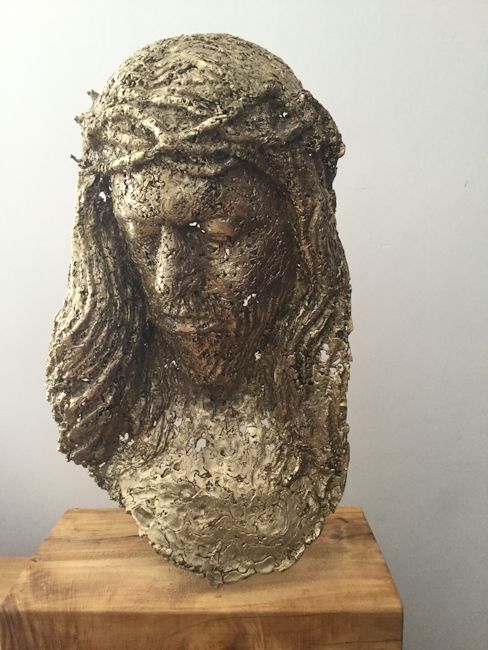
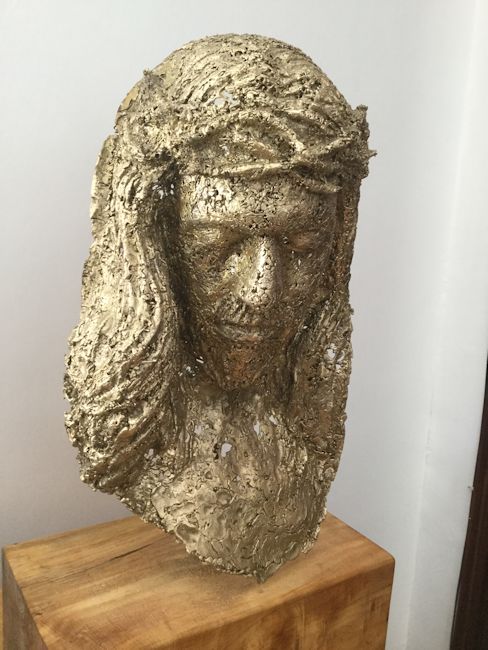
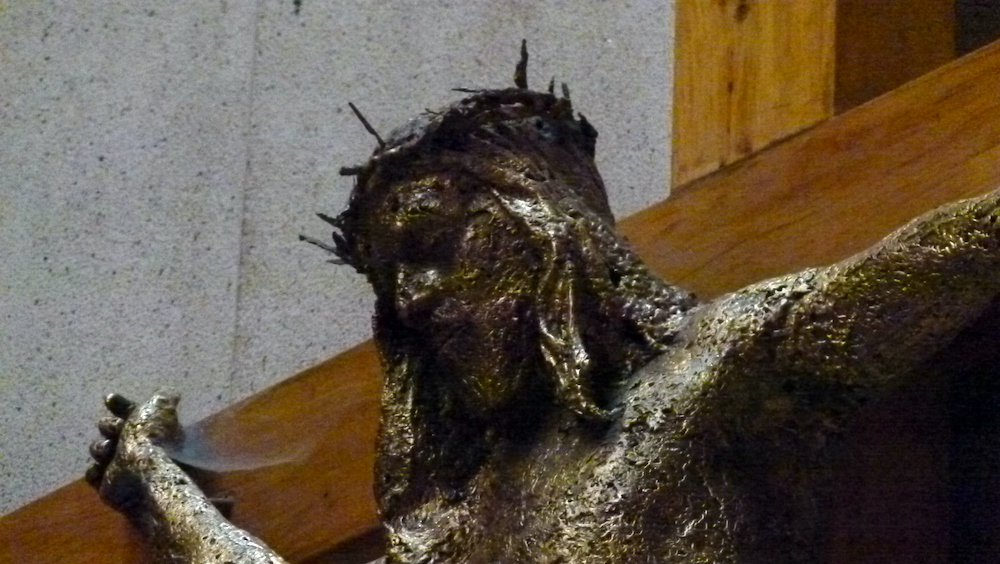
The figure of Christ came about through a meeting at Kitengela, arranged by Nani Croze, who had been helping us connect with suitable artists throughout the project. It was there that I was introduced to Toumer Yeshim, a well-known sculptor in Kenya. He brought his portfolio. In it I saw images of partial figures onto which he had dripped molten metal using a welding flame — building up the surface of the sculpture layer by layer in a way I had never seen before. The effect was extraordinary.
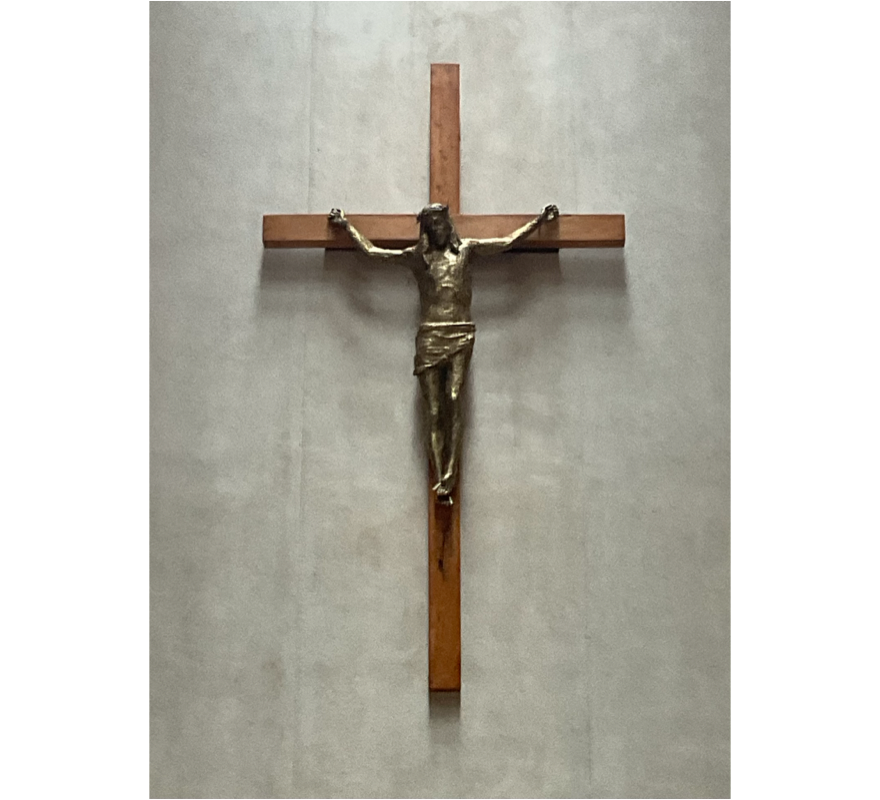
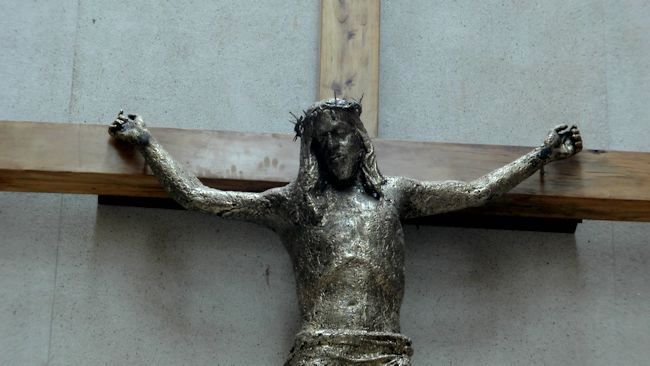
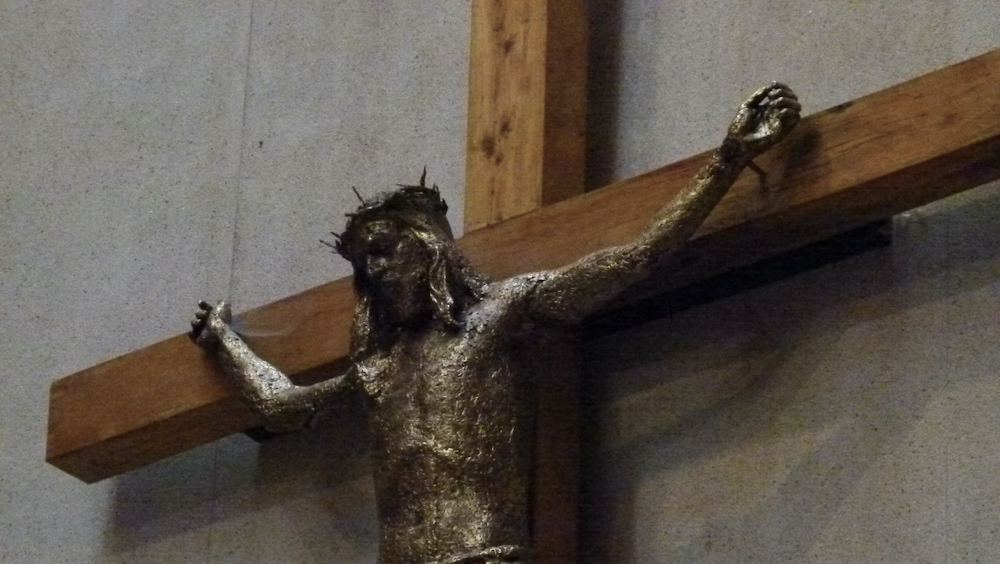
George Paterson was with me at the meeting. We discussed whether the same method could work in brass. We agreed that it could, and that brass would give us something remarkable. A full-sized plaster cast of a human figure was made in Italy and sent to Kenya. Toumer used it to create the moulds from which the complete figure was built — dripping molten brass rod by rod using a welding flame, building the body of Christ section by section. The individual pieces were later brazed together into the finished figure, approximately life-sized at around 5'8".
The surface of the finished figure is not smooth but accumulated — each drip of metal cooling fractionally differently, catching light at a slightly different angle. At close range the face has an almost liquid quality, as if the metal froze in the moment of becoming. It is neither the smooth idealised bronze of traditional church sculpture nor raw expressionism — it occupies its own territory entirely.
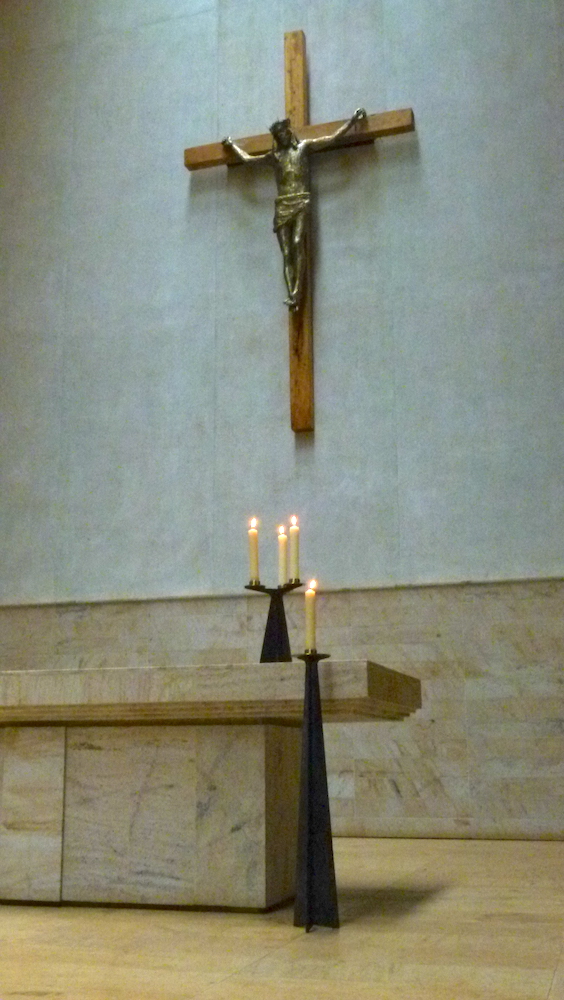
When the figure was complete, I asked Toumer to make the cross itself from the wood we had kept in storage since that first day — the tree that had stood in the footprint of the building, felled to make way for it, and now returned to the heart of it. The finished cross stands approximately 4.5 metres high.
The candlesticks below the altar were also made by Toumer Yeshim, using related metalwork methods — angular and dark in finish, a deliberate counterpoint to the warm brass of the figure above. Together, crucifix and candlesticks form a coherent sanctuary ensemble.
Crucifix — Sacred Heart Cathedral, Kericho
Artist — Toumer Yeshim
Material — Dripped and brazed brass figure, site timber cross
Dimensions — Cross approximately 4.5 metres, figure approximately life-sized
Location — Sanctuary wall, above the altar
Candlesticks — Sacred Heart Cathedral, Kericho
Artist — Toumer Yeshim
Material — Cast and worked metal
Location — Sanctuary, below the crucifix
Crucifix— Gallery
The Roofs
The Roof Pattern
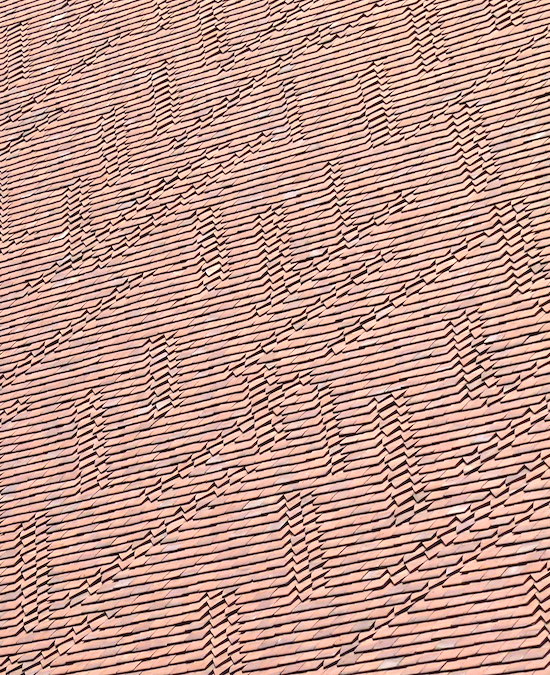
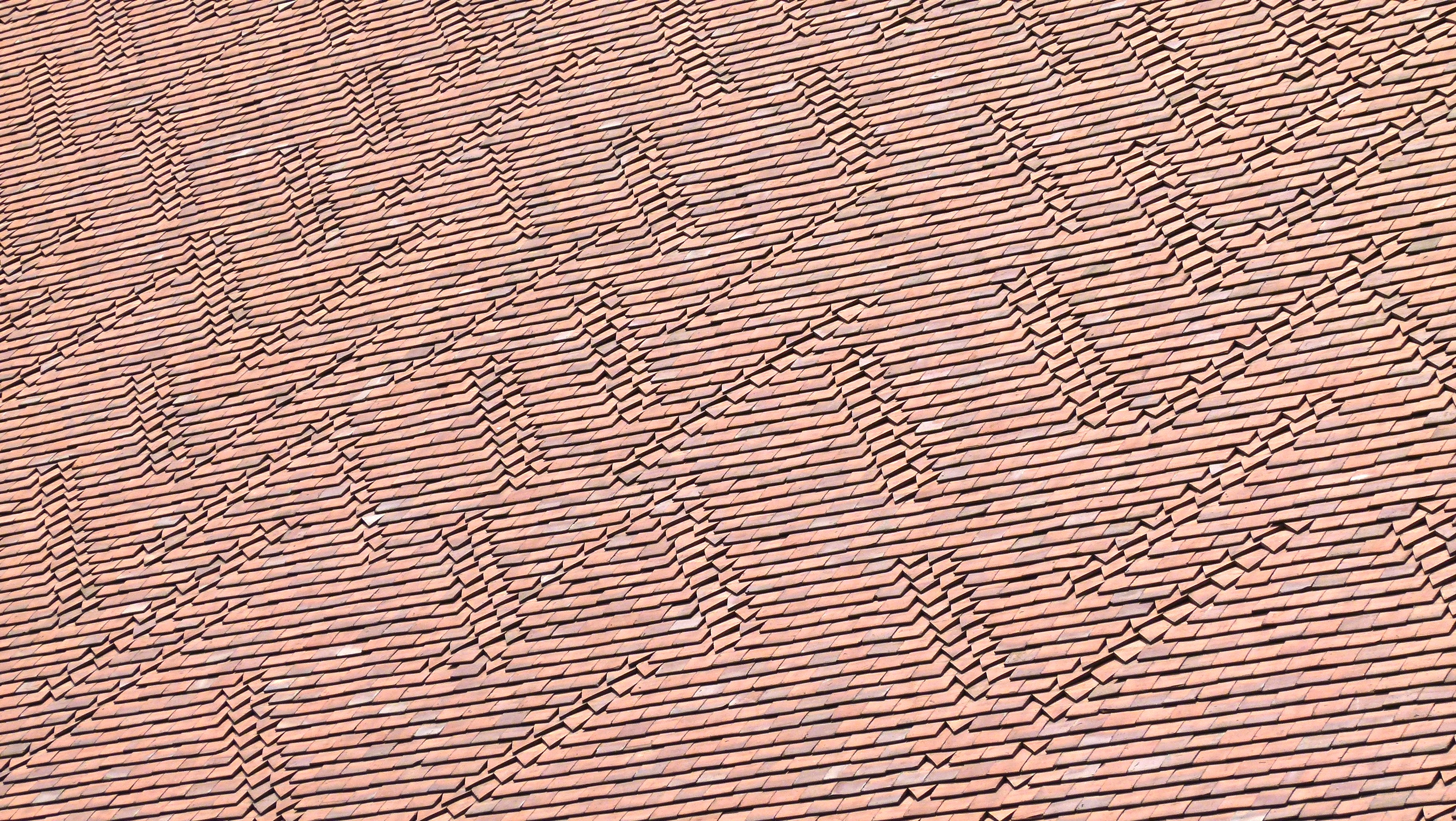
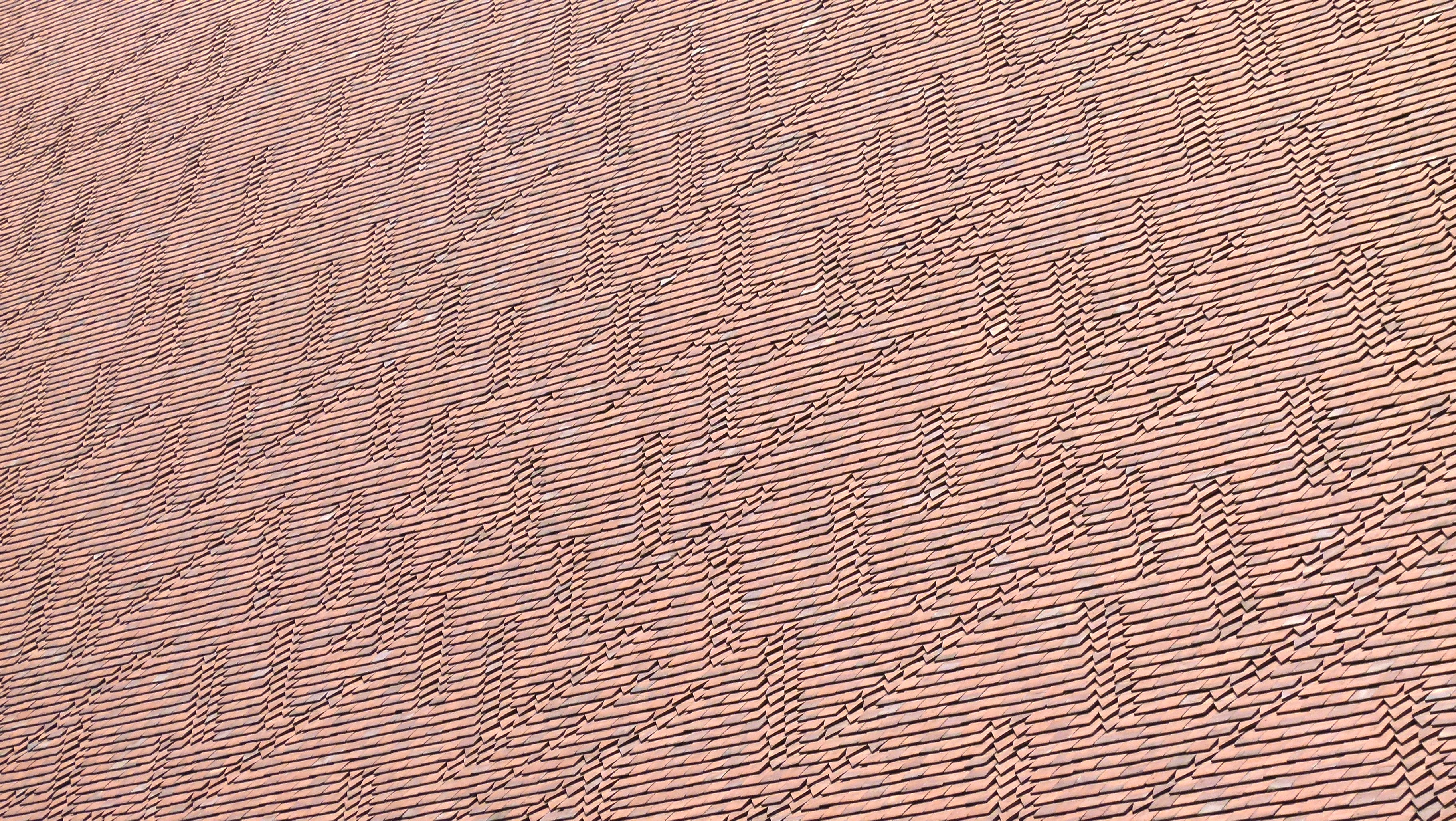
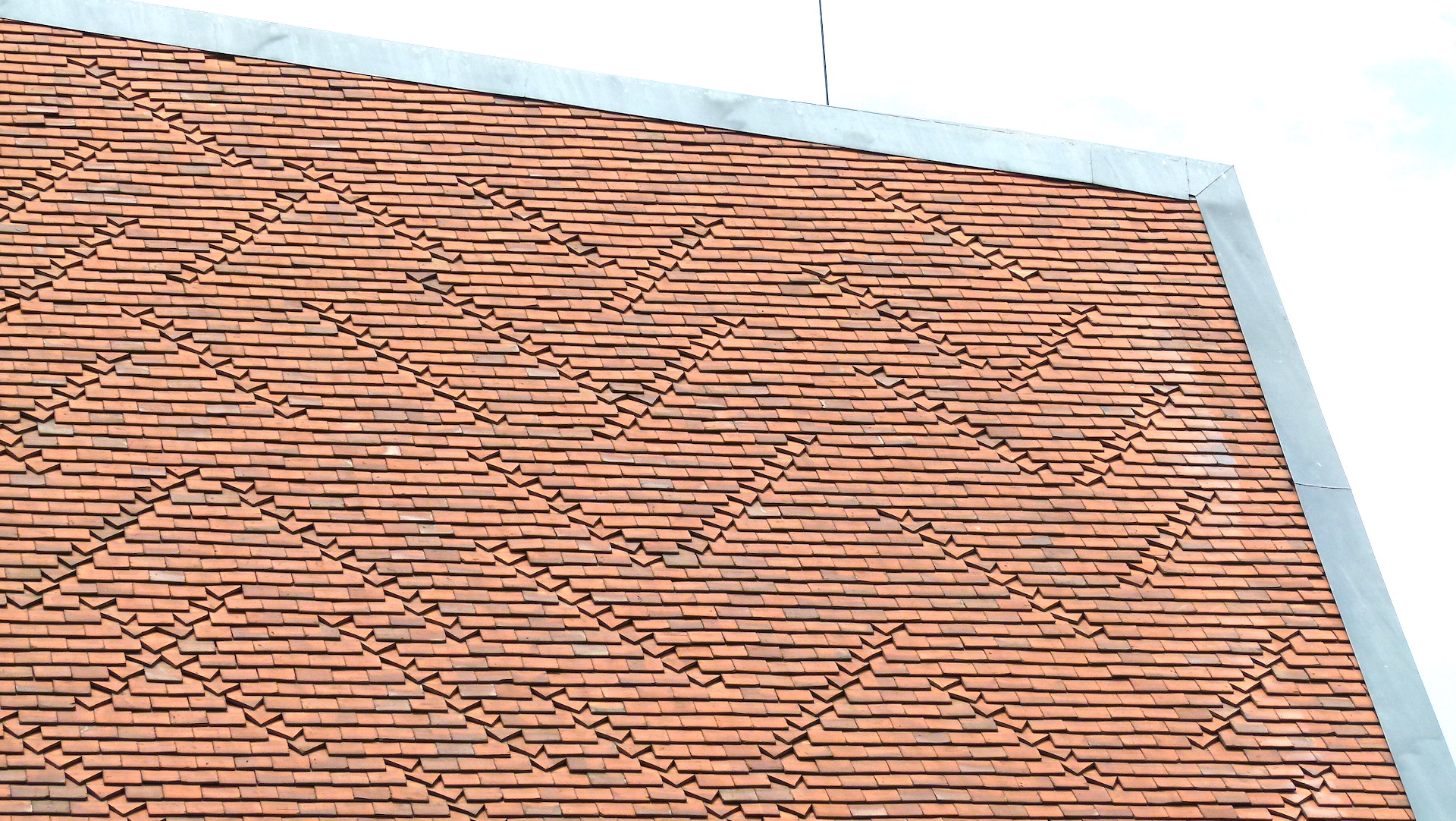
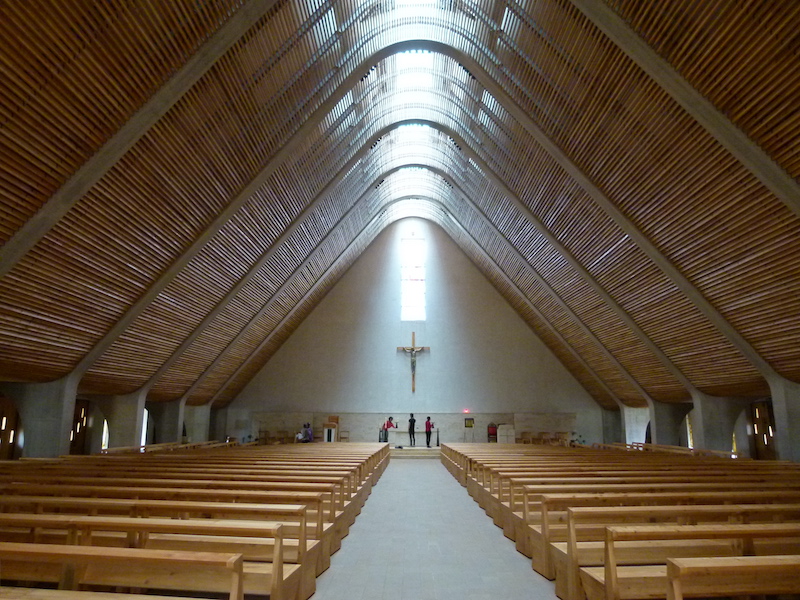
It was always intended that the roofs would be decorated in some way. The theme of wheat — representing the Eucharist — was decided during a discussion with the Bishop in the cathedral's design phase. The symbolism is doubled: wheat represents the bread of the Eucharist, and the host is referred to as the body of Christ; but the congregation itself is also referred to as the body of Christ. The wheat pattern therefore covers the whole community gathered beneath it during services — a quiet, continuous blessing written into the building's skin.
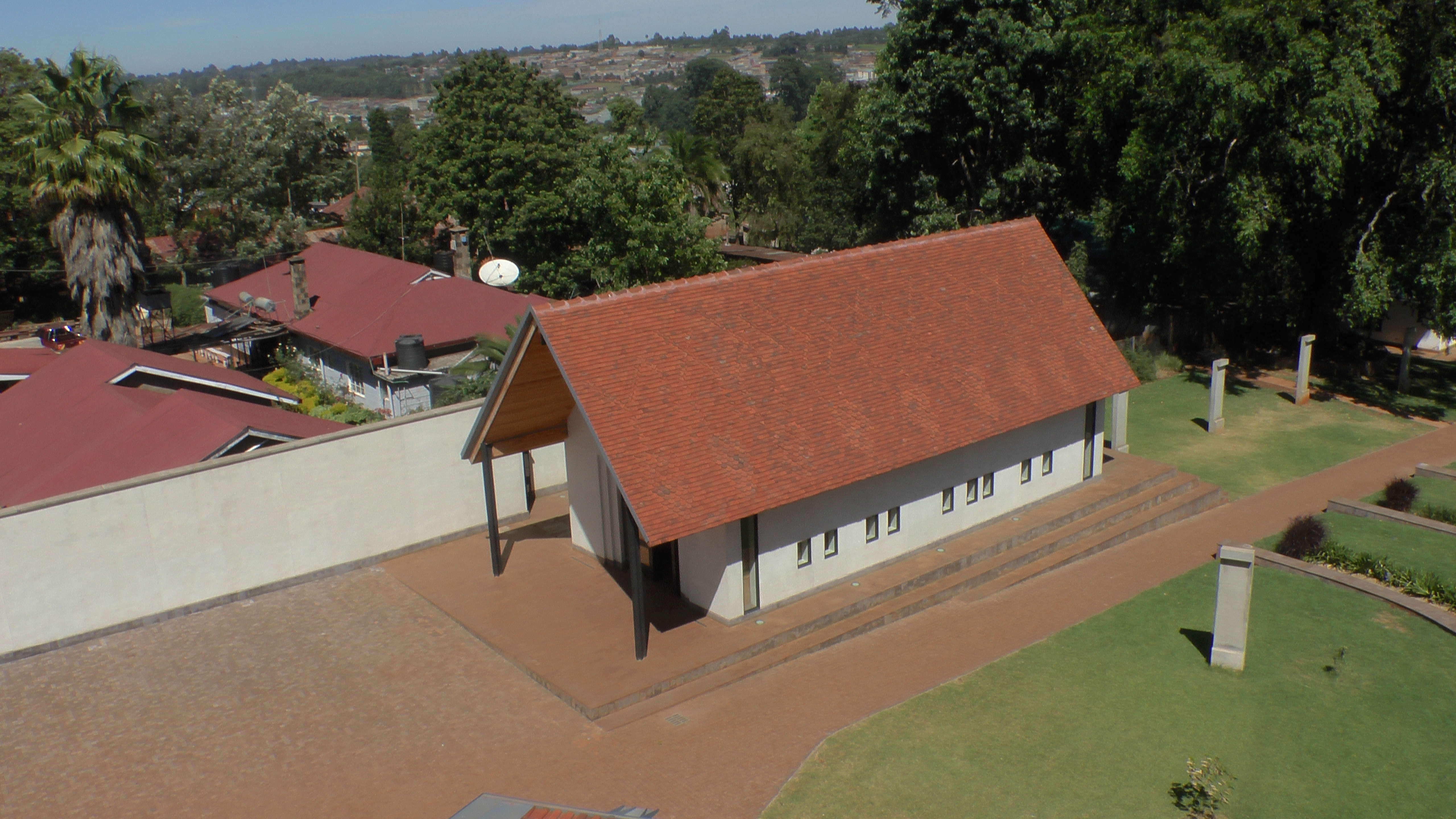
On the chapel roof, a smaller and more intimate building, both symbols of the Eucharist are present: wheat and grapes together, emphasising the daily mass celebrated within.
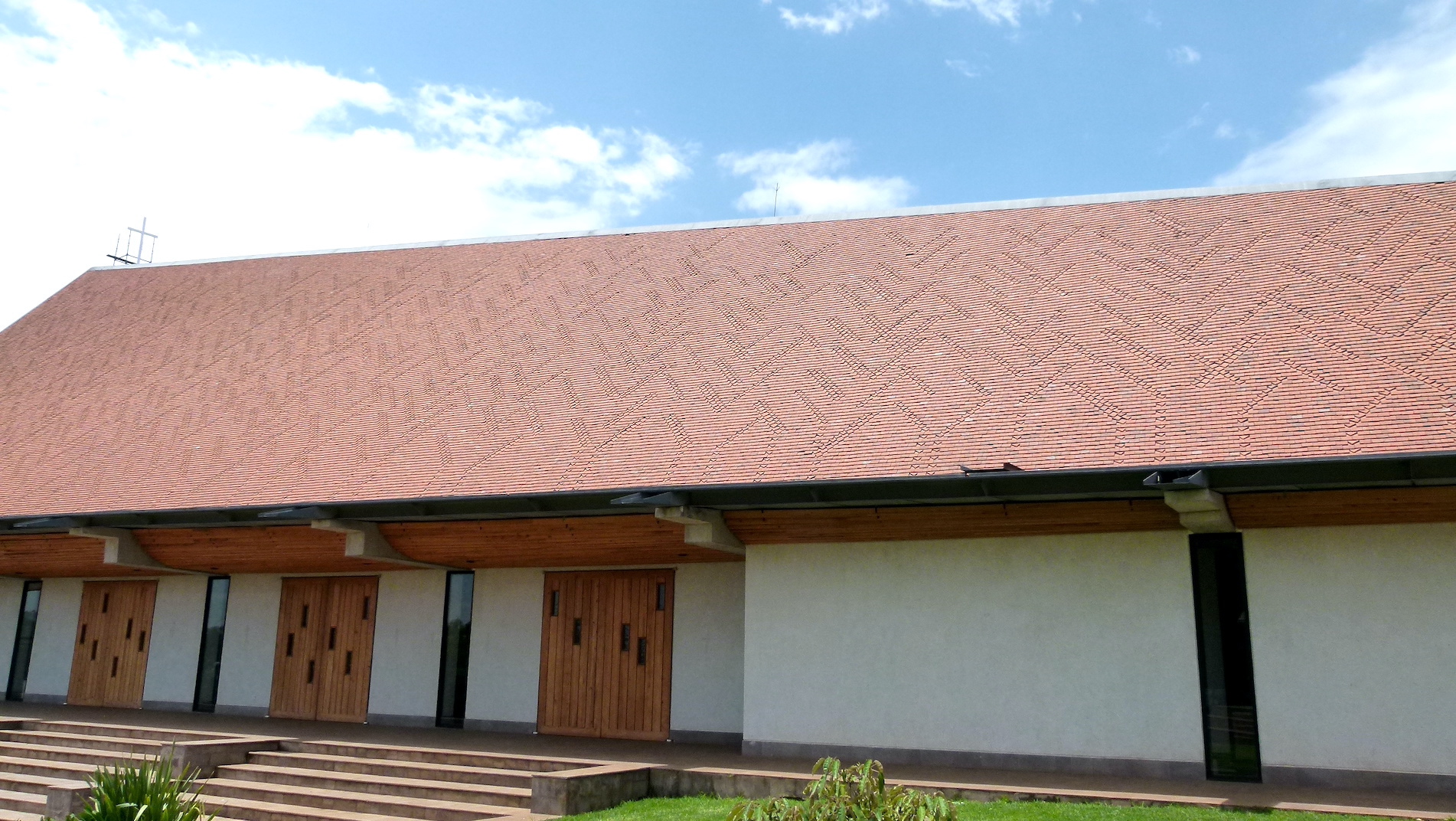
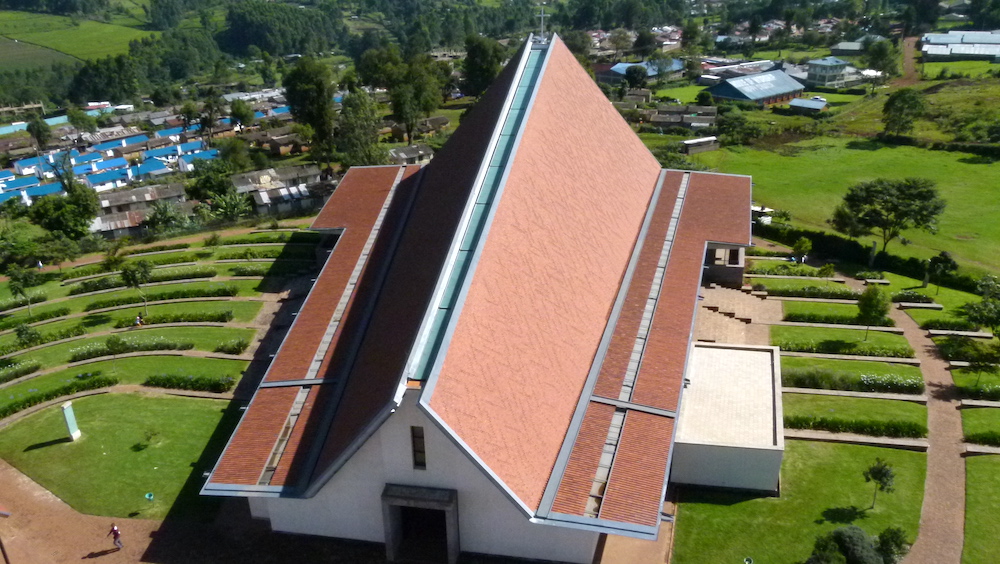
There is also a link to the underlying architecture, though it is subtle enough that many visitors will not immediately notice it. The pattern is centred on each of the structural arches beneath, so the rhythm of the roof decoration and the rhythm of the building's bones are quietly aligned.
The tiles were made by Kenya Clay — in keeping with the project's commitment to using locally made materials wherever possible. I conceived the design by making two oblique cuts on the tiles, one right-sided and one left-sided. From these two simple options, a complex pattern emerges across the almost sixty-metre length of the main roof. The concept was first tested by cutting tiles while the clay was still wet during production, but it became clear that this would not be fast enough to get the tiles into the kilns in time. The cuts were made after firing instead.
A five-by-four-metre sample was built on site during the early stages of construction to test the concept properly. It performed well — watertight even in heavy rain, though the tiles are not the primary weather barrier. I made a short film of the process at the time, which is included below, it was an amazing process.
On site, I mentored a team of tilers in how to create the pattern from my scale drawings. After a few days, two leaders, Francis and Mohanji, emerged who was able to carry the work forward independently. The method was straightforward once understood: all tiles were first laid in place, then using the drawings and the column centres as reference, each tile was marked with chalk — left slope or right slope — and exchanged into its correct position.
The Roof Pattern - Wheat
Roofs — Gallery
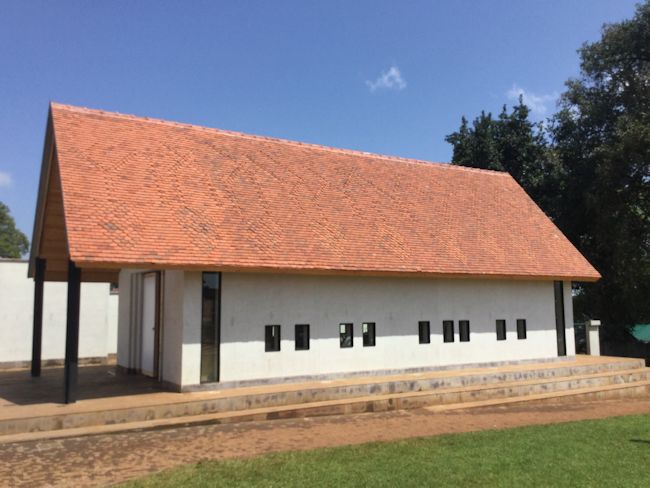
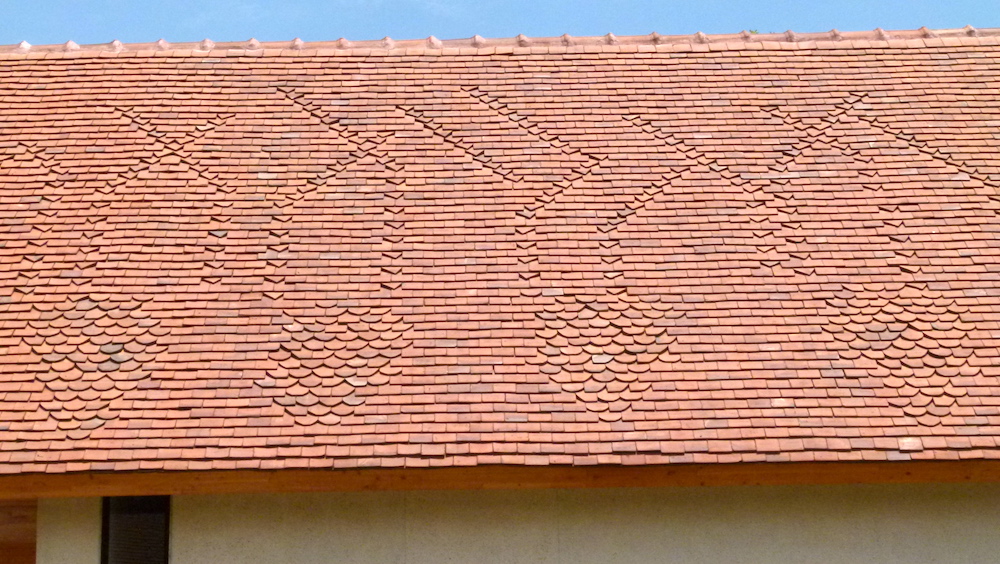
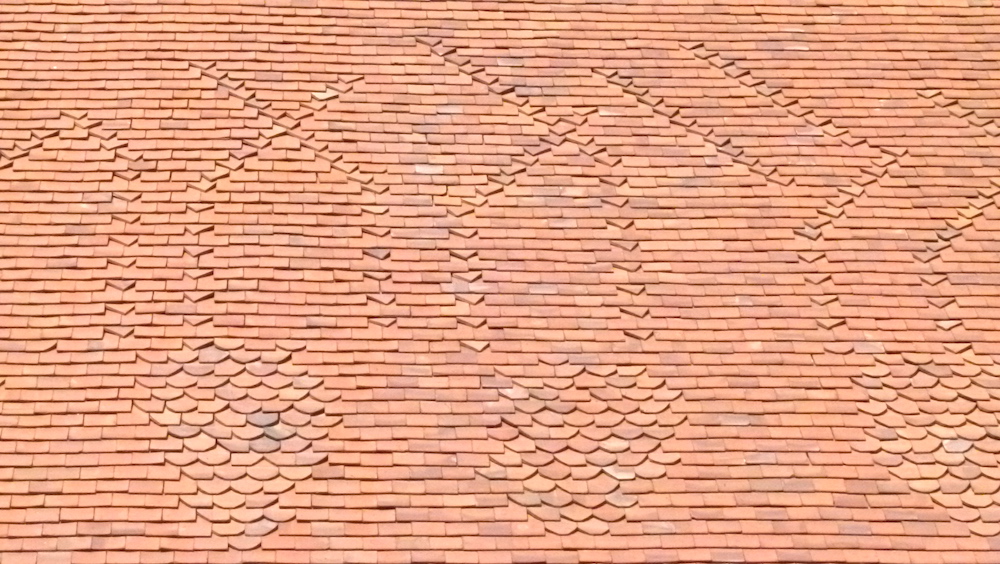
how the roof pattern was made
making the roof
this video shows how this amazingly complex roof pattern was achieved.
We had an amazing team of guys who were asked to work with me in creating the roof, a huge joint effort, the roof is 54 metres long.
The Mosaic
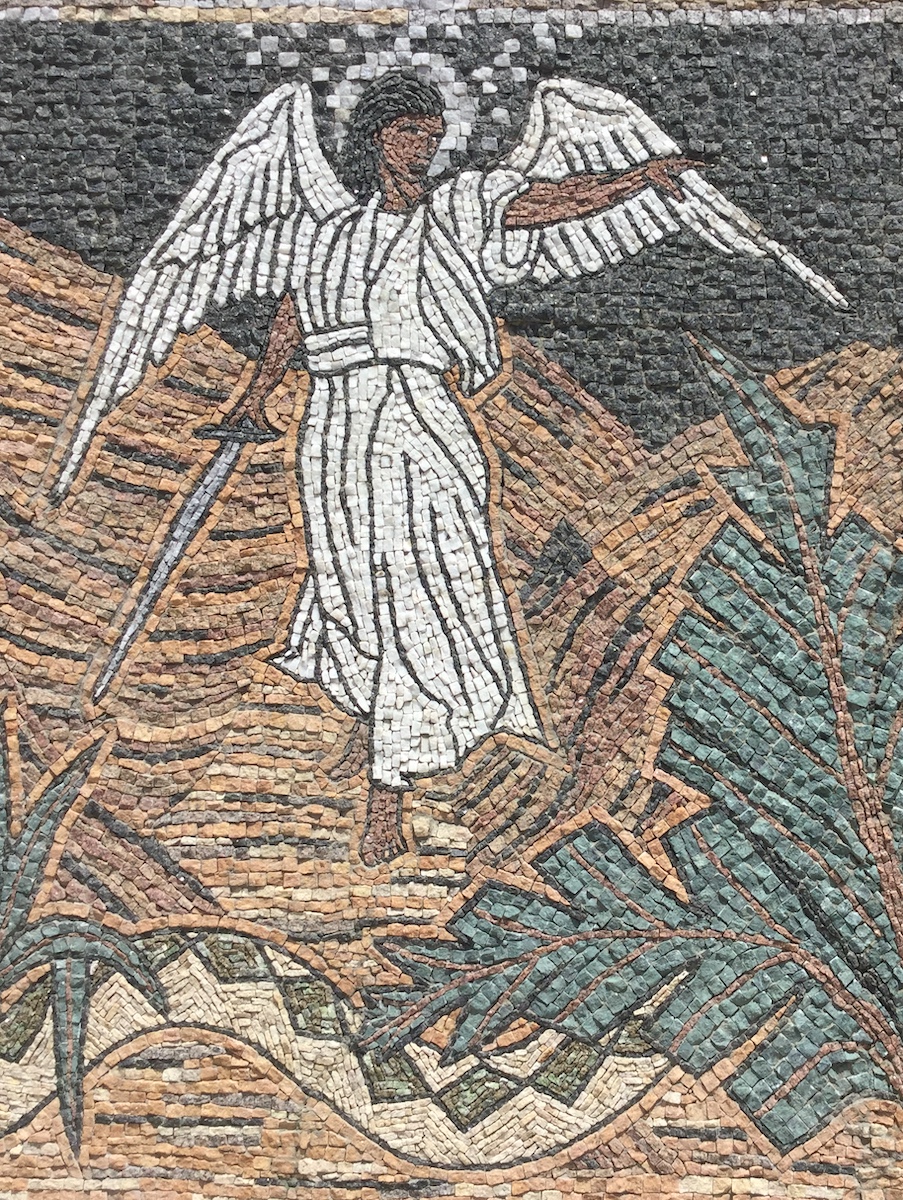
Mosaic
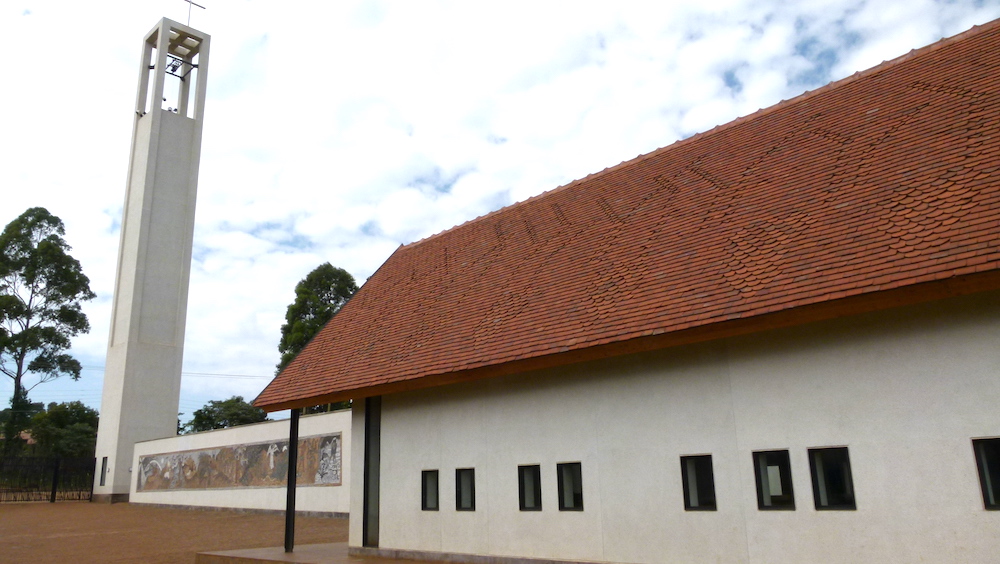
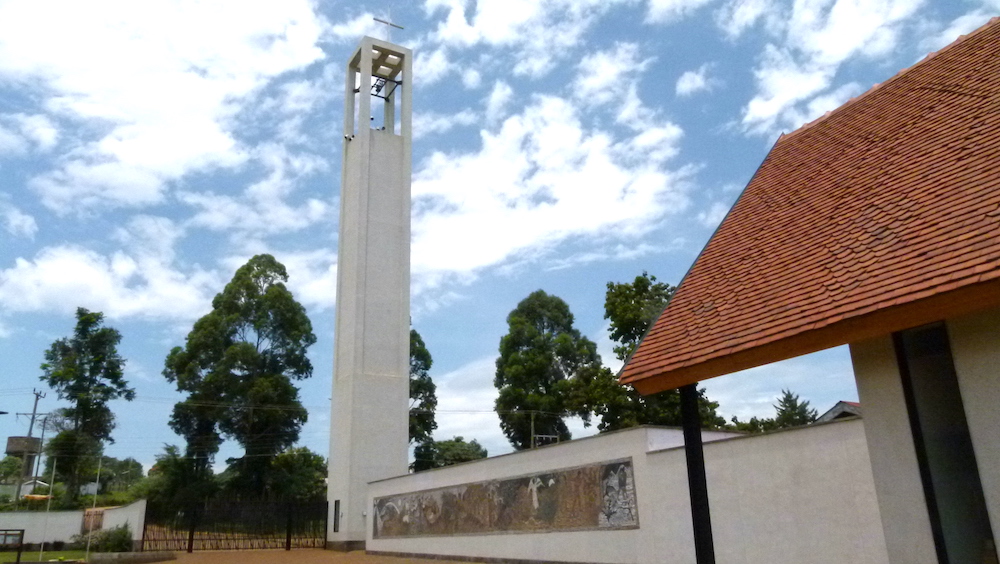
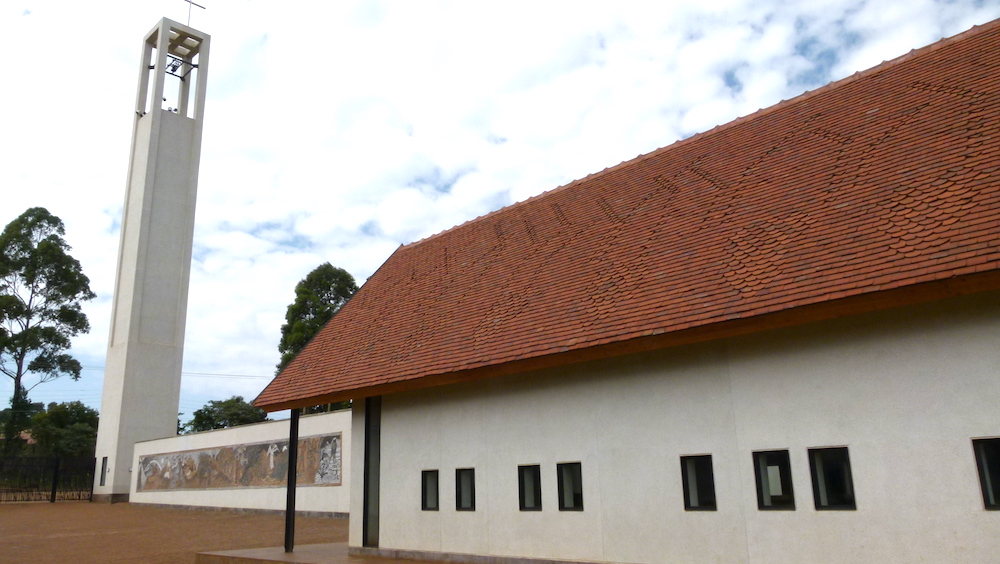
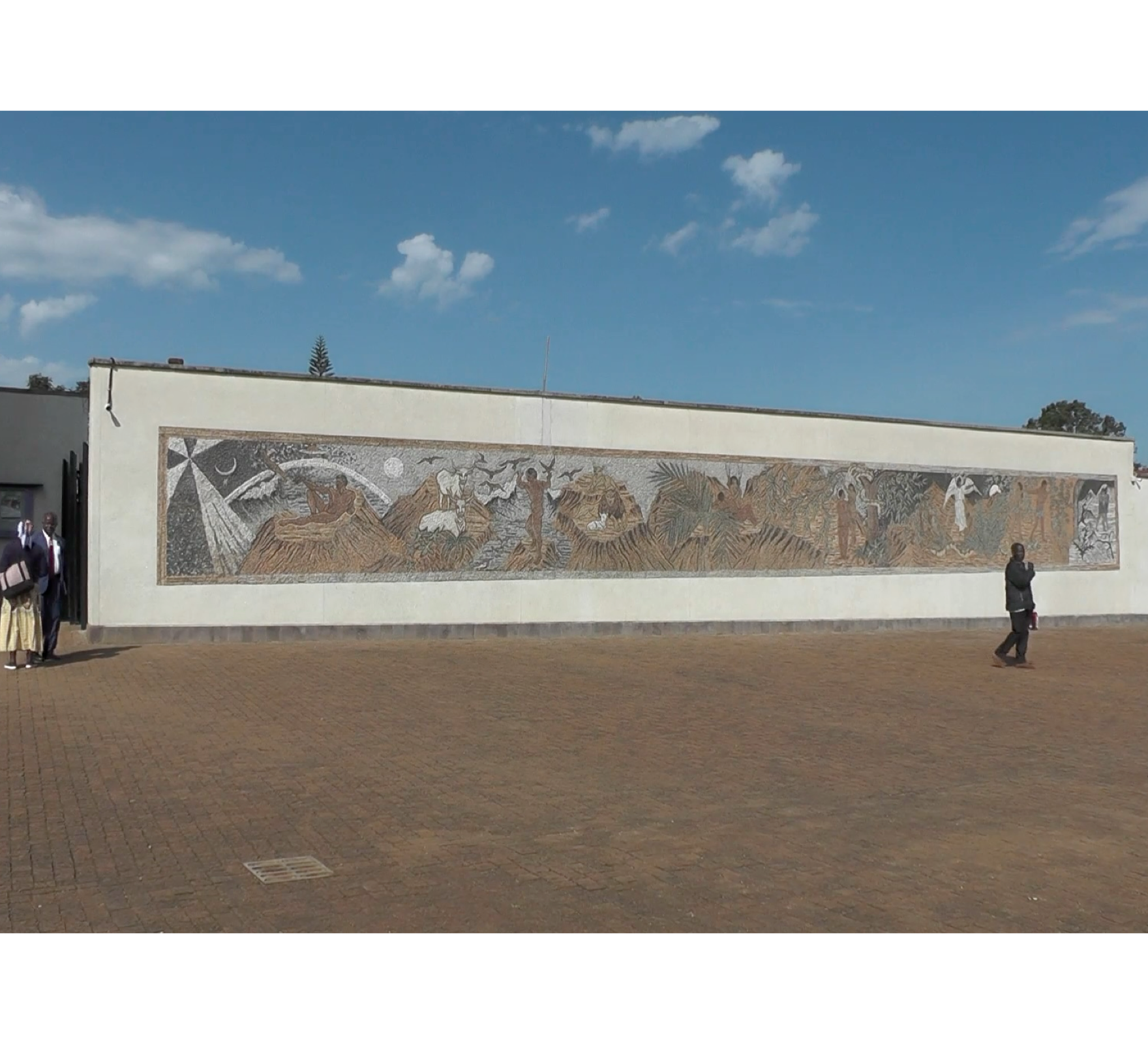
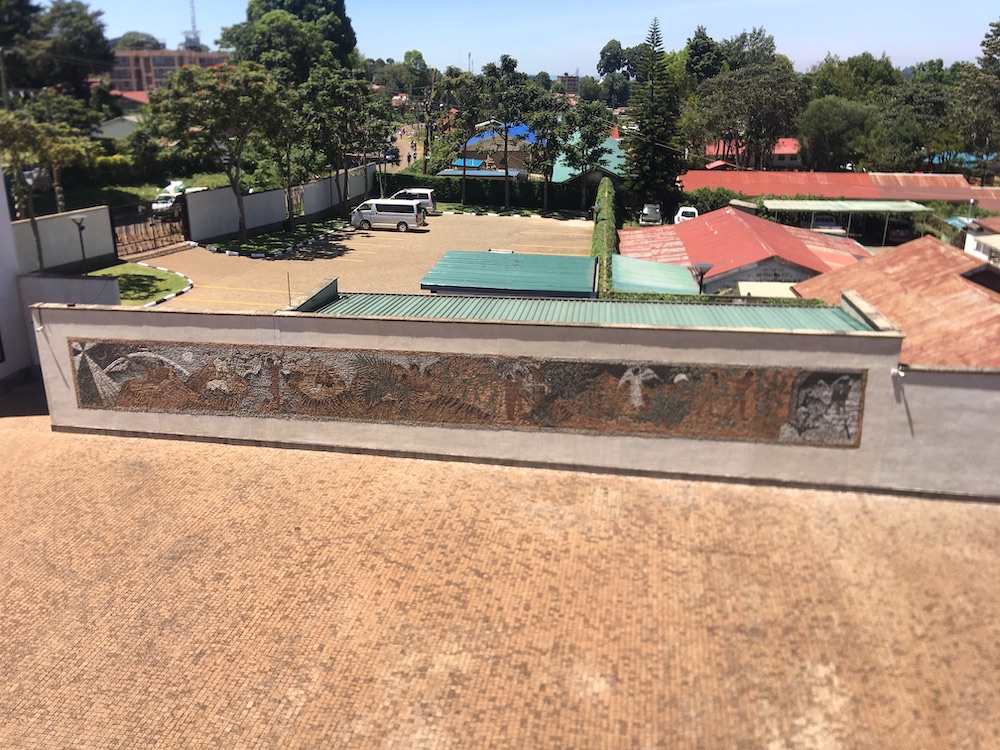
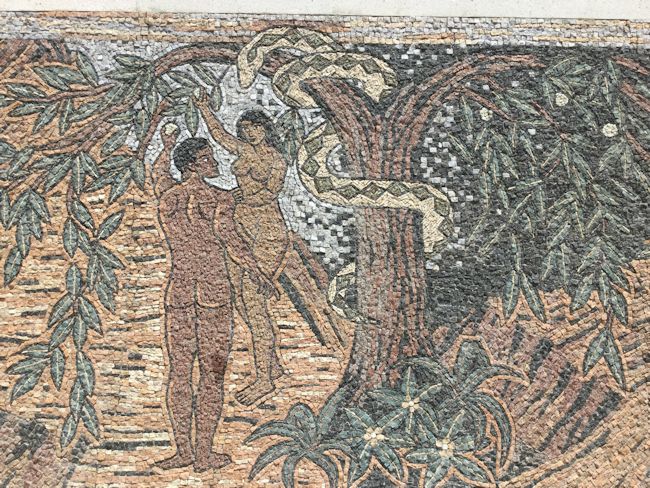
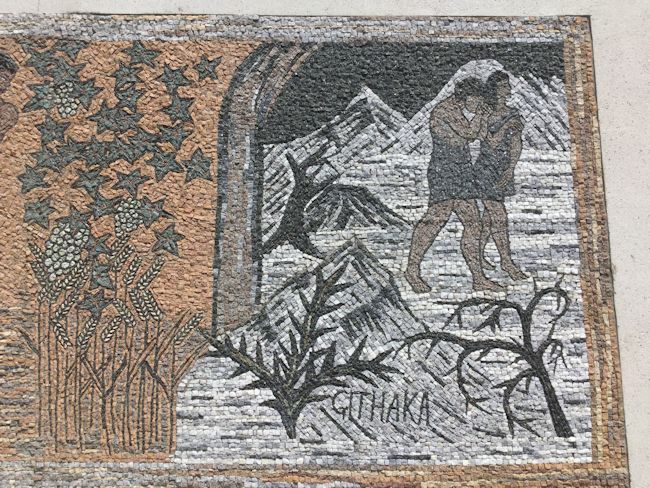
In keeping with the spirit of the wider project, the Garden of Eden mosaic for Sacred Heart Cathedral, Kericho, was made almost entirely from Kenyan quarried stone. Offcuts and broken sheets of marble and granite, collected from Kenya Marble in Nairobi's Industrial Area, provided the raw material, hand-cut into individual tesserae before any work on the mosaic itself could begin. Twenty metres long and two metres high, the mosaic is set into the cathedral's terrazzo entrance wall, where it visually links the freestanding bell tower to the chapel beyond — often the work visitors notice most clearly on leaving the building rather than arriving. Its theme was a natural choice for the setting: Kericho lies at the edge of the Great Rift Valley, long regarded as the cradle of humankind.
The narrative unfolds along the wall's full length. It opens in a dark, cool palette with the Creation — light drawn out of darkness beneath a night sky of moon and stars. The story moves through the naming of the animals and on into the Garden itself, where the palette opens into the richest colour the stone allows: dense foliage, fruiting trees, and the figures of Adam and Eve at the centre of the work. An angel marks the turn toward the Fall, and the mosaic closes as it began, returning to a dark, monochrome landscape for the Expulsion from Eden.
The mosaic was commissioned in early 2014. Nani Croze of Kitengela Glass, though unable to design the work herself, introduced the artist who would lead its making: Githaka Karuri, based in a small organic community of Rastafarian artists in Maragua. Githaka was the only member of his team with prior mosaic experience, in ceramic and glass. I designed the work and prepared full-scale drawings, then taught Githaka and his growing team — eventually eight strong — to hand-cut tesserae using traditional hammer techniques, working from a restrained, subtle palette of around twelve to fifteen stone tones.
The early stages were demanding: the team's instinct was to follow the drawing's outlines rather than its tonal logic, and it took several reworkings of the first few metres before the relationship between light and dark stone began to carry the form convincingly. Once that understanding took hold, the work proceeded with real confidence, largely without my involvement.
The mosaic was built using an indirect method — sections were assembled off-site, then cut, transported, and bonded to the wall as a single stone relief. Installation and cleaning took around two weeks, and the mosaic was complete and in place before the cathedral's dedication at Pentecost 2015.
The mosaic was made by Githaka Karuri and his team: Wambui, Muchina, Muiruri, Wandutu, Kimutai, and Abasa. Githaka signed the finished work directly into the stone.
Mosaic — Gallery
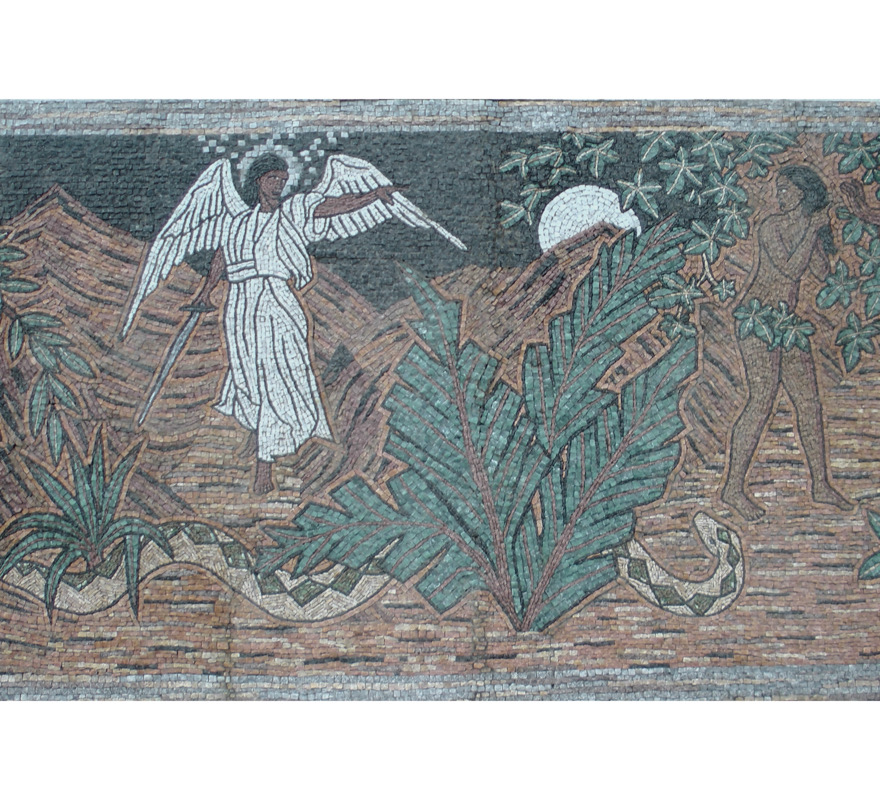
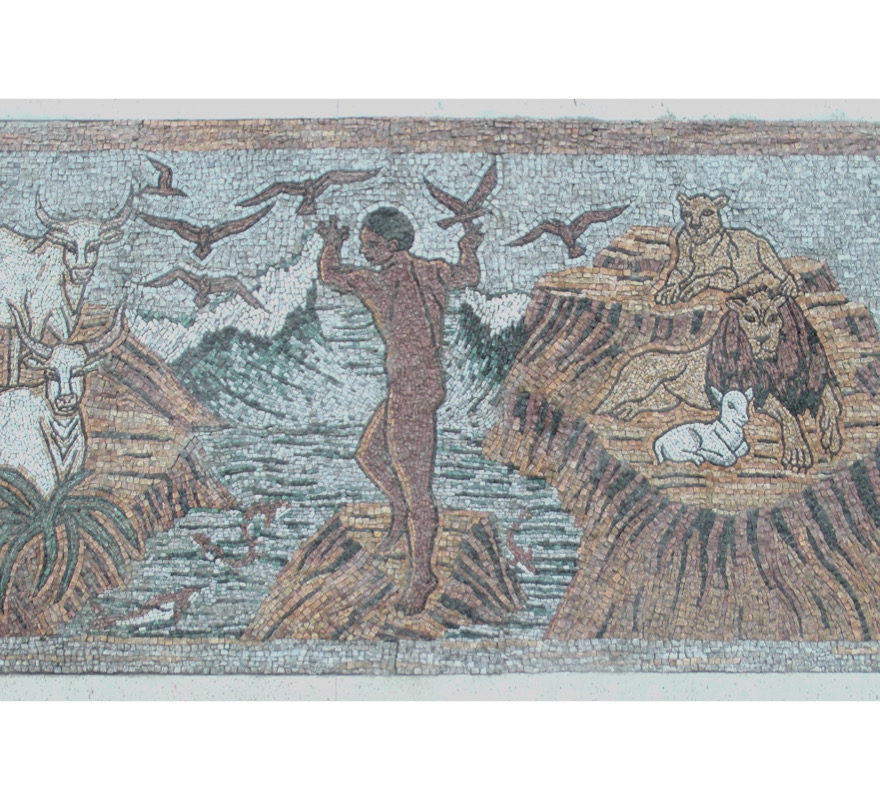
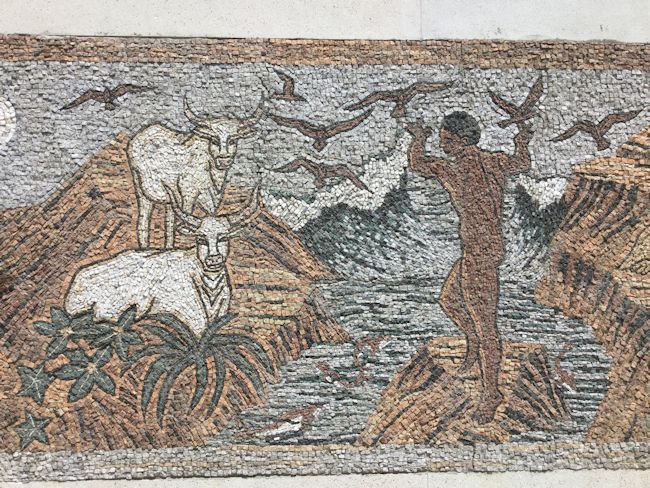
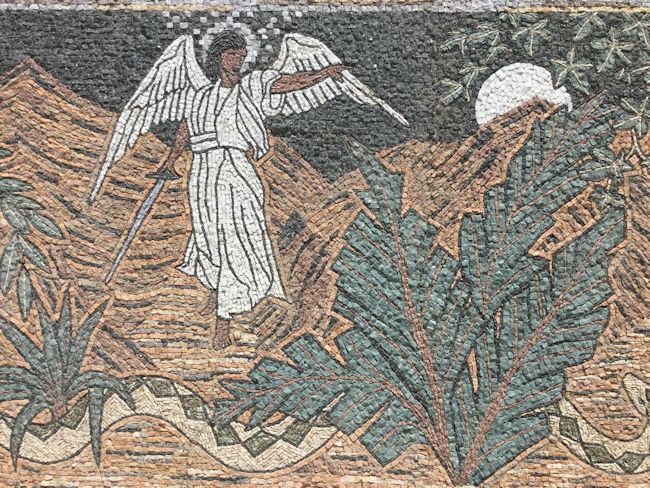
The Mosaic Wall
The Mosaic
Having people in the video gives a sense of the scale. The mosaic is 20m x 2m — it is what you see as you exit the cathedral through the main doors.
It was wonderful meeting with Githaka and the team he had gathered. I was there in Maragua many times with them. They were very receptive to this very complicated project, open to being mentored and guided. I loved working with them and was delighted by what we achieved.
How the Mosaic Was Installed
Installation of the Mosaic
The Main Windows
The Light Band
The Holy Spirit Window and the Window of the Enthroned Christ
There is a question every cathedral commission of this kind eventually has to answer, and at Kericho it was asked plainly, by the client: we have Christ, and we have the Spirit — but where is the Father? The answer arrived at does not attempt a figure at all. It uses light itself, and it uses the building.
Running the full length of the cathedral's roof is a sequence of skylights, each aligned with one of the building's structural concrete arches. This sequence, not any single window, is the Father: not depicted, but present at every arch the whole length of the building, never concentrated into a single figure until the rhythm finally arrives at its two ends.
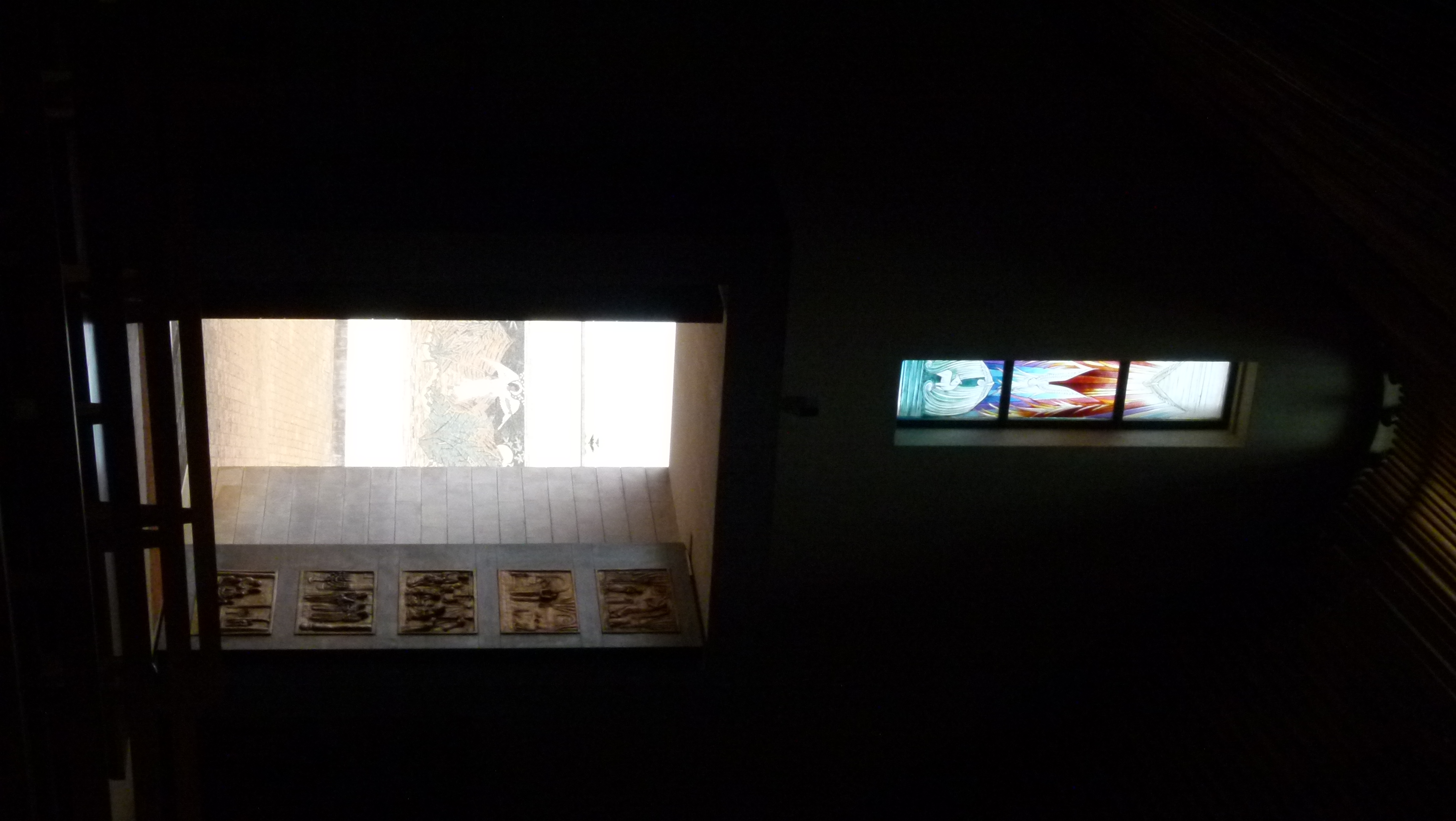
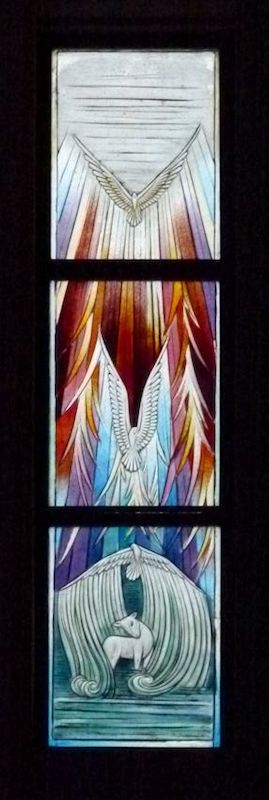
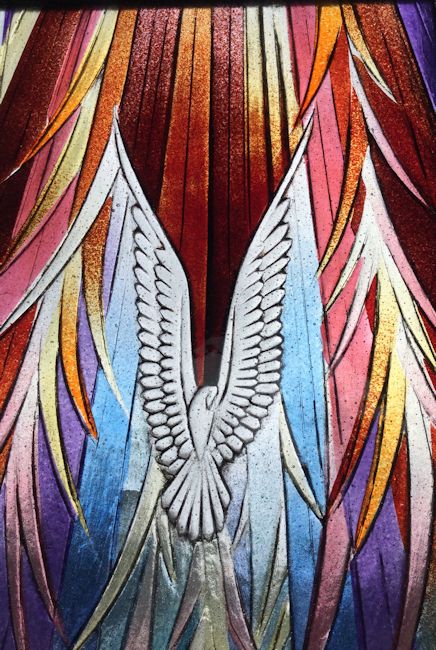
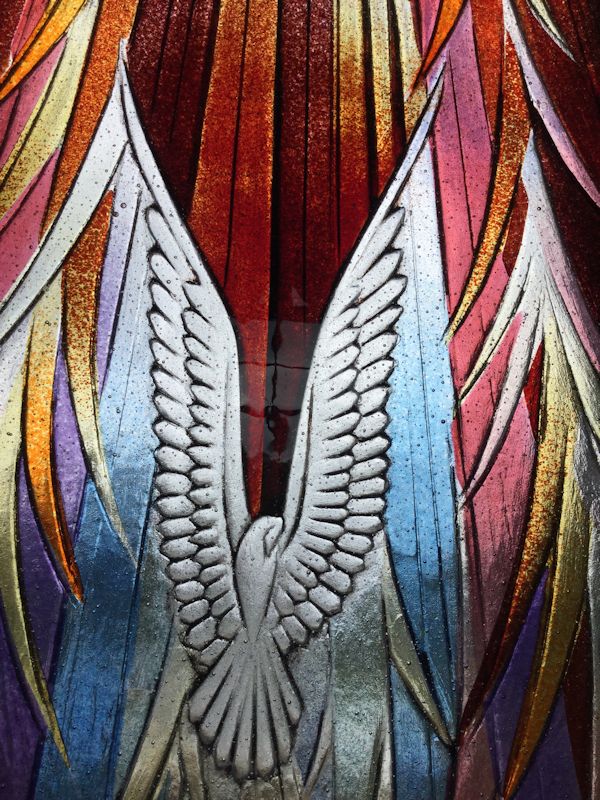
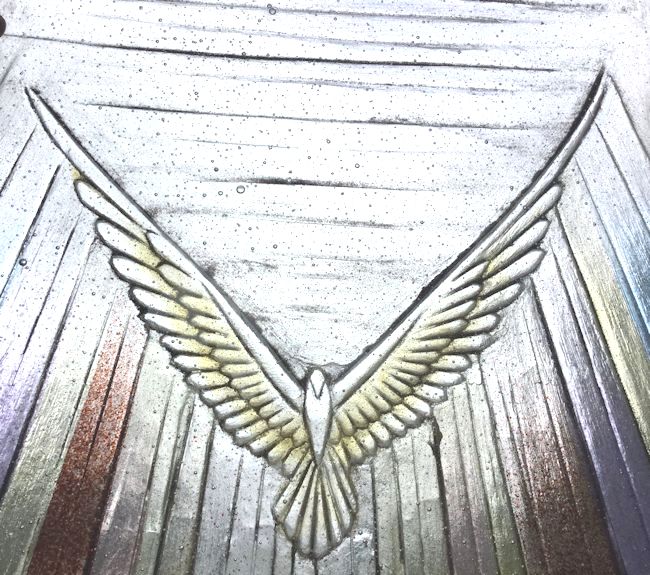
At the entrance, above the main doors, a tall narrow window receives the light band at the width the roof skylight delivers. From the white at its top, stylised wings open into the full body of a dove, diving through a fan of flame-coloured rays toward a small lamb standing in water below. This is the Baptism window — its subject is arrival, the Spirit's descent at the threshold a person crosses to enter the building.
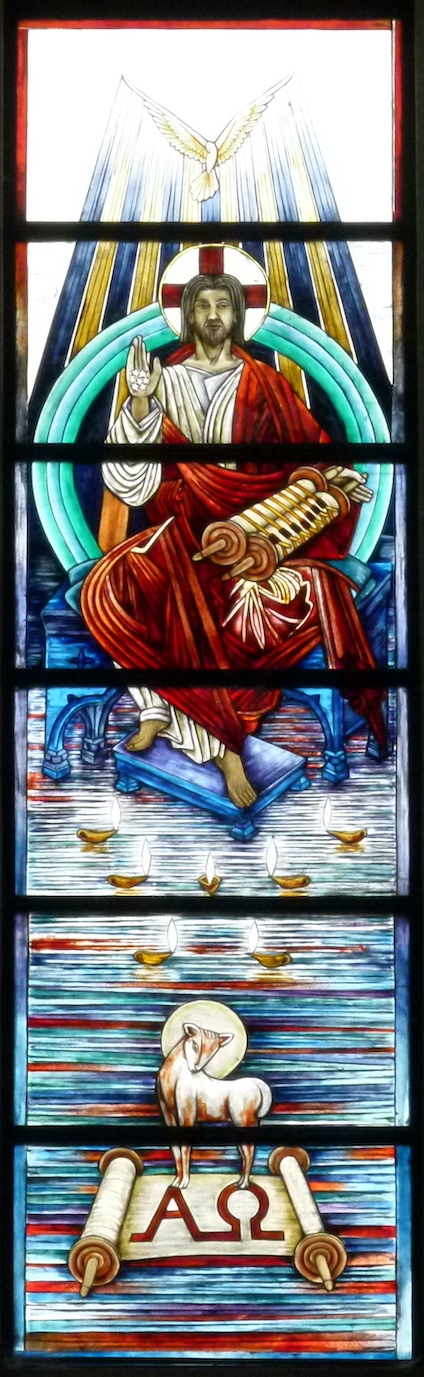
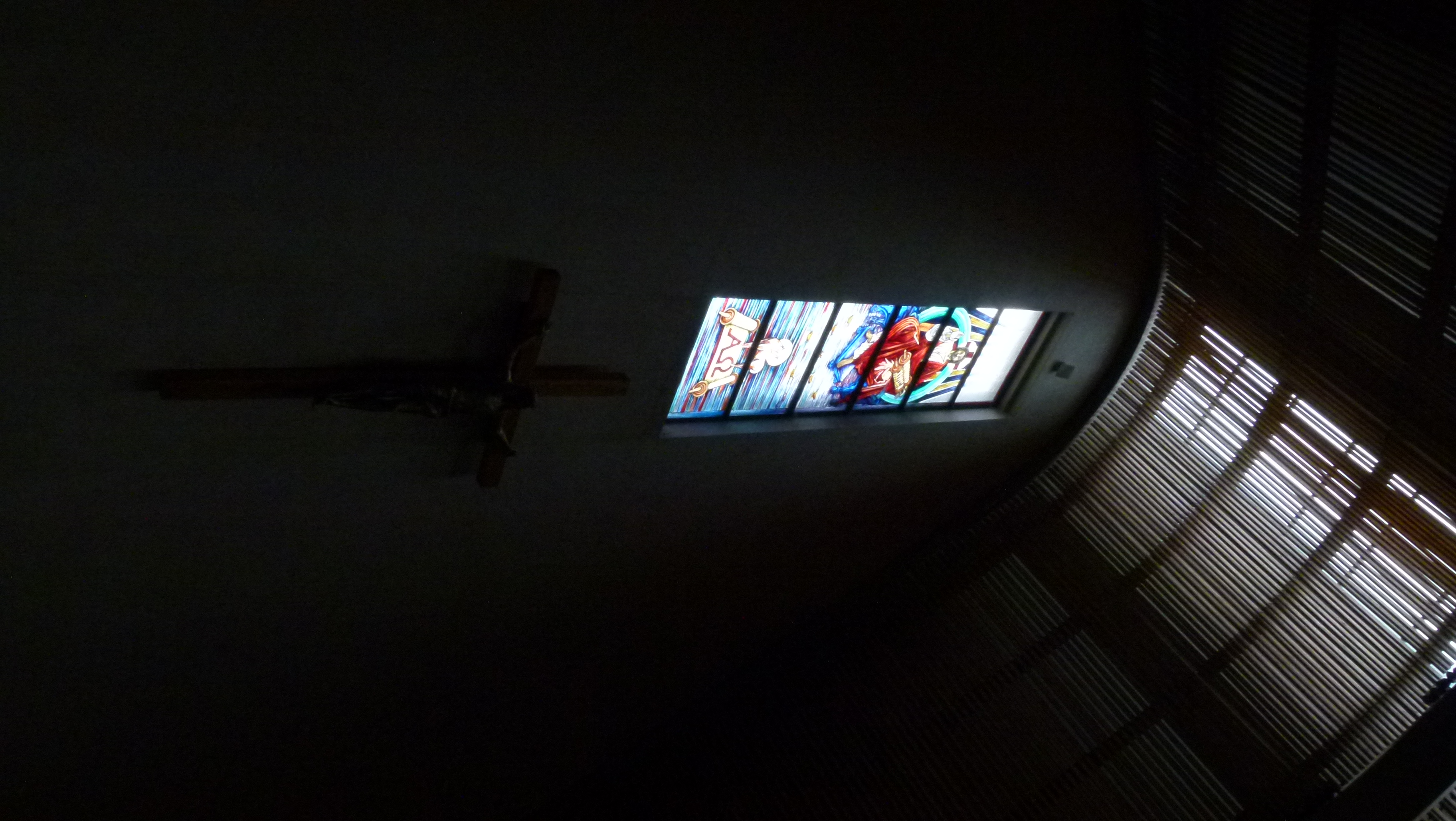
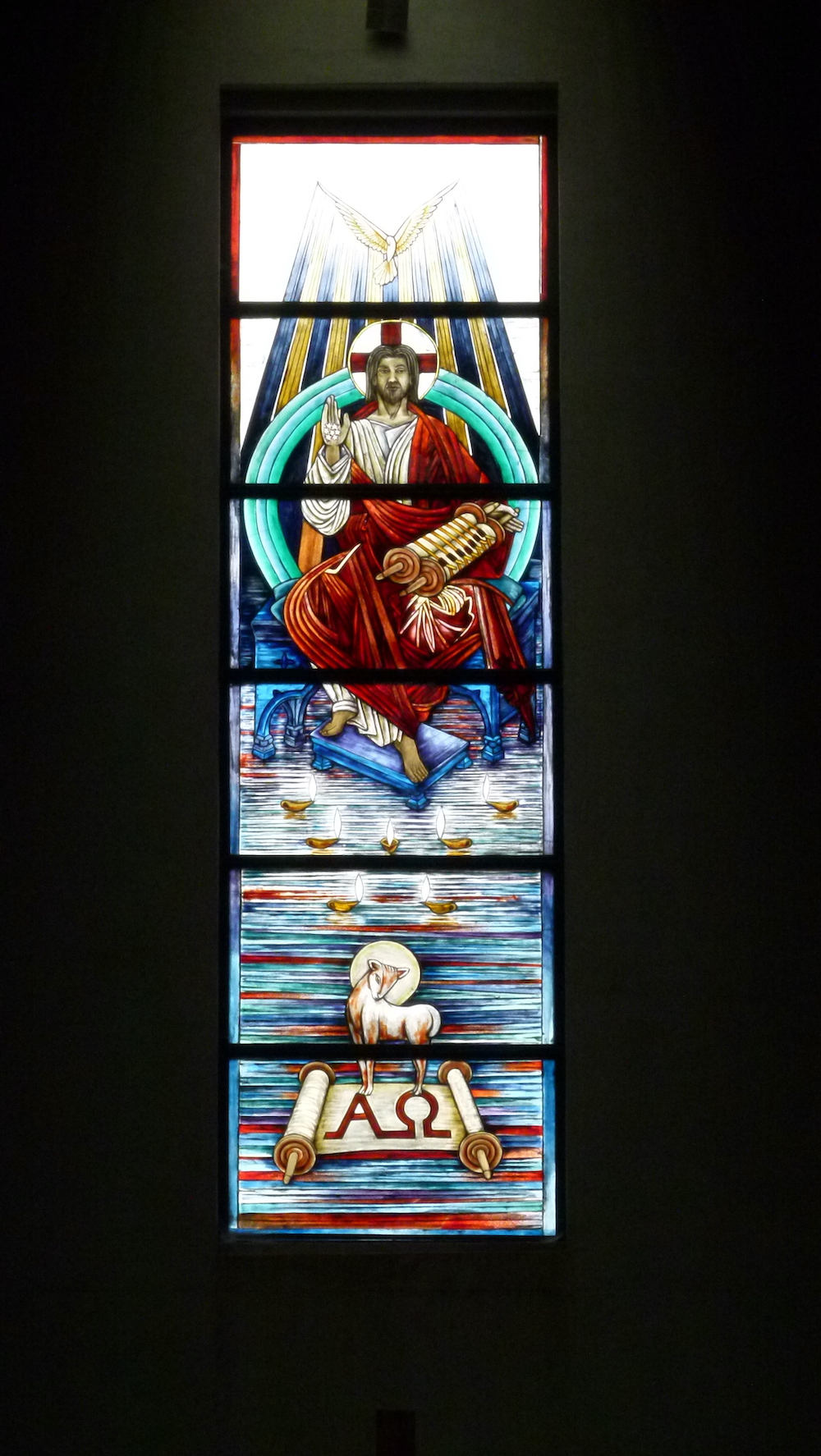
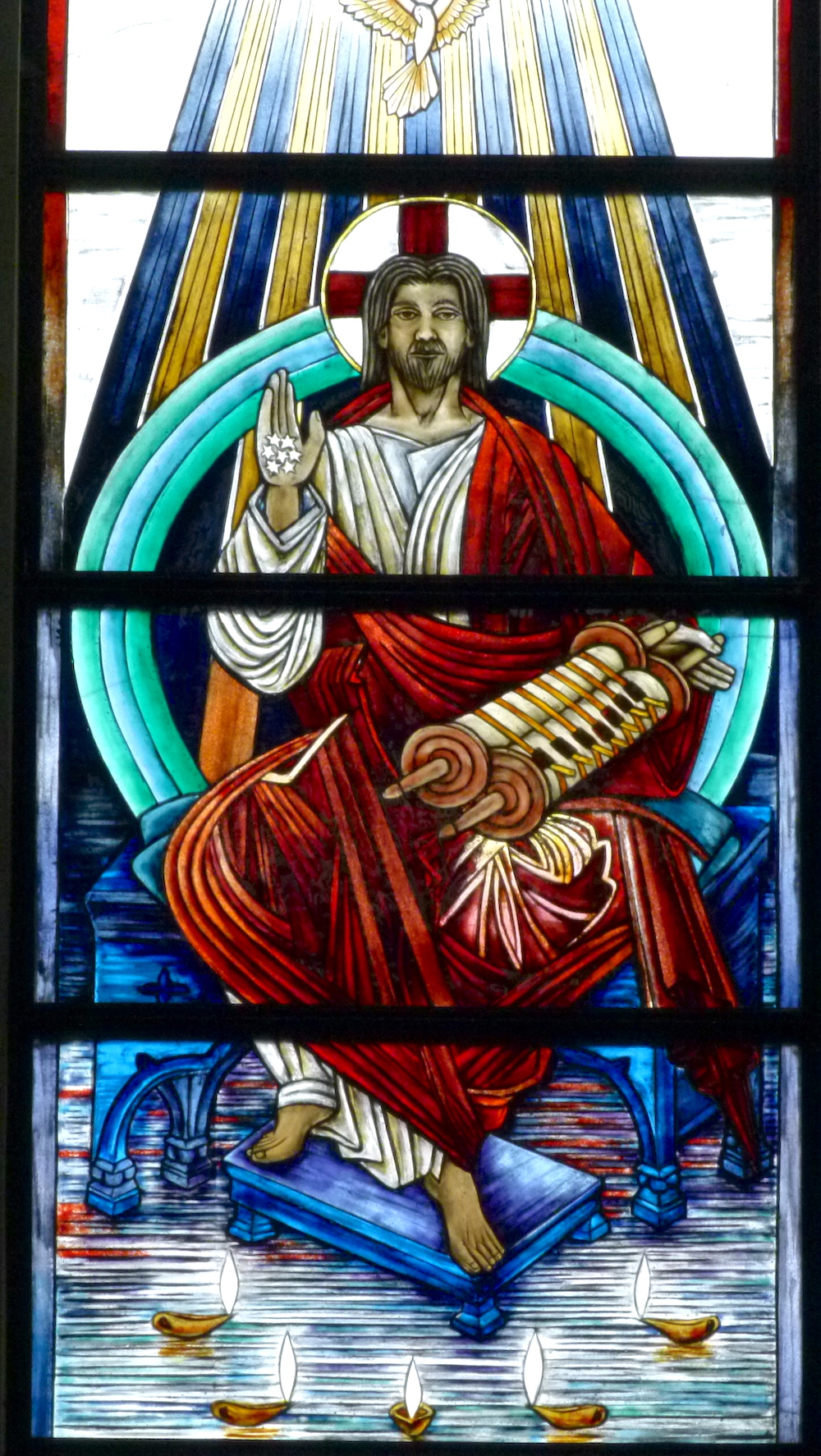
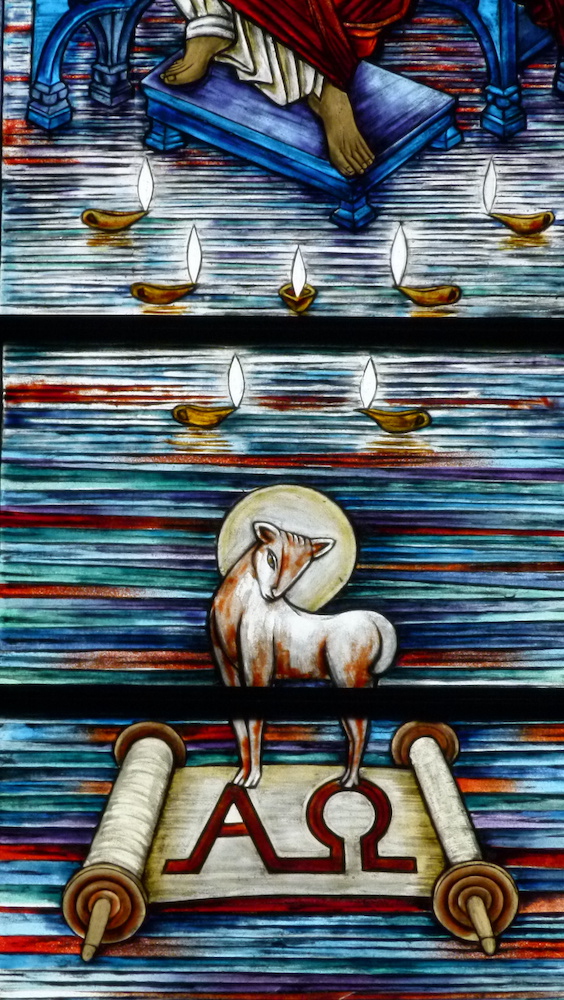
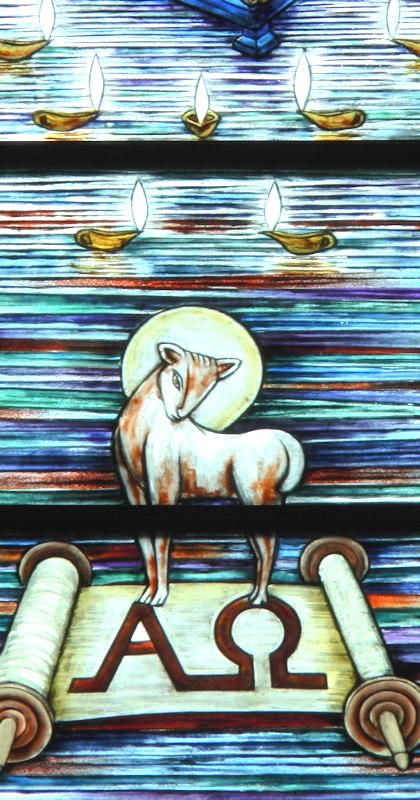
At the sanctuary end, six metres of glass receive the same light band. The dove reappears, descending into the seated figure below: Christ enthroned, robed in red and white, right hand raised with seven stars resting in it, encircled by a rainbow of emerald and turquoise — the sapphire throne and emerald rainbow of the fourth chapter of Revelation, rendered close to the text. Below, seven small flames float like lamps adrift, and a haloed lamb stands upon an unrolled scroll.
Both windows are fused, relief-sculpted glass, the same method used throughout the Stations of the Cross. At the sanctuary end, six metres up with open sky beyond, traditional glass paint was added over the fused relief to reinforce line and form where height alone would have flattened it.
Standing at the open main doors, the sanctuary window appears as a single brilliant point of colour at the building's far end — a beacon at the conclusion of a long, deliberately extended sightline, the light band overhead drawing the eye onward the entire way.
Read the full essay on the Light Band →
Holy Spirit Window (Baptism) — Sacred Heart Cathedral, Kericho
Material — Fused and relief-sculpted Bullseye Glass, etched detail
Technique — Fusing, glass relief sculpture, sandblasting/etching
Location — Entrance façade, above the main doors
Window of the Enthroned Christ (Revelation) — Sacred Heart Cathedral, Kericho
Material — Fused and relief-sculpted Bullseye Glass, traditional glass paint
Technique — Fusing, glass relief sculpture, painting and firing
Dimensions — 6 metres
Location — Sanctuary end, above the apse
Main Windows — Gallery
Questions and Answers about the Project
How did you become involved in the Kericho Cathedral project?
Following a lecture I gave at the RIAS in Dundee in 2009, architect George Paterson approached me and asked if I would help bring the artworks to life for a new cathedral he had been commissioned to build in Kenya.
What was your role in the project?
I was part of the original design team, appointed before the architects, with the role of lead artist and arts enabler. My task was to find and mentor Kenyan artists and craftspeople capable of creating the full artistic programme of the building, and to design and make several of the works myself.
When was the Cathedral dedicated, and when were the artworks completed?
The Sacred Heart Cathedral, Kericho was dedicated on Pentecost 2015. The artworks were finally completed in 2018, after nearly a decade of involvement with the project.
Where is Sacred Heart Cathedral?
Kericho, Kenya. This is a new Diocese quite close to Lake Victoria. It is about 5 hours drive from Nairobi and is in the middle of one of the major tea growing areas in Kenya
Was the project filmed?
Yes. As the clients were based outside Kenya and wanted regular updates between visits, I took on the role of videographer and filmmaker, documenting the construction of the building and the making of the artworks throughout the project. This gave another major focus for me each day I was there. I would have my rucksack filled with video equipment and I would discuss with my driver Patrick Kamau what our visiting plan would be. Nairobi was going through a major road building process at that time and I never had a clue where I was.
What is the theme of the roof, and why?
The roof pattern is based on wheat, symbolising the Eucharist. Wheat is the substance of the host, referred to as the body of Christ — but the congregation is also called the body of Christ. The pattern therefore covers the whole community gathered beneath it during Mass. On the smaller chapel roof, both Eucharistic symbols appear together — wheat and grapes — marking the daily Mass celebrated there.
What material was used for the roof tiles, and how long is the roof?
The tiles were made by Kenya Clay, in keeping with the project's commitment to local materials. The decorated roof extends almost sixty metres.
How was the roof pattern made?
Each tile received one of two oblique cuts, sloping left or right. From this simple system, a complex pattern was built across the full roof. Local tilers were mentored on site and trained to install the design from scale drawings.
Who were the artists and craftspeople involved in the project?
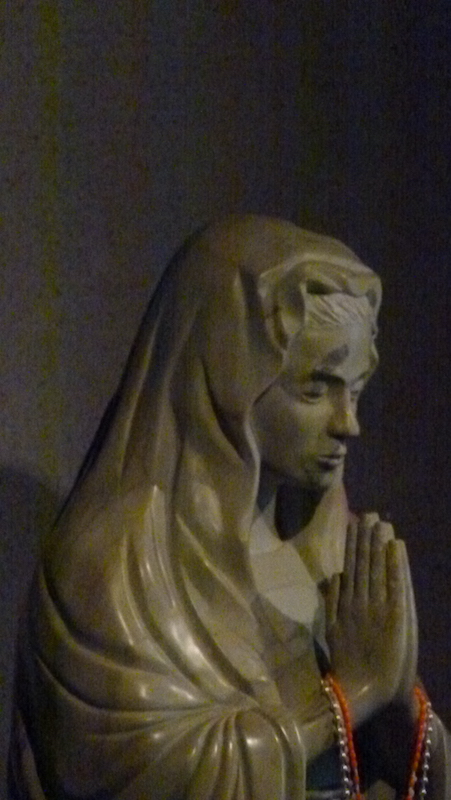
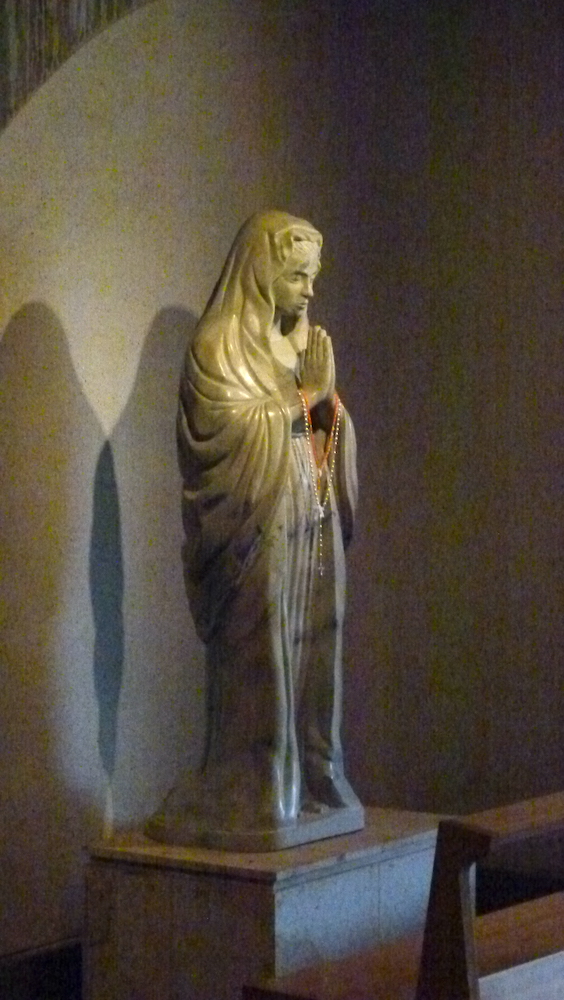
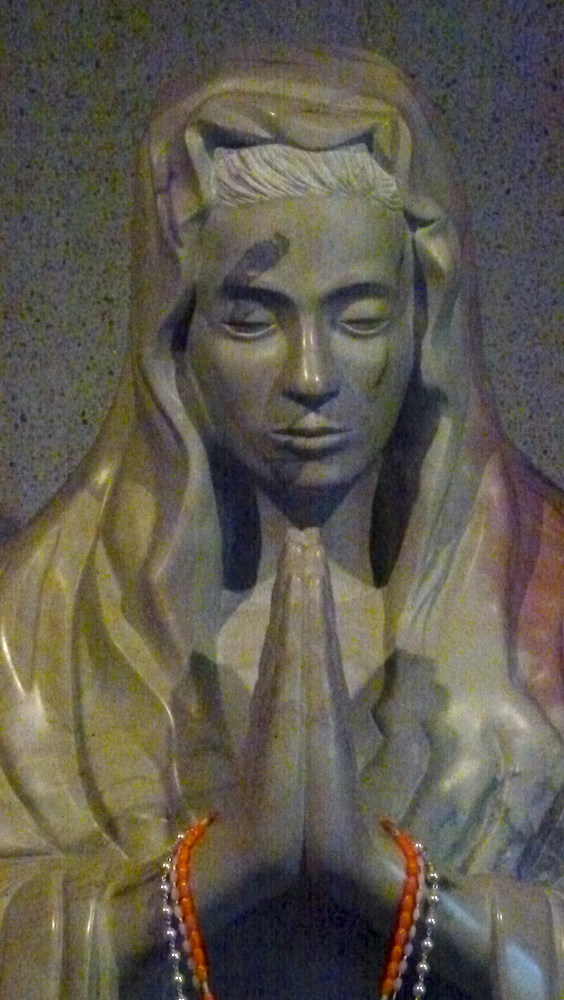
Florence Wangui designed the main cathedral doors and the Stations of the Cross. Toumer Yeshim created the figures for the crucifixes and the candlestick metalwork. Peter Kenyanya Oendo carved the three soapstone sculptures. Githaka Karuri created the Garden of Eden stone mosaic. Naeem and Beth Biviji of Studio Propolis designed and made the furniture, holy water fonts, the steel structure of the doors, and the candle holders, and installed the bronze panels. Rajinder Ahmed cast the bronze panels for the cathedral and chapel doors. I designed the roof, the chapel door panels, and the east and west windows.
What materials were prioritised across the project?
Wherever possible, Kenyan materials and Kenyan artists and artisans were used — locally made clay tiles for the roof, Kenyan-quarried stone for the mosaic, and a deliberate commitment to mentoring local talent rather than importing finished work.
Is there a lasting legacy from the project?
Yes. Nakshi Glass Studio was founded as a direct legacy of the Kericho project, maintaining the imported glass-fusing equipment and continuing to offer Kenyan artists opportunities to develop these skills.
Can I find out more about a specific artwork or commission a similar project?
Yes — for further information about any aspect of the Kericho Cathedral artworks, or to discuss a new commission, please get in touch directly.