Queens Park Synagogue
Glasgow, Scotland — 1990 to 1992
Twenty-two windows and a half dome — a complete iconographic programme of the Jewish festivals, the Sabbath, and the cycle of the Jewish year. This was the commission that defined what a career in architectural glass could be.
I started this project when I was about thirty. It is the kind of project you think you would make much later in life. It took me six months of research before I drew a single line. The result of that research astonished the people who asked me to do this work — and astonished me.

The Research
Six months of research before the first design was drawn
Knowledge Comes From Research
The most important thing this commission taught me is that knowledge comes from research — it is not inherently inside you. You have to find it, absorb it, live with it, before you can begin to design. I spent six months reading, studying, talking to people, before I picked up a pencil.
What that research revealed changed the whole direction of the programme. The most important conclusion I came to was that the Sabbath is the most important festival in the Jewish calendar — and it is generally overlooked. Most people, including most of the congregation, would not have named it as such. But the research was unambiguous. The Sabbath had to be at the heart of the iconographic programme.
The result of this research astonished the people who asked me to do this work. That is what six months of serious engagement with a tradition produces — not decoration, but understanding translated into light.
Queens Park Synagogue — Glasgow, Scotland
22 windows plus half dome — 20 sq/m total
Technique — Stained glass, acid etching, silver staining, glass painting
First windows — John Kenneth Clark's Glasgow studio
Remaining windows — Derix Glasstudios, Taunusstein, Germany
Completed — 1990–1992
The Sabbath — Shabbat
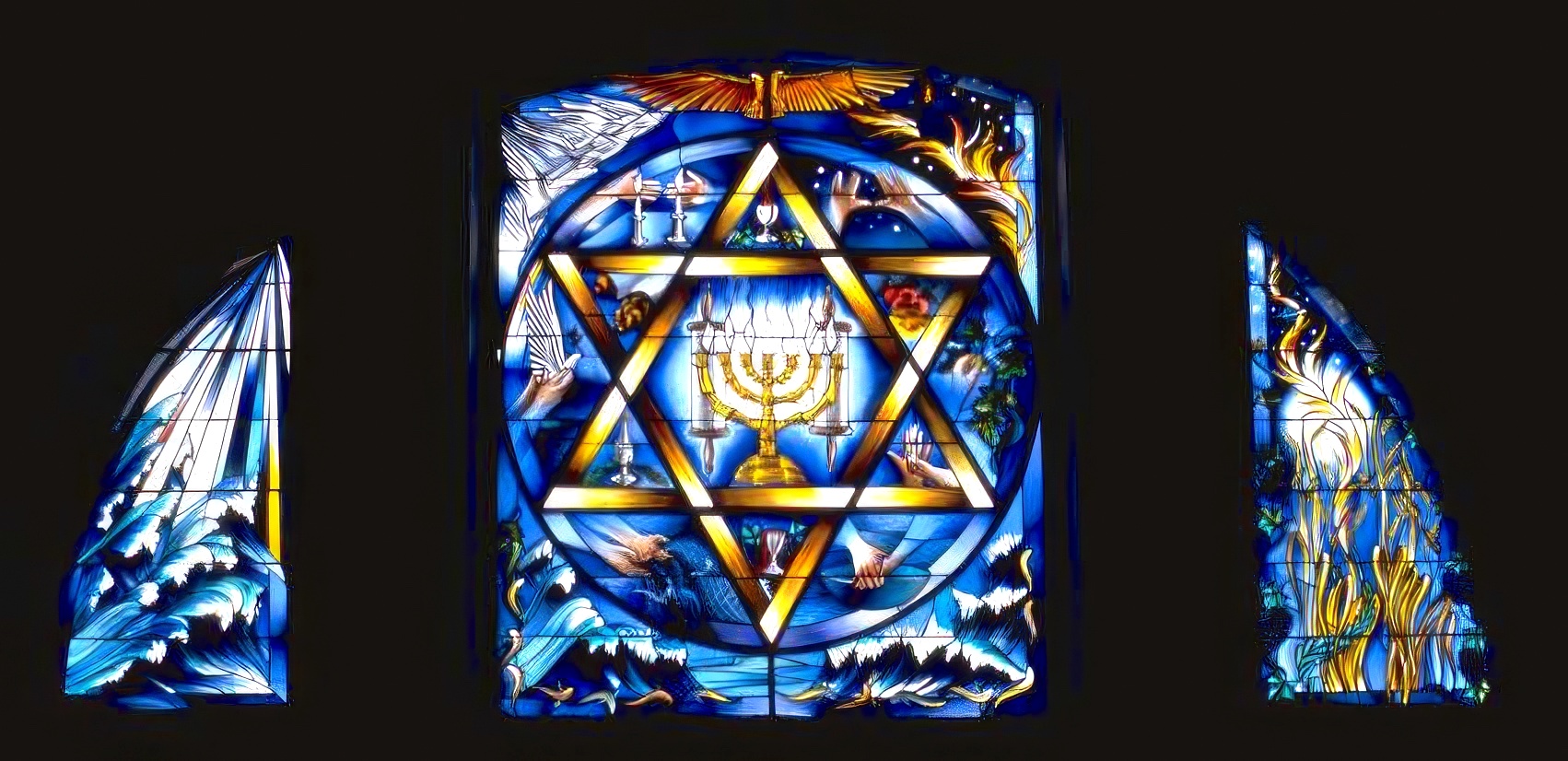
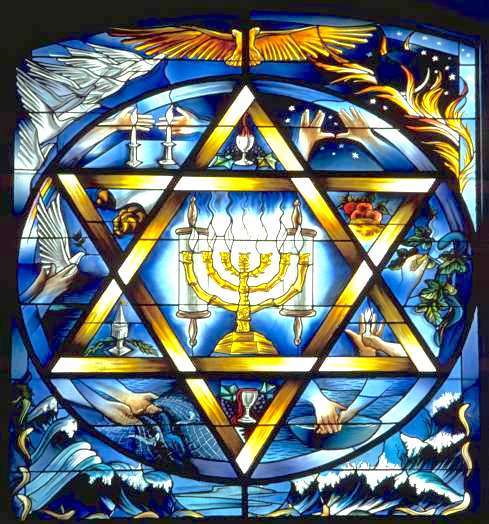
A Memorial of the Creation
This was the first window I designed, and every window that followed — with the sole exception of the dome — grew out of it. I was given the Sabbath as my theme. What I found, once the research was done, was Creation itself. The Kiddush for Sabbath calls it a "memorial of the Creation," and the Friday evening service gathers six psalms of nature around the six days of the world's making, before the Sabbath's own psalm completes it.
The triptych follows that structure. The left panel carries the first day, light, and the second, the separation of the waters. The right panel carries the third day, the greening of the earth, and the fourth — sun, moon and stars, the moon shown new, in memory of the ancient link between the New Moon and the Sabbath. The centre panel gathers the fifth and sixth days, birds and fish, animals and mankind, and at its heart, inside the six-pointed star, the Torah, the Menorah, and the Star of David itself — the three symbols by which Judaism knows itself.
Around the points of the star are the small ceremonies of the Sabbath as it is actually lived — the double loaves and the dew-cloth, wine poured for the Kiddush, apples and honey for a sweet year, and at Havdalah the braided candle, the cup, and the spice box that mark the Sabbath's departure. The window closes on the words of Ezekiel: "I gave them My Sabbath, to be a sign between me and them, that they might know that I am the Lord that sanctify them."
It hangs opposite the dome. The dome holds the time before Creation — the letters through which the world was spoken into being. This window holds Creation completed, and the day set aside to remember it. Between them, the congregation sits inside the whole of the story.
Rosh Hashanah — The New Year
Rosh Hashanah — the Jewish New Year
The New Year
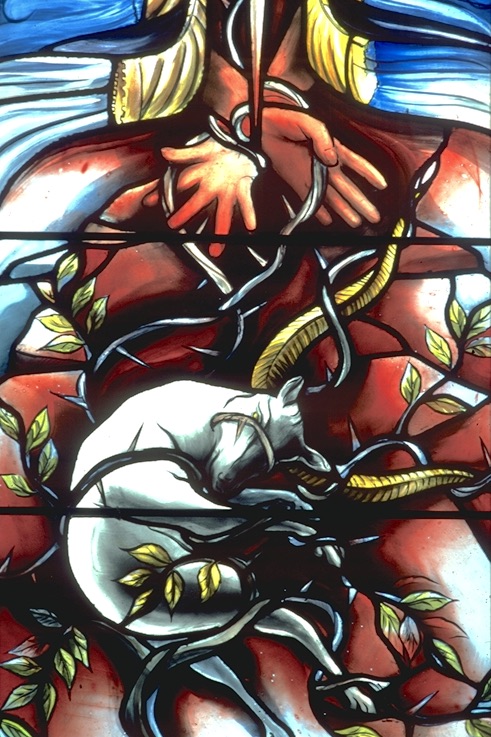
Rosh Hashanah and Yom Kippur stand ten days apart in the calendar and inseparable in meaning — the Days of Awe, the most solemn stretch of the Jewish year. I gave Rosh Hashanah three windows, one for each of its distinct identities in the liturgy, and Yom Kippur a fourth to answer them.
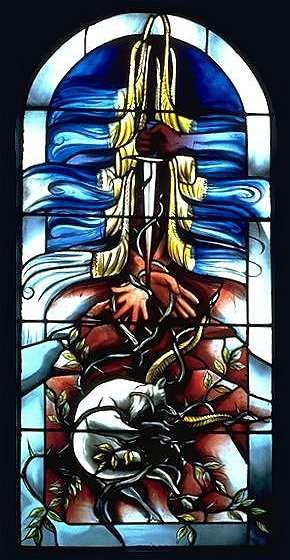
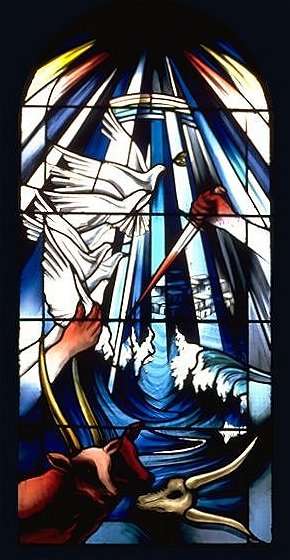
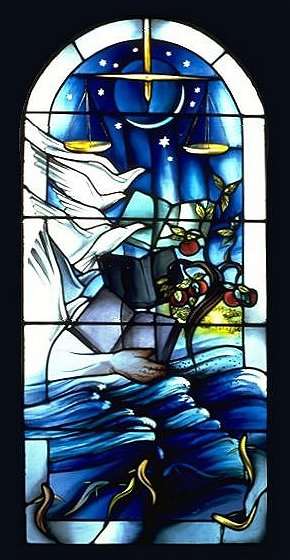
The first window carries the Akedah — the binding of Isaac, the ram in the thicket — with the shofar sounded above it, many voices at once. The second draws on the prayer of remembrance: a crown in darkness, the dove and the rainbow, the waters parting as they do in the Season of Freedom window. The third holds the Day of Judgement itself — the scales, and the three books opened in heaven, one for the righteous, one for the wicked, and one for the rest of us, left open until the year is sealed.
Yom Kippur closes the sequence in a different key entirely. Where Rosh Hashanah is dramatic — the knife, the many shofars, the hope for sweetness — Yom Kippur is still: white vestments, birds multiplying as prayers for forgiveness, and at the very end a single shofar blast where the first window sounded many. The Book of Life appears in both windows — opened on Rosh Hashanah, sealed on Yom Kippur, the ten days between them the space in which repentance still has room to work.
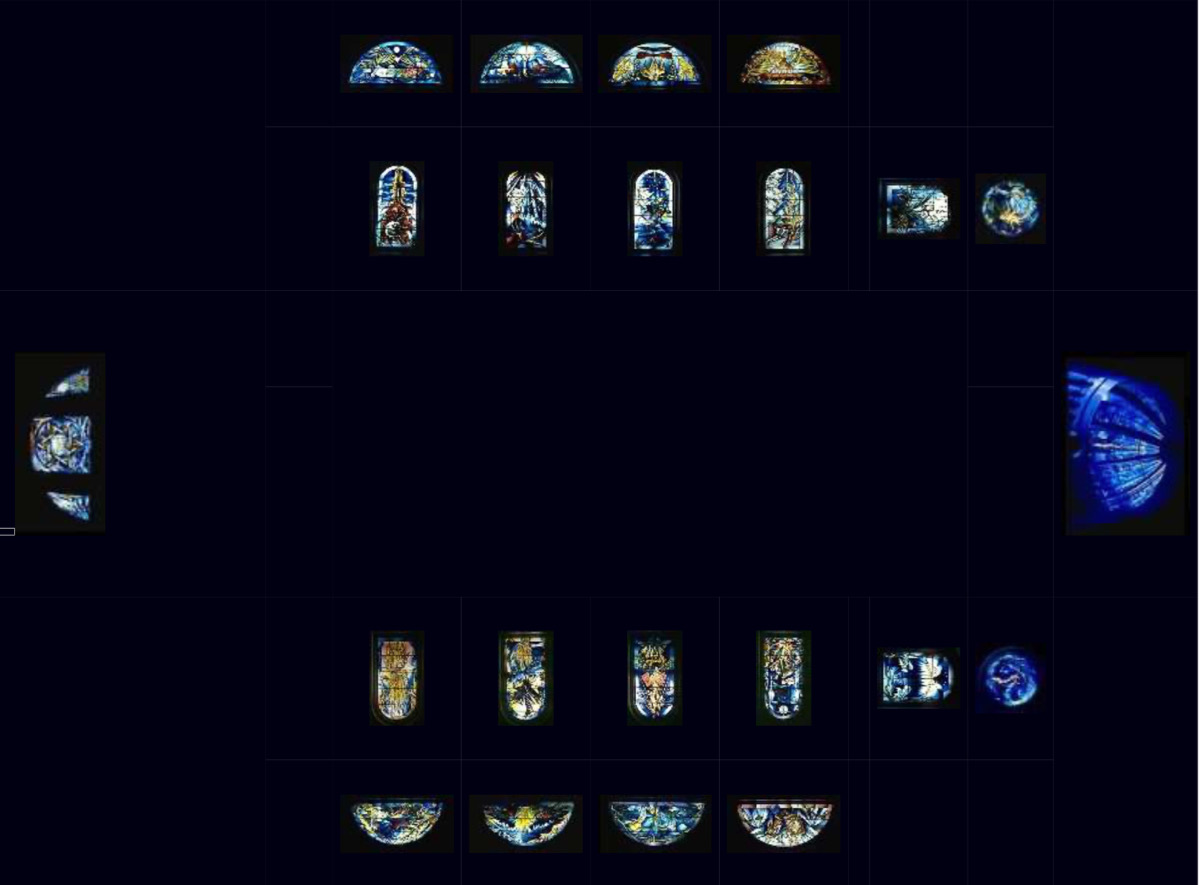
Layout of Windows
Placing
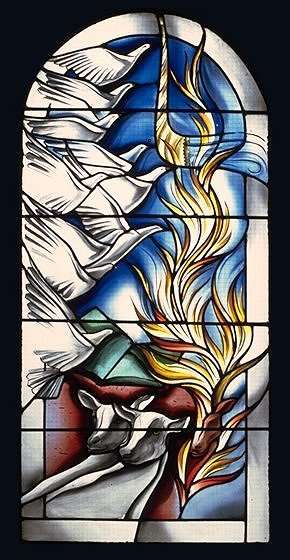
This layout montage demonstrates the conceived layout for the building. The designs were made to fit the available window openings at the time.
the synagogue had an upstairs and downstairs sections. The upper windows are the half-round shapes. The Dome was high on the East Wall above the Arc. The Sabbath triptych was high on the west wall.
As the festivals have several different aspects, the windows reflected that. There are three aspects of Pesach, therefore three Pesach windows, and so on.
When the synagogue was closed down, the windows were taken to the Giffnock synagogue. Wonderful that they have been saved and are protected, but they no longer have the same intensity that the tightly controlled light situation in Queens Park had, the windows were the only light source.
Passover — Pesach
Spring Season Detail
Pesach
Pesach is three things at once — the historical Exodus, the agricultural festival of the barley harvest, and the liturgical re-enactment of the Seder — and I gave each its own window rather than folding them into one.
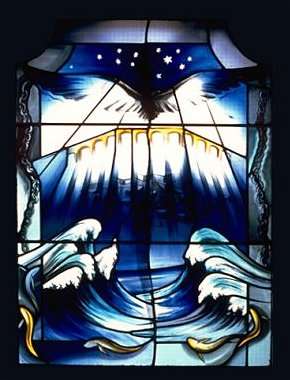
The Season of Freedom carries the flight from Egypt: the sea parting below, and above it an eagle that holds two meanings at once — God's wings bearing Israel to himself, and the Angel of Death passing over. The same wings, the same image, both readings true simultaneously, which is exactly the character of that night.
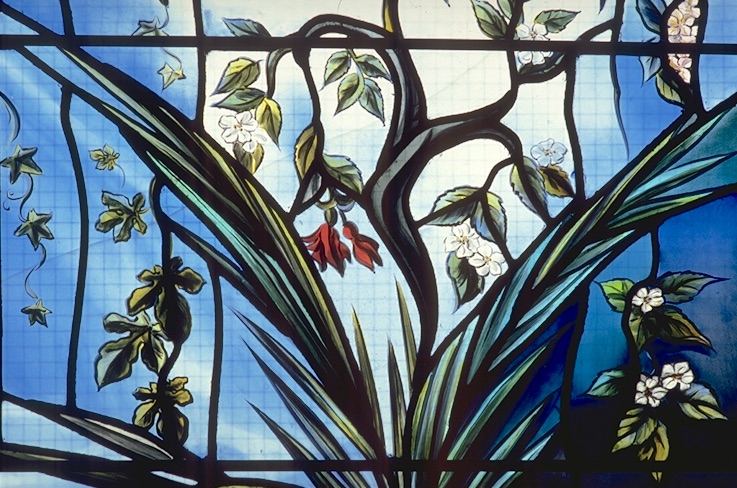
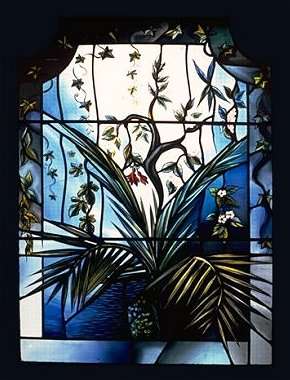
The Spring Season is the quietest window in the whole programme — no figure, no narrative, just a tree in blossom carrying five species at once, and a palm at its base. It says nothing and argues everything: the natural world keeping faith with its season the way God kept faith with a people in bondage.
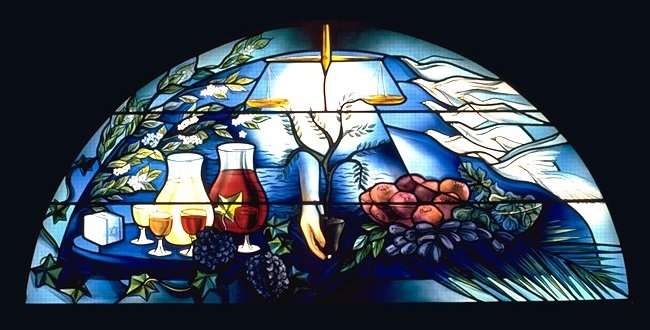
The Festival of Matzot holds the Seder itself — the plate, the four cups, the cup of Elijah kept for the prophet's return, the scales that mark this as the first of five judgements running through the year. It is the densest window in the series, because the night itself is dense — every object at the table carrying its own history.
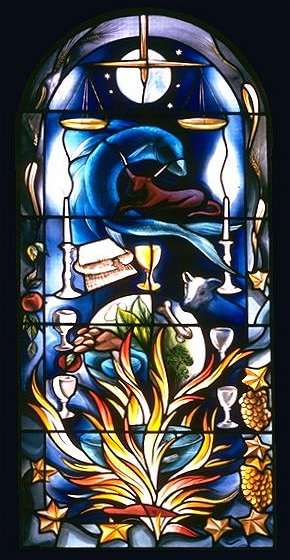
Shavuot — The Festival of Weeks
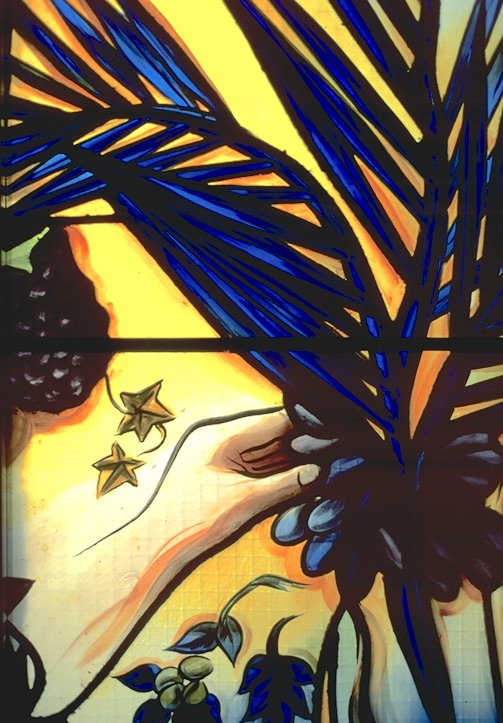
Shavuot — the Festival of Weeks
The Festival of Weeks
Shavuot is the Torah given, the Torah kept, and the Torah's ethics enacted — three windows, three dimensions of the same festival, fifty days after Pesach when the counting of the Omer completes.
The Giving of the Torah holds Sinai and its aftermath together in one image — the tablets and the lightning above, the burning bush at the base recalling where Moses' story began, and the golden calf already forming in the darkness. The covenant offered and broken in the same window, because that is the truth of what happened on that mountain.
First Fruits in Israel carries forward the tree that stood in blossom at Pesach — now bearing fruit, the promise kept, the harvest brought as thanksgiving. A sickle cuts wheat at its base, reaching toward the third window.
The Wheat Harvest completes the sequence with Ruth — gleaning not beside the harvesters but behind them, following the Torah's own commandment that part of every harvest be left for the stranger. The covenant given at Sinai becomes, here, a hand reaching for grain left deliberately in the field.
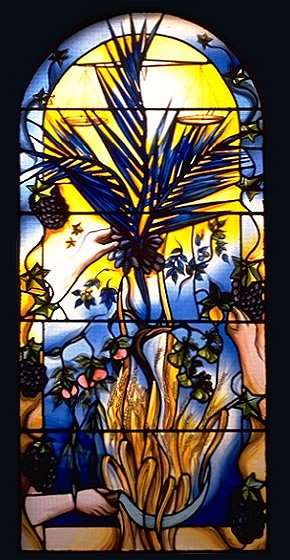
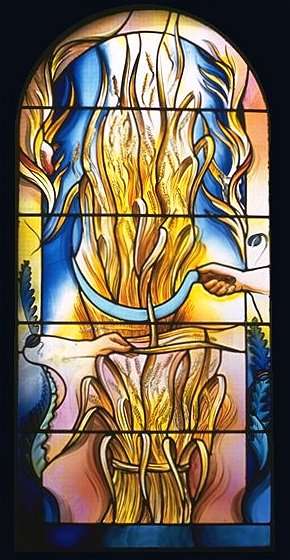
Sukkot — The Feast of Tabernacles
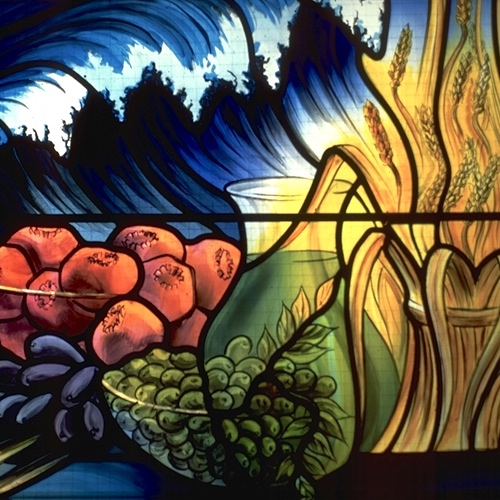
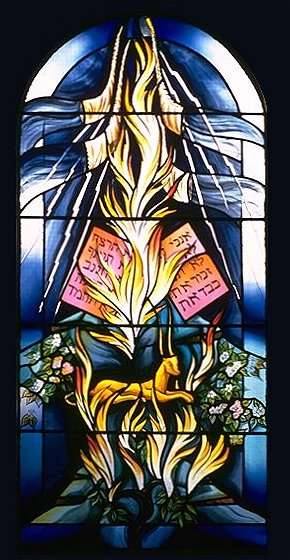
Sukkot — detail from Ingathering
The Feast of Tabernacles
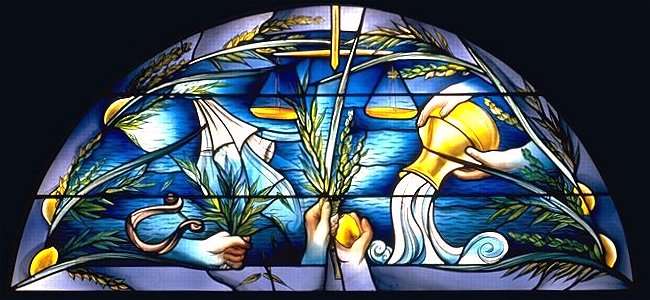
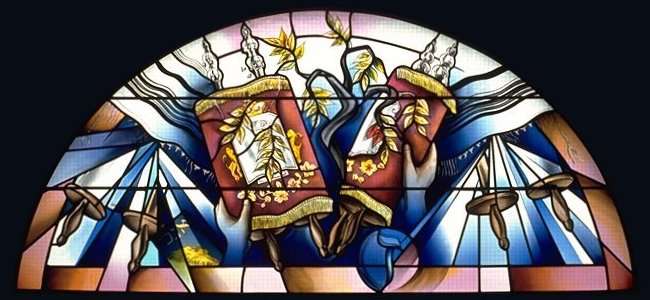
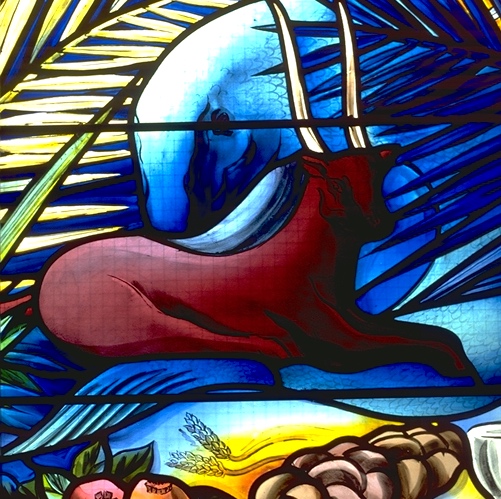
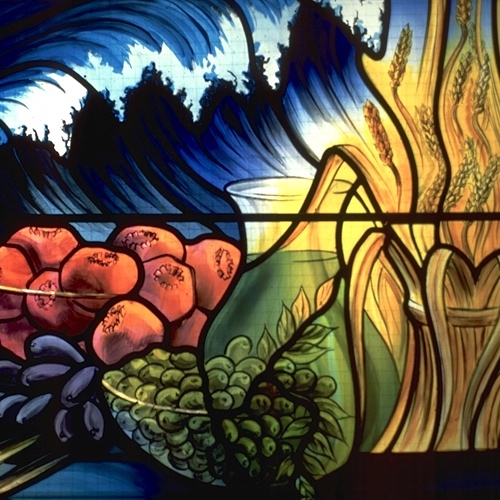
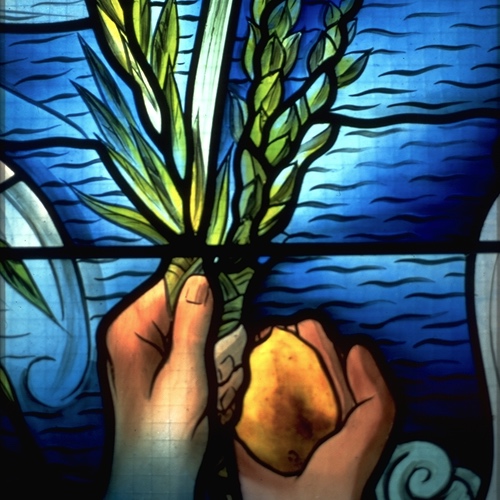
Sukkot is the fullest of the four multi-window sequences — four windows moving from the domestic booth in the garden to the cosmic structure of the dome above, closing the agricultural arc that began at Pesach.
Booths holds the sukkah itself — golden vine leaves at the border rising into stars, the remembered Temple becoming the sky seen through the roof, with the Leviathan and Behemoth waiting in the feast to come.
Ingathering of Crops carries a single sweeping wave that reads at once as the sea of the Exodus, the cloud that led Israel through the wilderness, and the sheer weight of the harvest itself — the seven species, blossomed at Pesach and fruited at Shavuot, now finally gathered in.
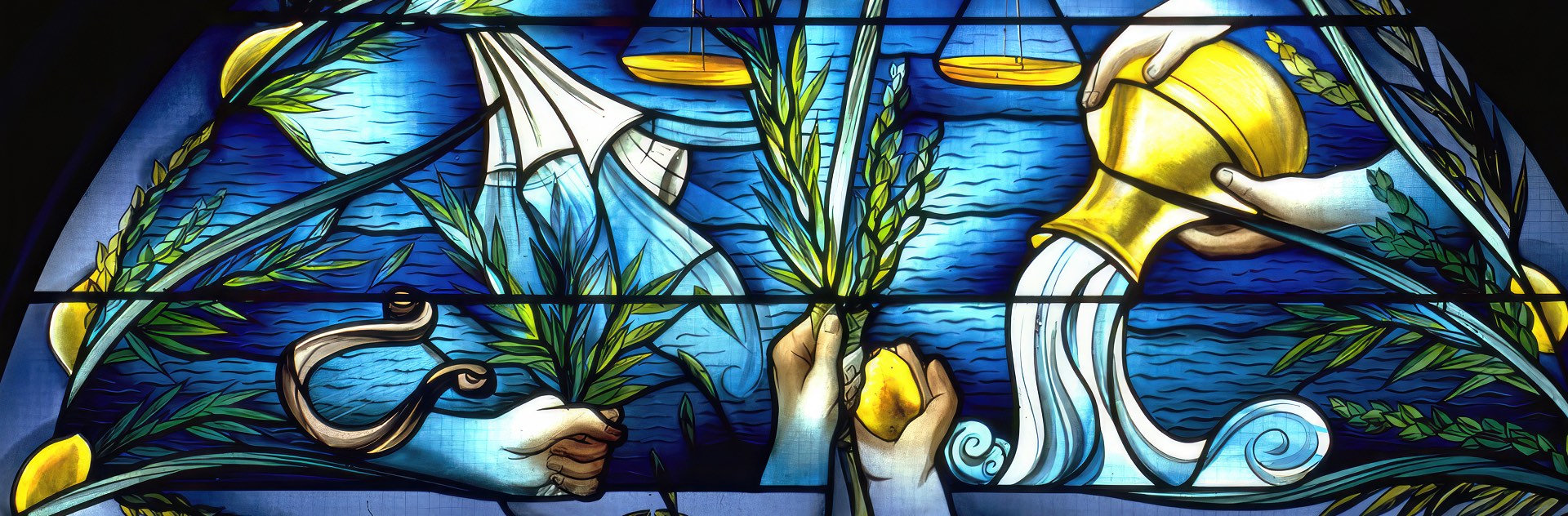
The Four Species and Hoshanah Raba turns to water — the scales here judging not grain or fruit but rain itself, the ancient libation ceremony drawn from a well outside Jerusalem, and willow branches beaten until every leaf falls, then carried home to sweep the house clean for the Pesach that will come again. The year closes the circle it opened.
Simchat Torah ends the sequence with the Tree of Knowledge — paired, deliberately, with the Tree of Life in the dome above. The Torah finishes at Deuteronomy and begins again at Genesis in the same breath. A child tastes a letter written in honey. The Law never really ends; it turns.
Minor Festivals
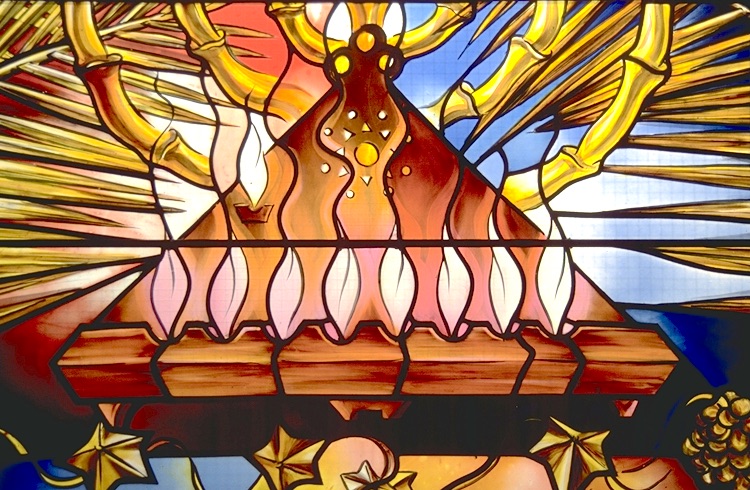
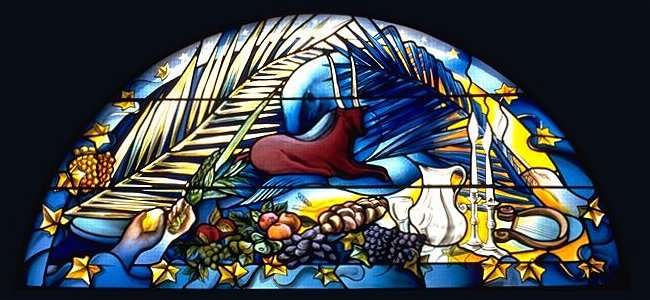
Detail from Chanukah Window
The Festival of Lights
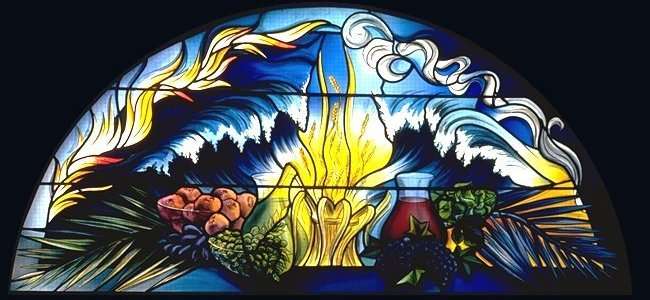
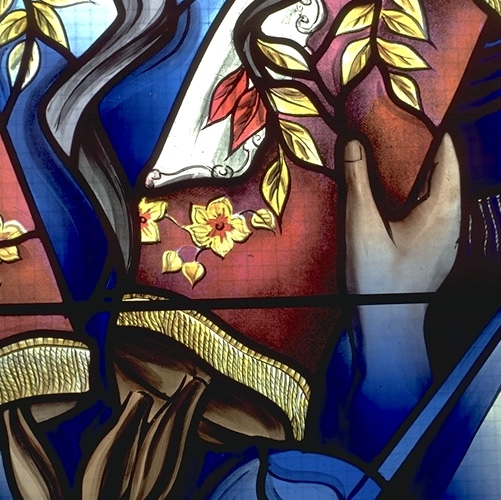
The minor festivals show a range the major windows alone can't — from the most solemn moment in the series to the most joyful, often within a single window.
Chanukah blazes: the Chanukiah set before the Menorah, eight lights building night by night, a laurel wreath fallen into darkness beneath them marking what was overcome.
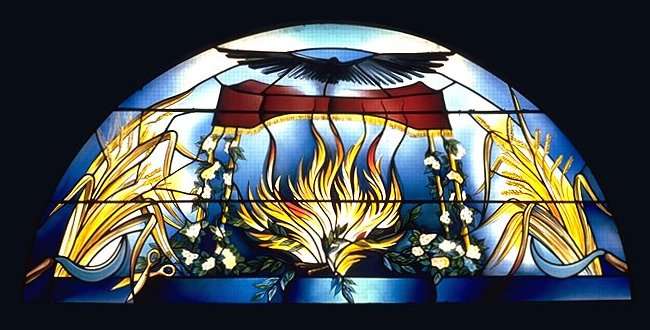
Lag B'Omer breaks the solemn counting of the Omer with a single day of bonfires and weddings — the Angel of Death appearing here for the second time in the series, now for the plague that struck Rabbi Akiva's students, framed between two sheaves of grain marking the fifty days between Pesach and Shavuot.
Tu B'Shevat closes something larger than its own small place in the calendar: the fifth and final appearance of the scales that have judged grain, fruit, water, and souls across the year now turns to the trees themselves. Four cups of wine move from white to red as winter yields to spring.
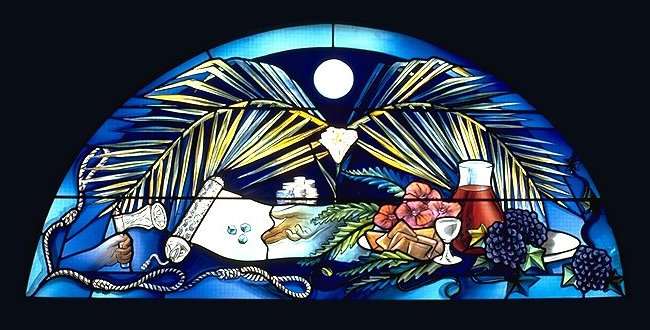
Purim closes the group with reversal itself as its subject — the full moon, the Scroll of Esther, a woman's hidden name spoken at the one moment it mattered, gallows built for one man become his own.
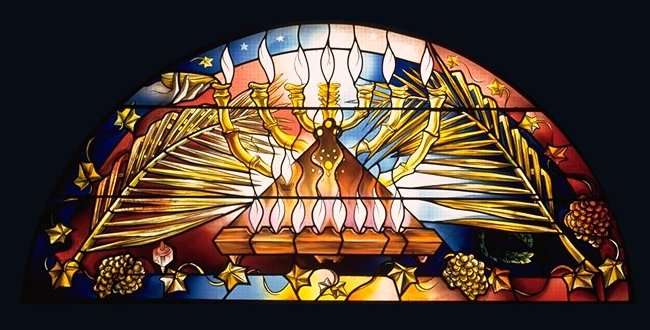
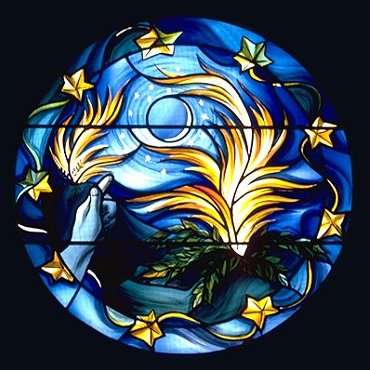
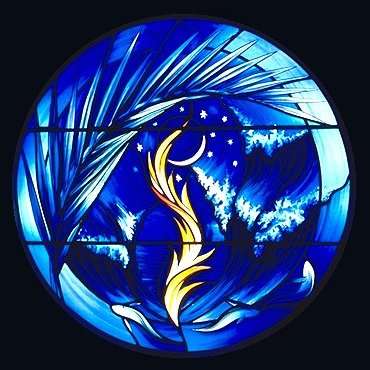
Rosh Chodesh — The New Moon
Rosh Chodesh — the Head of the Month and the Sanctification of the New Moon
Head of the Month
"Also in the day of your gladness and in your appointed seasons, and in your new Moons, ye shall blow with the trumpets over your burnt offerings…"
The Torah placed the celebration of the New Moon on a par with the observance of the festivals — it was often referred to together with the Sabbath, prompting the speculation that originally the Sabbath itself was the full moon. The Jewish calendar is a lunar calendar, and all the festivals, with the exception of the Sabbath, are linked to the moon. Rosh Chodesh is unique in being celebrated not once but twelve times a year.
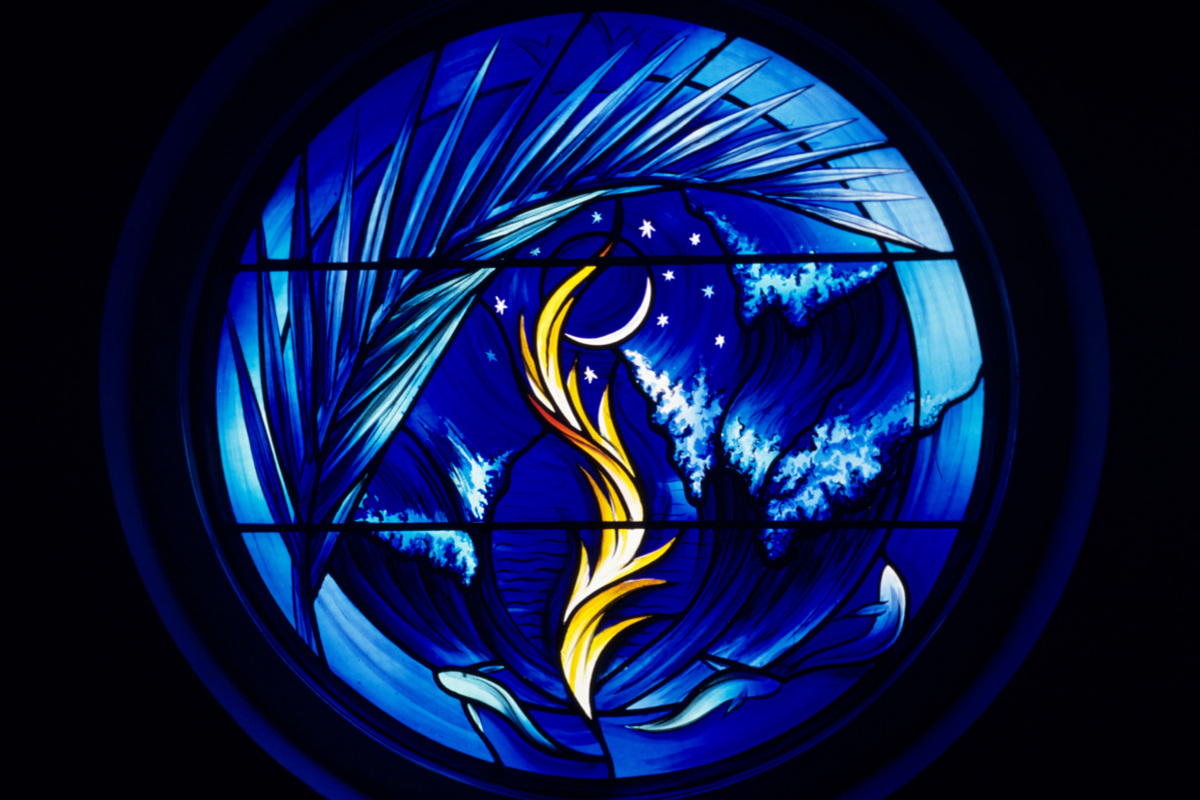
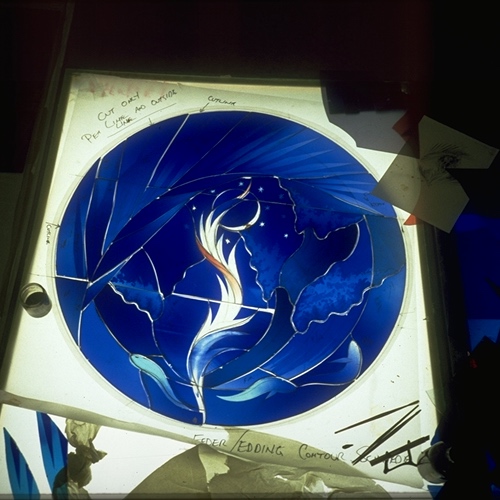
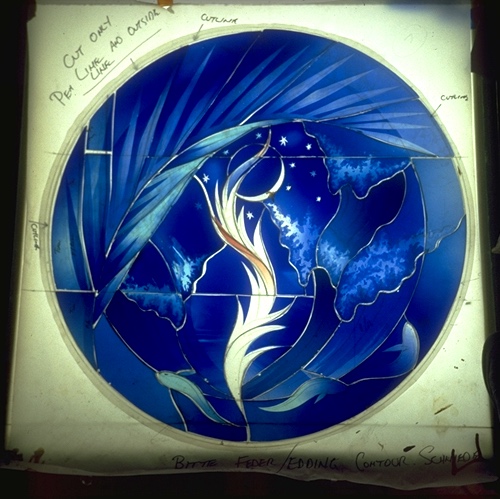
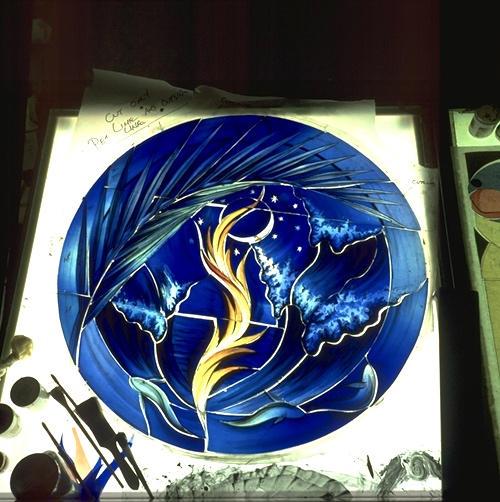
Window 15 emphasises that connection between the moon and the festivals, containing symbols for the main festivals within it: the crown at the top represents Rosh Hashanah; the parting of the sea, Pesach; the fire, Shavuot; and the palm, Sukkot. Although the day is no longer celebrated as it once was, a blessing is still made in the synagogue at the time of the New Moon.
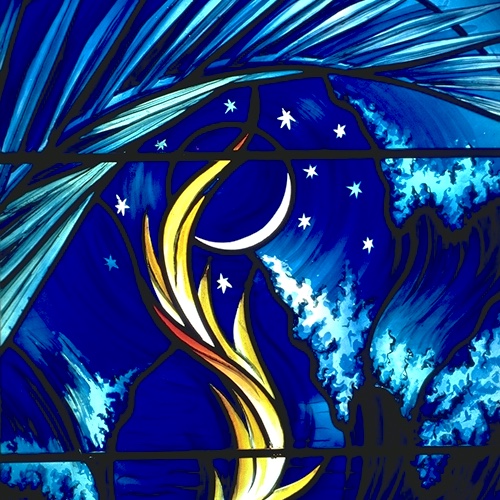
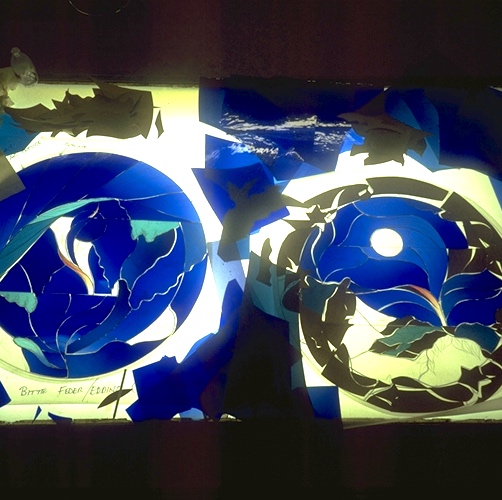
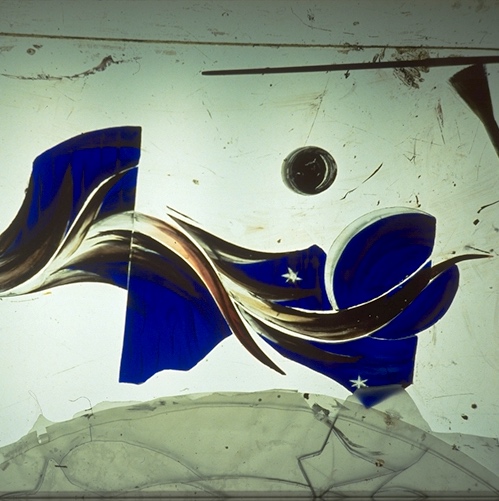
Window 16 depicts the Sanctification of the New Moon. In ancient times, on the 30th day of the month, the Sanhedrin would assemble to wait for two reliable witnesses to testify that they had seen the crescent moon in the sky. Once convinced, the Sanhedrin would solemnly sanctify that day as Rosh Chodesh — and the news was spread across the land by beacons, bonfires lit on hilltops beginning on the Mount of Olives and repeated on mountain-tops throughout the land. The moon is shown surrounded by stars. As throughout the whole window series, golden vine leaves are symbolic of the Temple.
This window draws on Psalm 104 — known by its opening words Bless the Lord, O my soul — regarded as one of the most beautiful examples of Hebrew poetry. Its central theme is the glorification of God as Creator of the universe, whose majesty and beauty testify to his wisdom. God is praised as the master of Heaven who renews the moon. Rosh Chodesh was a day of rest when no trade was done and festive meals were prepared — though unlike the Sabbath, work was not forbidden, making it a minor festival.
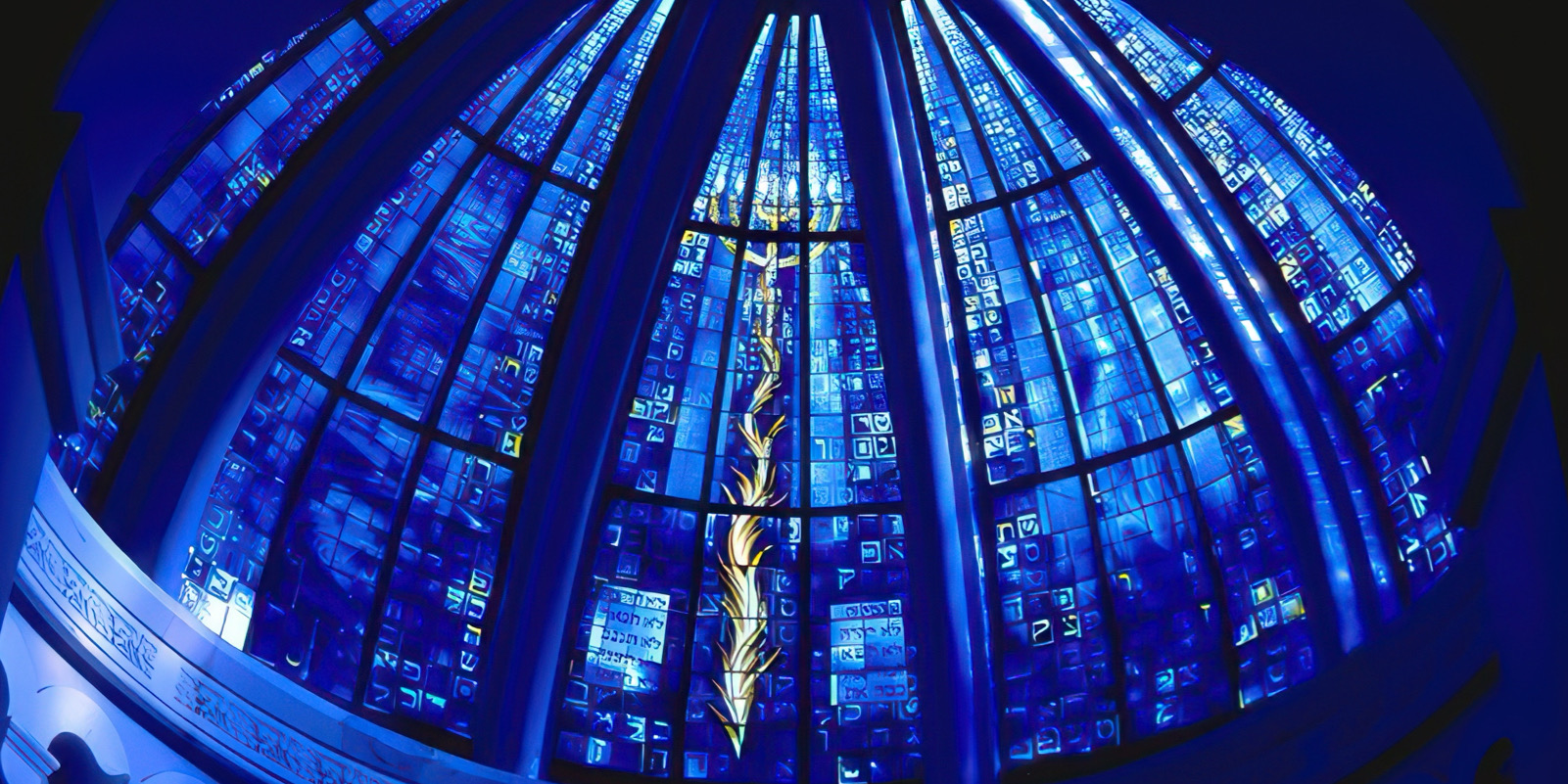
The Dome — Before Creation
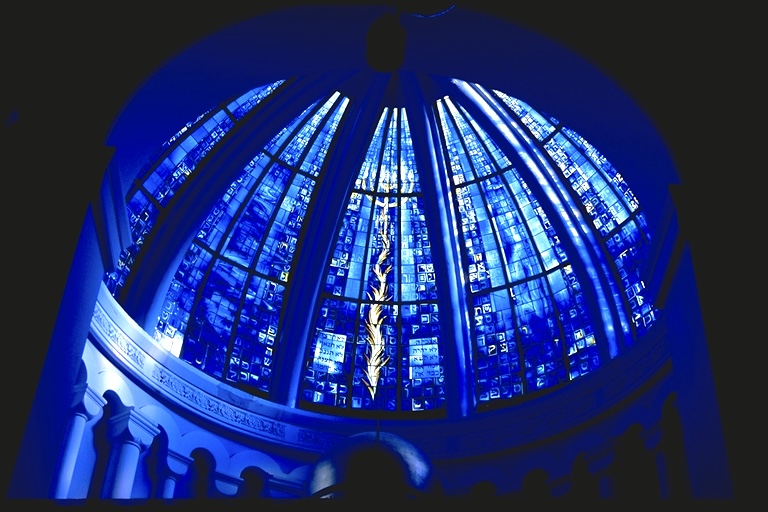
The position of the dome in the building
Not in the Brief
The dome was not part of my original brief. A donor was found for it midway through the commission, and I had no theme, no starting point, nothing from the festival windows to draw on — a dome is not a festival, it is a whole sky. I found what I needed in a bookshop: a single reference to the Sefer Yetzirah, the oldest speculative text in Hebrew, and I knew immediately that this was it, before I understood why.
The dome holds the time before Creation. Its deep cobalt is the sapphire of the divine throne; within it, filling every panel, run the Hebrew letters of the thirty-two paths through which — in Kabbalistic thought — God spoke the world into being. At the centre, in gold against the blue, the Tree of Life descends from the crown of pure divine being to the material world in which the congregation sits.
"John, I know what you are saying and you obviously know what you are talking about — but you and I are the only two here, including the Rabbi."
— Chief Rabbi Dr Jonathan Sacks, at the dedication
Sacks understood the festival windows without needing them explained. At the dome, he stopped mid-sentence. One thousand people stood in the room that day, and two of them could follow the thought all the way to its source.
The dome has not been permanently installed since the synagogue closed. It remains, for now, waiting for a space that can hold what it was made to do.
The Windows at Giffnock
The windows as they stand today at Giffnock Synagogue, filmed in their original Queens Park sequence
When Queens Park Synagogue closed, the festival windows were relocated to Giffnock Synagogue, where they remain — installed, cared for, and still doing the work they were made for. This film shows them in the order they were designed to be seen, the sequence they held at Queens Park, even though their physical position in the building has changed: windows that were upstairs are now downstairs, and downstairs windows are now up.
They look good in their new home. But no relocation can fully recreate what Queens Park itself gave them — a building where the windows were the only source of light, tightly controlled, so that the whole sequence read as one continuous argument in glass rather than as individual pieces competing with daylight from elsewhere. Some of that intensity is inevitably lost in translation to a different architecture.
This footage was filmed in 2017, and at the time the Sabbath window — the first window designed, the conceptual origin of the whole programme — was chronically under-lit. I hope that's since been addressed. And of course, there was nowhere in Giffnock to place the dome at all; it remains, as it has for years, in storage.
What Others Have Said
"This was the final work and based on the elements of air, fire and water, the Hebraic alphabet and the symbols of the Law - the nearest to complete abstraction. This window alone would seem to me to give cause to salute the coming to maturity of a Scottish artist of real stature."
— Cordelia Oliver, art critic
"Text of Neil Baxter's response to be inserted here."
— Neil Baxter, architectural historian
Questions and Answers
Why is the Sabbath the most important festival in the programme?
The Sabbath — Shabbat — is not a festival in the conventional sense but the recurring foundation of Jewish life, observed every single week. My research made clear that it is the most theologically significant element of the Jewish calendar, and that it is routinely underestimated even within the community. A programme of windows depicting the Jewish year that did not place the Sabbath at its centre would have misrepresented what that year actually means. The research dictated the design, not the other way round.
How did the committee react when you first presented your designs?
I was given a list of festivals and asked to design windows for them. The list didn't include the Sabbath. I disappeared for months of research before drawing a single line, and when I returned with my concept for the large triptych — the window that would become the centrepiece of the whole programme — it was the Sabbath, and the committee had not expected it. Their surprise told me I'd gone somewhere they hadn't anticipated, which is exactly where six months of primary-source research should take you.
How did the design for the dome come about?
The dome wasn't part of my original brief — it came later, once a donor had been found for it, and I had nothing from the festival windows to build on. I had no starting point and no one to ask. I went to a bookshop, found a book called Judaism by Isidore Epstein, and came across a reference to the Sefer Yetzirah, the oldest speculative text in Hebrew. I knew immediately that this was what the dome needed, before I understood why. Almost everything the dome is built from came from that single book.
What happened when Chief Rabbi Sacks saw the dome?
Chief Rabbi Dr Jonathan Sacks visited for the dedication, with around a thousand people present. He understood the festival windows without needing them explained to him. At the dome, I began to explain how I'd based the design on the Sefer Yetzirah — the thirty-two paths, the ten Sefirot, the Hebrew letters as the fabric of creation. He stopped me: "John, I know what you are saying and you obviously know what you are talking about — but you and I are the only two here, including the Rabbi." A thousand people in the room, and only the two of us could follow the thought to its source.
Were you given any special access to the synagogue after the windows were completed?
Yes — I was given the keys to the building and all the necessary passcodes. Given the long and difficult history between Christian artists and Jewish sacred spaces, that wasn't a small gesture. It was the community's way of recognising that I'd entered their tradition with real seriousness, and earned their trust through it.
Does the Wheat Harvest window's Ruth carry any personal meaning for you?
Ruth gleans not beside the harvesters but behind them, gathering grain deliberately left for the stranger under Torah law — not an act of charity, but of commandment. Looking back, I think there's a parallel with my own position in this commission: a non-Jewish Scottish artist, entering a tradition through months of solitary study, welcomed in the end by a community that gave me their trust. I found that story in the text before I fully understood it was also, in its way, my own.
What was the half dome and why was it not in the original brief?
A donor was found for it partway through the commission, and I was asked whether I could produce a design. I had no theme and nothing from the festival windows to draw on — a dome isn't a festival, it's a whole sky. What I arrived at, from the Sefer Yetzirah, was the time before Creation itself: the deep cobalt of the divine throne, the Hebrew letters of the thirty-two paths filling every panel, and the Tree of Life in gold at the centre. It became the theological foundation the rest of the programme rests on, even though it was never part of the original plan.
What techniques were used in making the windows?
The windows use the full range of traditional stained glass techniques — glass painting, acid etching, silver staining, and leading. The combination of these methods allows for the tonal range, the symbolic colour relationships, and the figurative and abstract elements that the iconographic programme required. The acid etching in particular was used extensively — this was a period when very few artists in the UK were using acid as a primary technique, and the Queens Park Synagogue windows are among the earliest major British commissions to deploy it at this scale.
Where is the synagogue and can it be visited?
Queens Park Synagogue was closed down and all the windows are now located in Giffnock Synagogue, apart from the Dome. Also the Sabbath Window is in a great position but sadly very under-lit and has lost a lot of it's potential impact because of that. Further visiting information to be added.